
Sinners (2025) Review
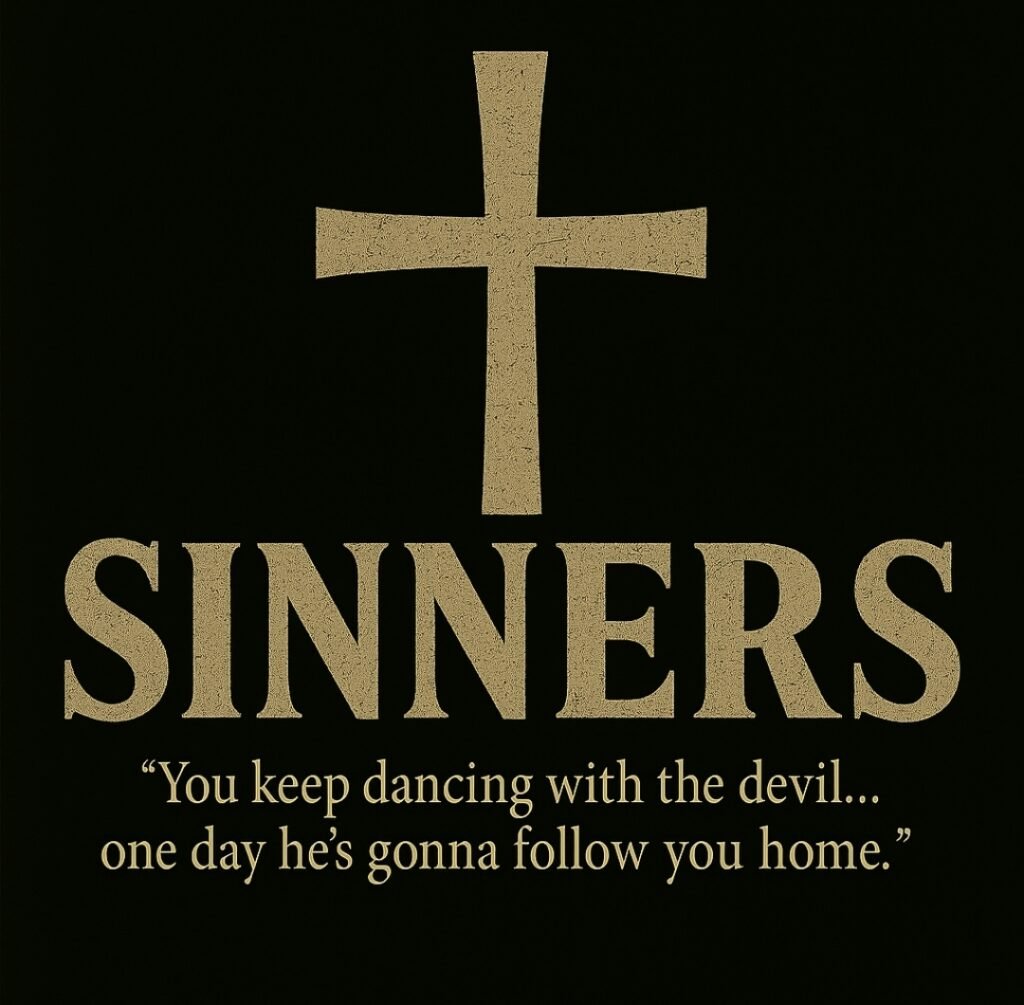
Introduction: Sinners. A Film That Lingers
Sinners is not a movie that simply ends when the credits roll. It’s the kind of film that sits with you afterward — the images, the music, the themes — all of it keeps echoing. Directed, written, and produced by Ryan Coogler. Sinners is a 2025 Southern Gothic horror film set in 1932 Mississippi. It blends historical drama, supernatural horror, and musical mythmaking into something deeply personal and often unsettling.
The story follows twin brothers Elijah “Smoke” Moore and Elias “Stack” Moore, both played by Michael B. Jordan, as they return to their hometown of Clarksdale after years working for the Chicago mob. Their dream is simple on the surface: buy a sawmill, open a juke joint, and carve out a space of joy and safety for their community. And what unfolds instead is a single, catastrophic night where old sins, racial violence, ancestral trauma, and a vampiric evil collide.
This is not an easy film, and it doesn’t always hold your hand. But in my opinion, that’s part of its power.
Story and Structure: A Slow Burn with a Violent Payoff
At its core, Sinners is a story about return — returning home, returning to history, returning to wounds that were never allowed to heal. Smoke and Stack come back to Clarksdale carrying money, confidence, and blood on their hands. The mob years have hardened them, but they’re also visibly exhausted by violence. Buying the sawmill and transforming it into a juke joint feels like an act of defiance. Reclaiming a place once associated with death and turning it into something alive.
The first half of the film takes its time. Yet from my experience watching it, this section plays more like a historical drama than a horror movie. Coogler carefully establishes the rhythms of life in the Jim Crow South. The tension of segregation, the coded language of survival, the church’s authority. And the fragile sanctuaries carved out through music and community.
The supernatural elements don’t rush in; rather, they seep through the cracks. Moreover, when Remmick (Jack O’Connell) arrives, he doesn’t announce himself as a monster. He’s charming, soft-spoken, almost comforting. That restraint made his presence far more unsettling to me than an immediate horror reveal.
Once night falls and the juke joint fills, the film pivots hard. What had been simmering suddenly erupts into violence — both human and supernatural. The final act becomes a siege. Trapping its characters in one location as they fight forces that represent both literal death and historical oppression.
Direction: Coogler at His Most Experimental
Sinners feels like Ryan Coogler at his most liberated as a filmmaker. He isn’t interested in staying inside one genre or tone. Instead, he lets the movie evolve — sometimes uncomfortably — as the night unfolds.
Visual Language and Format Shifts
One of the most striking aspects while watching Sinners is how the image itself changes. The film alternates between Ultra Panavision 70 (2.76:1) and IMAX 70mm (1.43:1), and these shifts are never arbitrary. Ultra Panavision is used to stretch the Mississippi landscape wide, emphasizing history, isolation, and myth. IMAX appears during moments of emotional intensity, music, and horror. The frame suddenly towering over you, making the characters feel trapped inside something larger than themselves.
Shot entirely on 65mm film, the image has texture — visible grain, deep shadows, and a warmth that digital rarely captures. To me, it gave the movie a physical presence, like the past was etched directly into the frame.
The visual power of Sinners owes an enormous amount to cinematographer Autumn Durald Arkapaw, whose large-format work gives the film a sweeping, almost mythic presence. Shooting on 65mm film with a combination of IMAX 15-perf and Ultra Panavision 70 cameras, Arkapaw crafts images that feel both intimate and monumental, shifting between expansive 2.76:1 compositions and towering 1.43:1 IMAX sequences to heighten emotional impact.
Her use of light and shadow is especially striking, blending earthy Southern textures with eerie, supernatural undertones that deepen the film’s atmosphere. The result is a visual language that doesn’t just support director Ryan Coogler’s storytelling—it elevates it, making Sinners as immersive as it is haunting.
A Genre-Fluid Approach
Rather than treating Sinners as “a horror movie,” Coogler builds it as a transformation. The first half is patient and grounded; the second half is chaotic, bloody, and frantic. I found the tonal shift jarring at first, but in retrospect, it mirrors the experience of the characters. As their safety collapses into terror with no warning.
Cultural Appropriation as Predation
In my reading of the film, the vampires are not just monsters — they are consumers. Remmick and his followers aren’t interested in domination through brute force alone. They want access. They want stories, music, ancestry, and belonging.
What disturbed me most is how polite and reasonable the vampires appear. They frame their desire as admiration. They want to share culture — but only by draining it of ownership and meaning. This felt like one of the film’s sharpest metaphors: appropriation presented as eternal life, at the cost of identity.
Assimilation and Erasure
Vampirism is offered as an escape from racism, from history, from suffering. But the price is sameness. In my opinion, Sinners makes a devastating point here: survival without identity is just another kind of death.
The vampires promise a world without color, without division. But the film makes it clear that this “post-racial” fantasy is simply erasure dressed as progress.
Music as Ancestral Power
Music isn’t background noise in Sinners. It’s ritual. Sammie’s (Miles Caton) guitar playing feels spiritual, almost dangerous. Watching those scenes, I got the sense that the music was opening doors — not just emotionally, but metaphysically.
The blues become a bridge between generations, between the living and the dead. But that same power attracts predators. For me, the film treats Black music as both a lifeline and a target — something sacred that has always been exploited.
Faith, Sin, and Survival
Sinners complicates religion. The church offers structure and safety, but also suppression. Hoodoo and ancestral practices act as fierce, protective shields. The narrative redefines sin by criminalizing creativity, pleasure, and the simple act of survival. While violence and oppression hide behind respectability.
Performances: Grounded, Human, and Unshowy
Michael B. Jordan as Smoke and Stack. This dual performance never felt like a gimmick to me. Smoke and Stack are distinct in posture, voice, and presence. Smoke carries himself like someone already haunted. Stack feels restless, charming, and dangerously optimistic.
What impressed me most was how natural their interactions felt. Even knowing the technical complexity behind it, I stopped thinking about “one actor playing two roles” and just accepted them as brothers with years of shared history.
Supporting Performances
Jack O’Connell
Jack O’Connell plays Remmick with unsettling restraint. His warmth is what makes him frightening. In Sinners, Jack O’Connell delivers a performance that is as volatile as it is vulnerable, grounding the film’s moral chaos in something painfully human. Best known for his raw intensity in Starred Up and his unflinching turn in Unbroken, O’Connell brings that same ferocity here, but tempers it with a quiet, almost fragile self-awareness that makes his character feel startlingly real.
He has a gift for inhabiting internal conflict — you can see the battle playing out behind his eyes even in moments of stillness — and it’s this layered subtlety that elevates the role beyond archetype. Rather than simply portraying a man wrestling with guilt and temptation, O’Connell makes you understand him, even at his worst, which gives Sinners its emotional weight and lingering impact.
Hailee Steinfeld
Hailee Steinfeld. Steinfeld anchors Sinners with a powerhouse performance, reaffirming her status as a generational talent. She masterfully navigates the line between icy control and vulnerable transparency. Since her Oscar-nominated breakthrough in True Grit. Steinfeld has shown a remarkable ability to balance strength with vulnerability, whether in the sharp-edged satire of The Edge of Seventeen or the blockbuster spectacle of Bumblebee.
Here, she channels that experience into a portrayal that feels intimate and deeply human. She doesn’t overplay the drama; instead, she lets emotion simmer beneath the surface, using subtle shifts in expression and tone to reveal her character’s inner turmoil. It’s a performance built on restraint and intelligence, anchoring Sinners with a quiet intensity that lingers long after the credits roll.
Wunmi Mosaku
Wunmi Mosaku as Annie, brings such depth and emotional intelligence to Sinners that it’s hard to imagine the film without her. There’s a grounded, almost soulful quality to her performance — she doesn’t need big, showy moments to make an impact. Instead, it’s in the quiet looks, the controlled strength in her voice, and the way she carries both resilience and vulnerability at the same time.
She makes her character feel lived-in and real, like someone with a full history beyond what we see on screen. Even in the film’s most intense scenes, she stays emotionally honest, which makes everything around her feel more believable. It’s the kind of performance that feels effortless, but you can tell there’s real craft behind it.
Miles Caton
Sammie played by Miles Caton. Miles Caton delivers a breakout performance that feels raw, magnetic, and emotionally grounded. What makes him so compelling is the naturalism he brings to the role—he never overplays a moment, instead allowing subtle expressions and quiet reactions to carry enormous weight.
There’s a vulnerability in his performance that makes the character deeply human, even amid the film’s heightened tension and supernatural undertones. At the same time, he commands the screen with a quiet confidence, holding his own in intense scenes and giving the story a beating emotional heart. It’s the kind of performance that doesn’t just support the film—it lingers with you long after the credits roll.
Delroy Lindo
Delroy Lindo is a stand out in Sinners. He has that rare kind of screen presence where you can’t look away when he’s talking. This is not because he’s loud or flashy, but because he feels completely real. Every line sounds like it’s coming from somewhere deep, like this character has lived a whole life before we ever met him.
What makes his performance so good is the subtlety; he can shift from warmth to intensity with just a look. There’s strength there, but also weariness and heart, and he lets you see all of it without ever overdoing it. It doesn’t feel like acting — it feels like you’re watching a person.
The Music In Sinners
Watching Sinners, it became clear that the score isn’t supporting the story — it *is* the story. Ludwig Göransson’s blend of Delta blues, gospel, Irish folk, and orchestral horror creates a soundscape that feels ancient and alive.
One extended musical sequence — where different eras of Black music blur together. This was one of the most powerful moments in the film for me. It visualizes cultural continuity in a way dialogue never could.
Technical Craft: Old-School Meets Cutting Edge
The twin visual effects are seamless, but what stood out more to me was how tactile everything felt. The violence is messy. The blood is thick. The environments feel lived-in and dangerous.
Practical effects lead the way, using digital enhancements to deepen reality rather than replace it. Even supernatural moments carry tangible weight and texture.
Where the Film Falters
Pacing and Balance: In my opinion, the film takes too long to reach its supernatural core. The first hour is rich but indulgent, while the final act feels rushed by comparison.
Horror That Holds Back: For a film with such a brutal premise, I expected more on-screen horror. Several major deaths happen off-screen, which dulled the impact for me.
Ideas Left Underdeveloped: There are hints at deeper vampire mythology — memory absorption, ancient histories — that never fully pay off. I found myself wanting more exploration of these concepts.
What Makes Sinners Stand Out
A bold, original vision. Stunning large-format cinematography. Career-best performances. A rare focus on Black joy alongside Black trauma. Horror rooted in history rather than shock value
Final Thoughts
In my opinion, Sinners is flawed, ambitious, and unforgettable. It doesn’t always move smoothly, and it occasionally overreaches — but it’s driven by a clear artistic voice and genuine purpose.Michael B. Jordan delivers extraordinary work, the music is transcendent, and Ryan Coogler proves he’s willing to take real risks with scale, genre, and theme.
Sinners isn’t just about monsters — it’s about what survives, what gets stolen, and what refuses to die. Even with its imperfections, it feels like a film that will be talked about for years — not because it’s perfect, but because it dares to be personal, political, and strange.


Pingback: Michael B. Jordan and Sinners shines at 2026 Actors Awards
Pingback: If You Like Weapons Then You Will Love These 7 Movies!