Until Dawn (2025) – Film Review
First Impressions Of Until Dawn
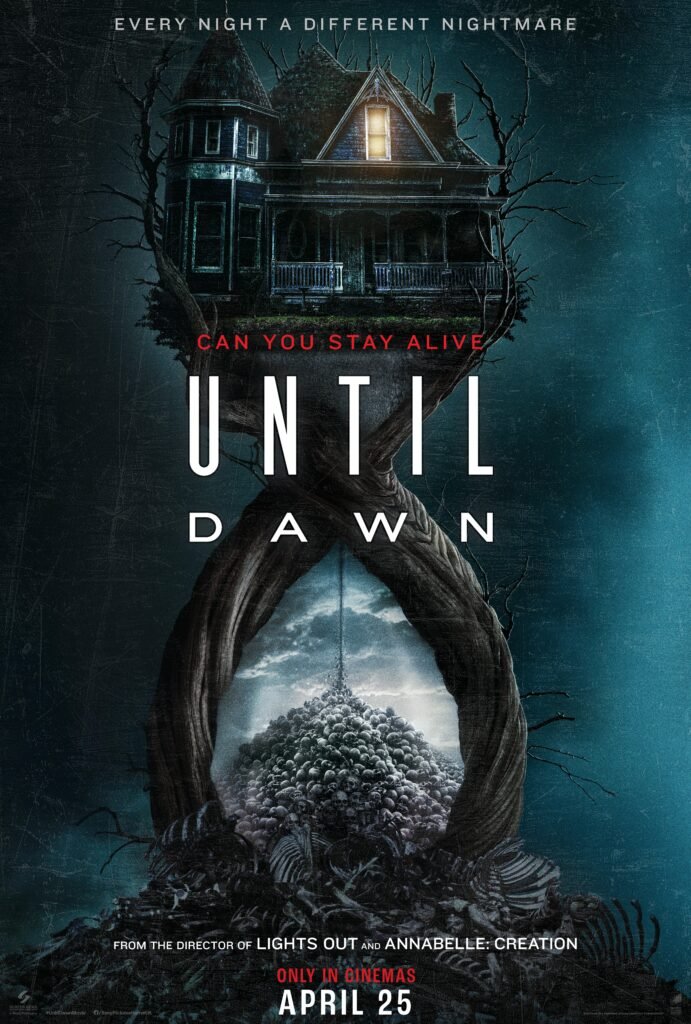
Walking out of Until Dawn (2025), I felt torn in a way that only video game adaptations seem capable of causing. On its own, the film is a grisly survival horror movie with a clever hook and a strong commitment to practical effects. As an adaptation of the 2015 PlayStation game, it feels like it’s borrowing the idea of Until Dawn The Game, rather than its soul. That tension sits at the heart of the movie—and ultimately defines how much you’re likely to enjoy it.
A New Story In A Familiar World
Rather than retelling the game’s events, the film takes place in the same universe but tells a completely original story. The setting shifts to the fictional Glore Valley. The disappearance of her sister Melanie a year earlier still haunts Clover. Hoping for closure, Clover and her four friends return to the area. They find themselves trapped in a relentless time loop.
Different threats hunt and kill them each night. These include masked slashers, supernatural entities, and wendigo-like creatures—before waking up at the start of the same evening. The twist is that death isn’t clean or consequence-free. With every reset, their bodies deteriorate further, and the group edges closer to permanent death if they can’t survive until dawn.
From a purely narrative standpoint, it’s a solid horror setup. The mystery unfolds gradually, and the escalating physical toll adds urgency. Even if the rules of the loop sometimes feel conveniently flexible.
Tackling an Unadaptable Game: Turning Player Choice into Story
Adapting Until Dawn was always going to be a nightmare. The game thrives on player agency, branching paths, and permanent consequences. It also boasts of hundreds of possible outcomes depending on your choices. The filmmakers reportedly explored canonizing a single ending early on—and then wisely abandoned the idea.
Instead, the filmmakers leaned into the concept of repetition itself. By introducing a time-loop mechanic, the movie mirrors the experience of replaying sections of the game. Dying repeatedly, and learning through failure. In my opinion, this is the smartest and most interesting creative decision the film makes, even if it comes with trade-offs.
When the Gimmick Cuts Both Ways
The loop allows the film to experiment with different horror subgenres—slasher, supernatural horror, body horror, but it also undercuts tension. Once it becomes clear that death is temporary, the fear shifts from if characters will die to how they’ll die this time. That works for spectacle, but it weakens emotional investment.
Direction and Production Choices
A Practical Effects Showcase
Director David F. Sandberg clearly loves hands-on horror, and it shows. The film leans heavily on practical effects, from latex creatures and detailed prosthetics to brutally convincing gore sequences. The film smashes faces, snaps bones, and breaks bodies in ways that feel tactile and nasty rather than digitally polished.
One particularly impressive sequence involves repeated blunt-force trauma. The crew stops the camera between takes, adds layers of prosthetics and blood, and then realigns the actor. The result looks like one continuous, punishing moment, and it’s easily among the film’s most memorable visuals.
The wendigos are another highlight. Instead of relying on CGI, the production cast extremely tall, thin performers and outfitted them with full prosthetic suits. The creatures feel physical, imposing, and genuinely unsettling.
Budget-Conscious but Creative
With a reported budget of around $15 million, the film doesn’t aim for blockbuster scale. Instead, it focuses on atmosphere, confined locations, and inventive staging. Shooting in Budapest doubled effectively for Glore Valley. The limited settings reinforce the feeling of being trapped in an inescapable nightmare.
Visual Style and Technical Execution
Shifting Horror Aesthetics
Each loop subtly changes the film’s tone and visual language. Early on, it plays like a straightforward slasher. Later loops lean into supernatural possession, grotesque body horror. At one point even brief found-footage-style chaos. This genre-hopping reflects the game’s varied inspirations, though it can also make the movie feel unfocused.
Visual cues track the characters’ mental and physical decay—handwriting becomes shakier, injuries worsen, and performances grow more frantic. These details help sell the passage of time, even when the story resets.
Cinematography That Breaks Horror Rules
Cinematographer Maxime Alexandre avoids the muddy darkness common in modern horror. Instead, the cinematography often uses harsh flashlights and strong contrasts to brightly light the scenes. Allowing the audience to actually see what’s happening while still maintaining a suffocating atmosphere. In my opinion, this choice works beautifully, especially during creature encounters.
The filmmakers use digital effects sparingly, mainly to enhance the practical work by removing seams, smoothing transitions, and intensifying especially violent moments.
Performances and Character Work
Standout Performances
Ella Rubin’s Clover anchors the film. She carries the emotional weight of the story. She convincingly charts her character’s descent from grief-stricken sister to increasingly unstable survivor. In quieter moments, she brings genuine vulnerability. later scenes however allow her to lean into something more feral and desperate.
Peter Stormare’s return as Dr. Hill is pure fan service, but it’s effective. He chews the scenery with gleeful menace. His presence immediately evokes the game’s unsettling tone. Every scene he’s in feels more alive—and more Until Dawn —than the rest of the film.
Ji-young Yoo also stands out as Megan, the group’s psychic. She injects personality and dark humor into a role that could have easily become a cliché. She seems fully aware of the movie she’s in.
The Rest of the Ensemble
The remaining characters are serviceable but thinly written. Michael Cimino does what he can with Max. The script saddles him with awkward dialogue that undercuts his performance.
Odessa A’zion brings strong screen presence, even if her character arc never quite goes anywhere meaningful.
The biggest issue is chemistry. The group doesn’t always feel like real friends. Making it harder to care who survives. Too often, the filmmakers use characters mainly as targets for creative kills rather than exploring them emotionally.
Faithfulness to the Game
Where the Film Succeeds
The time-loop concept cleverly mirrors the trial-and-error nature of gameplay. Practical gore and inventive deaths capture the game’s slasher roots. Peter Stormare’s involvement provides a genuine connective thread to the source material
Where It Loses the Spirit
Replacing Blackwood Mountain and the original cast removes much of the game’s identity. The loop mechanic reduces the impact of death, which was crucial to the game’s tension. The mythology becomes cluttered, mixing wendigos with ghosts, witches, and zombies without clear rules. In the game, every choice matters because death is permanent. In the film, the story integrates death into its structure, but that translation loses something essential.
Structural and Tonal Issues
As the film progresses, the repetition starts to wear thin. Once viewers understand the mechanics, the scares lose their edge. The movie struggles to escalate meaningfully. The shifting tones, while ambitious, sometimes clash rather than complement one another.
The mythology also feels underexplained. Instead of deepening the mystery, the filmmakers introduce new elements and then abandon them. Leaving the world-building feeling messy rather than intriguing.
Final Thoughts and Verdict
Until Dawn (2025) works best when viewed as a standalone horror experiment rather than a direct adaptation.
If you’ve never played the game: This is a fast-paced, bloody, and visually inventive horror movie. It has a fun central gimmick and impressive practical effects. It’s messy, but entertaining.
If you’re a fan of the game: You’ll likely see this as a missed opportunity. While it borrows familiar names and ideas, it lacks the atmosphere, and player-driven tension that made the original special.
Final Recommendation
If you’re in the mood for a gory, high-concept horror film and can separate it from the game, Until Dawn is worth checking out. Just don’t go in expecting the definitive cinematic version of the experience you played. As a movie, it mostly works. As an adaptation, it never quite finds its footing. It ends up feeling like Until Dawn in name more than in spirit.