How to Live Without Going Crazy movie review: A Refreshing Polish Comedy-Drama
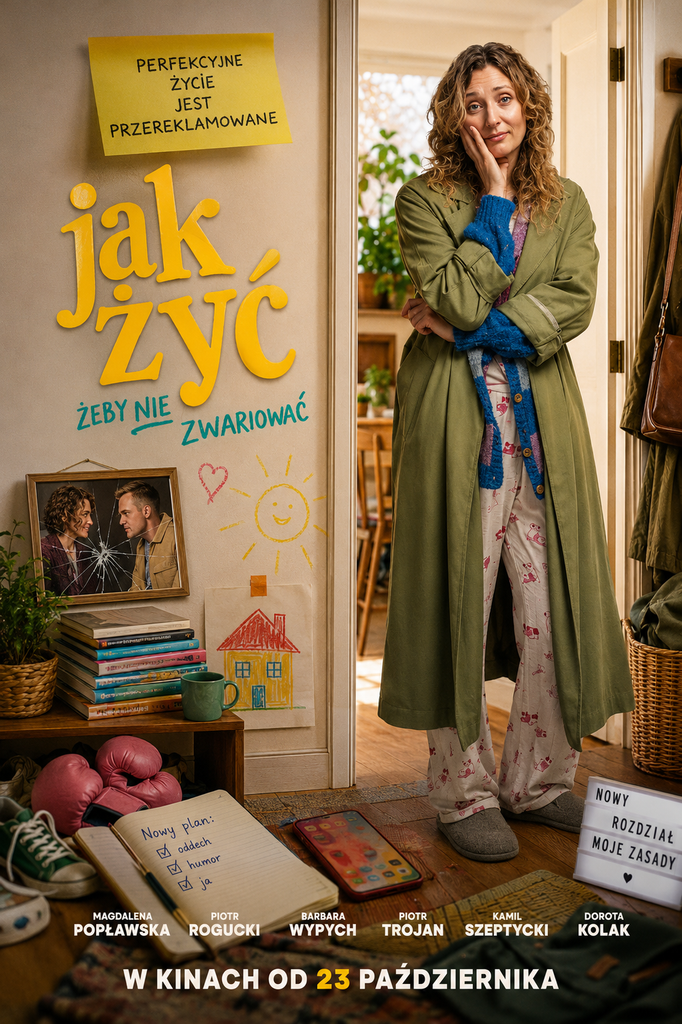
Sometimes things just go wrong. Marriages end, careers are lost and money issues crop up out of nowhere. ‘How to Live Without Going Crazy’ is a humorous, heart-warmingly funny take on a common nightmare.
Released in Poland on 23rd October 2026, this Polish comedy drama directed by Tomasz Konecki and Iwona Ogonowska-Konecka looks at how Anka (who seems to have her life together) ends up with her whole life going wrong.
This film stars Magdalena Popławska, Piotr Rogucki and Barbara Wypych. This film looks at starting over when you feel like all hope is lost, the pressures put upon women, family dynamics and the importance of humour.
Whilst the narrative can be predictable at times it gives a fun and relatable look into starting over.
When Everything Falls Apart
Anka (Magdalena Popławska) seems to have everything under control. She has a good job, a husband, kids and a great apartment in the center of the city. Plus she writes articles about healthy lifestyle.
However, she quickly finds out that things are not as perfect as they seem. Her husband cheated on her and her marriage falls apart. What’s more, she loses her job.
On top of that she has money issues and a bailiff shows up. Her kids are having issues too and Anka suddenly has to deal with multiple crises.
Instead of giving up she starts to rebuild her life. Her best friend gives her some support. New relationships come into her life and she finds herself doing stand-up comedy.
This idea forms a solid basis for a modern comedy drama. Although Anka does have quite relatable issues, it feels like they have been exaggerated on purpose. The movie knows that life rarely throws one crisis at you.
A Refreshing Take on Starting Again
The film has an amazing aspect to it regarding self-reinvention. This is seen through Anka learning how to find her own identity outside of being a wife, mother and career woman.
This creates a great sense of independence. Anka had to learn how to make her own choices and revaluate what happiness really meant.
Throughout the film we see how women are put under pressure to be able to do it all. Trying to balance your career, relationships, children and home life can become overwhelming.
Anka has a breakdown due to feeling exhausted from constantly trying to please others.
We also see how her mental health has been affected by betrayal and money worries. This affects her confidence and relationships meaning recovering from this is not as straightforward.
Throughout the screenplay we see how she uses humour to cope. Stand up comedy helps her to think differently about the situations she is going through. Laughing helps her to take back some control.
However, the film does not imply that everything will be fixed through positive thinking. Anka makes mistakes and things do not go as planned.
However, by accepting that life is not going to go back to how it was she seems to have a more realistic progression.
Direction and Cinematography
Tomasz Konecki and Iwona Ogonowska-Konecka created an easy to follow story. The film focuses on the relationship between characters.
They also do not heavily rely on the romantic-comedy tropes. The story still focuses on Anka’s character development and therefore feels more modern.
However, the cinematography was not as effective. The cinematographer, Piotr Śliskowski creates a very crisp and shiny feel throughout the film. The bright lighting and careful composition creates a very commercial feeling.
This sometimes does not fit with the context of the story. Anka is going through some financial troubles and has a lot of emotional issues. However, her environment looks very neat.
It can at times feel like a television advert or interior design book. If they had used a more rough style, it would have shown how unstable her situation is. This can be seen in the more challenging moments of the film.
Despite this, the cinematography is very clear and professional. It just lacks character.
Magdalena Popławska Leads an Excellent Cast
Magdalena Popławska is the best aspect of the film. She portrays Anka perfectly, showing how drained she is by the fall of her meticulously planned life. She portrays all of the right elements of vulnerability, frustration and humour.
While Anka isn’t always the most rational or easy to understand character, her choices can be abrupt and driven by her feelings, Magdalena Popławska makes her very likeable.
She shows how Anka slowly begins to change her perspective on life. Whilst trying to get her life back under control, she must come to terms with whether her life really was as rewarding as she thought.
Piotr Rogucki plays an interesting character in Bartek, Anka’s cheating husband. He does not play him as a pure villain but adds some regret and depth to his character, which makes the relationship more interesting.
Barbara Wypych also stands out as Ada, Anka’s supportive friend. She gives some nice humor and encouragement but can sometimes feel like a cliché.
The younger actors also stood out. They acted very naturally which helped to create realistic family dynamics. Their interactions often felt more natural than some wider comedic situations in the screenplay.
Piotr Trojan plays Lucek, a stand up comedian. This ties in Anka’s personal journey with the themes of comedy in the film. Dorota Kolak and Krzysztof Stelmaszyk also add some experience to the supporting cast.
Kamil Szeptycki also plays Mikołaj, a lawyer. He brings another cliché to the film. It feels a bit too convenient that Anka meets an unattainably attractive possible love interest.
The Importance of Humour
Overall, the comedic elements are best in their more realistic form. There are many awkward moments in the film after Anka tries to deal with multiple disasters but she often has humorous reactions.
It is also fresh that the film does not always make the tough situations dramatic. It acknowledges that people can often find themselves laughing in uncomfortable situations. Sometimes you just have to laugh.
This balances out the more dramatic parts of the film. The divorce, unemployment and debt could easily become a very bleak film but it keeps a friendly vibe throughout.
The comedy is not always effective. Some situations felt like they were made to fit with the common tropes of this genre. At times the plot takes precedence over realistic choices from characters.
There are some awkward moments when trying to blend comedy with drama. Some moments flow well whilst others feel pretty forced. The emotional parts could have benefited from being a bit more measured.
Where the Story Loses Its Way
Whilst the protagonist was an enjoyable character, there were some issues with the structure of this film. There were many obstacles given to Anka throughout the script but not all were developed properly.
The idea behind the film was good. As Anka was trying to rebuild her life after losing her marriage, job and money, there was plenty of potential for drama. However, there were some plot twists which took away from this.
Anka can also seem a bit erratic at times. Some of her decisions were made because the script needed to introduce another obstacle. This can make her character development feel less realistic.
The best friend relationship was quite predictable. Although not necessarily a bad thing, there were many easy love interests. This made some parts of the story feel less original.
The visuals did not always match up with the story. The set designs were very polished and did not really show how much Anka was struggling financially and emotionally. If the film had been more realistic it could have added to the realism.
Overall there are some issues with this film but the acting was still enjoyable and the main message was a good one to take from the film. The best parts came from the characters.
Final Verdict
How to Live Without Going Crazy is a warm, relatable comedy-drama led by Magdalena Popławska’s excellent performance.
Its familiar storytelling and overly polished visuals hold it back, but its humour and positive outlook make it an enjoyable watch.