Avatar: Fire and Ash (2025) Review – James Cameron’s Epic Return to Pandora”
Introduction Avatar 3: Fire And Ash (Warning contains Spoilers)
Avatar 3: Fire and Ash begins exactly where Avatar: The Way of Water ends. As I sat in the cinema, I felt the weight immediately.
There is no reset. There is no relief. Instead, the Sully family remains shattered by Neteyam’s death.
Directed once again by James Cameron, the third chapter pushes Pandora into volcanic territory. Both visually and emotionally, this is the darkest entry in the series.
However, while the ambition is undeniable, the execution feels uneven.
A Volcanic Shift in Setting and Tone
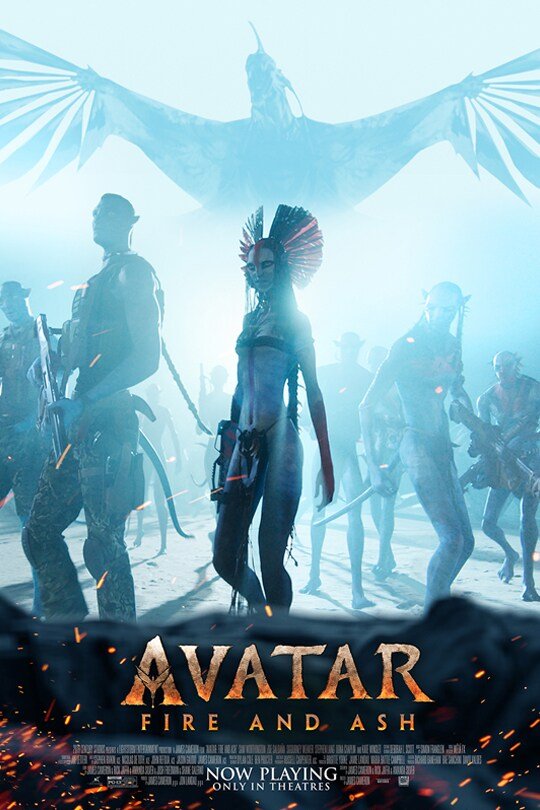
This time, Cameron introduces two new Na’vi cultures. The Windtraders live as nomadic sky merchants in massive living airships. In contrast, the Ash People occupy volcanic ruins shaped by fire and loss.
The contrast is deliberate. The Windtraders represent movement and connection. Meanwhile, the Ash People embody isolation and dominance.
Early on, the Windtraders add warmth and humor. Their leader, Peylak, brings a brief sense of lightness. Nevertheless, they remain peripheral.
Ultimately, the film belongs to the Ash People and their leader, Varang.
A Promising Idea That Feels Familiar
On paper, Fire and Ash presents one of the franchise’s boldest ideas. The RDA returns, now exploiting geothermal energy. Consequently, they form an uneasy alliance with the Ash People.
For the first time, the series embraces large-scale Na’vi-versus-Na’vi conflict. That shift should transform the moral framework entirely.
Yet despite its nearly three-hour runtime, the structure feels familiar.
The Sullys arrive in a new territory. They observe customs. Tensions escalate. Quaritch lurks. Eventually, everything builds toward a massive elemental climax.
This time, fire replaces water. However, the emotional rhythm echoes earlier films.
As a result, the experience feels like a remix rather than a reinvention.
Grief Drives the Narrative
Cameron described this as the darkest Avatar film. After watching it, I agree completely.
Grief saturates every frame. Jake prepares for war as a coping mechanism. He trains his children as if violence is inevitable.
Meanwhile, Neytiri’s sorrow hardens into rage. Her anger toward Spider feels raw and deeply uncomfortable.
Zoe Saldaña refuses to soften Neytiri’s bitterness. Instead, she allows the character to fracture relationships.
Those moments represent the film at its strongest. Rather than uniting the family, grief divides them.
Visually, the volcanic landscapes reinforce that bleakness. Gone are Pandora’s luminous blues. Instead, red skies and black ash dominate the frame.
Pandora no longer feels like a sanctuary. It feels wounded.
Varang: The Franchise’s Most Compelling Villain
Oona Chaplin delivers a commanding performance as Varang. From her first scene, she radiates danger.
Varang rejects Eywa after volcanic devastation destroyed her homeland. In her view, faith failed.
That ideological break adds thematic weight. These are not outsiders misunderstanding Pandora. They are Na’vi who believe everyone else is wrong.
What makes Varang compelling is her emotional parallel to Neytiri. She represents what grief can become if left unchecked.
Her scenes with Stephen Lang deepen the tension. Their dynamic introduces subtle power struggles and manipulation.
For the first time, Quaritch feels layered rather than mechanical. Lang plays him with restrained menace and visible unraveling.
The Sully Family: Strong Performances, Uneven Arcs
Sam Worthington portrays Jake as exhausted and worn down by endless war.
Meanwhile, Zoe Saldaña gives Neytiri some of her most emotionally brutal material.
Sigourney Weaver continues to impress as Kiri. She captures adolescent awkwardness while hinting at something mythic.
Kiri finally receives a defining moment. That scene feels earned and powerful.
Lo’ak also gains meaningful development. Britain Dalton portrays his survivor’s guilt with vulnerability.
However, the film juggles too many subplots. Consequently, several arcs feel truncated.
Spider’s storyline, played by Jack Champion, remains uneven. A late plot development involving his adaptation to Pandora feels convenient rather than organic.
Technical Brilliance Without the Same Awe
Technically, Fire and Ash remains astonishing.
The performance capture captures every micro-expression. The volcanic ecosystems feel alive and hostile. Additionally, the ash whales rank among the franchise’s most haunting creations.
Nevertheless, the sense of wonder has faded.
The innovation now feels like refinement. While impressive, it no longer feels revolutionary.
Moreover, the variable frame rate occasionally distracts during action scenes. At times, the visuals resemble high-end gaming rather than immersive cinema.
Instead of deepening immersion, those moments pull me out.
Ambition Versus Habit
Avatar 3 wants to explore faith, vengeance, and cyclical violence. At its best, it succeeds.
The Ash People’s philosophy challenges Pandora’s spiritual foundation. Neytiri’s rage questions the moral clarity of earlier films.
However, Cameron often retreats into familiar spectacle.
Several subplots emerge and then disappear. Additionally, certain threats resolve too quickly within chaotic finales.
By the end, the film feels episodic rather than complete. It resembles chapters stitched together rather than a singular narrative arc.
Final Verdict: Visually Stunning, Emotionally Heavy, Structurally Uneven
I left the theater impressed but exhausted.
Avatar 3: Fire and Ash offers some of the franchise’s boldest ideas. Varang stands as its strongest antagonist. The performances feel committed and emotionally raw.
Yet the film struggles with repetition and excess.
For the first time, an Avatar sequel feels less like a revelation and more like a test of endurance.
There is undeniable greatness here. However, it remains buried beneath indulgent pacing and familiar structure.
If James Cameron fully commits to the darker path he introduces, the next chapter could be extraordinary.
For now, Fire and Ash feels like a franchise at a crossroads, torn between evolution and repetition.