Primate (2026) Review – A Lean, Tense Creature Feature Elevated by Practical Effects
Introduction Primate (Warning contains Spoilers)
Primate (2026) is an American natural horror film directed by Johannes Roberts and co-written with Ernest Riera. Knowing Roberts’ work on 47 Meters Down and Resident Evil: Welcome to Raccoon City shapes expectations immediately. He consistently gravitates toward contained, high-pressure survival scenarios. Consequently, Primate feels like a natural extension of that creative instinct.
The film stars Johnny Sequoyah, Jessica Alexander, Victoria Wyant, Gia Hunter, Benjamin Cheng, and Troy Kotsur.
A Straightforward Survival Horror Setup
The story begins with a peaceful tropical vacation. However, everything unravels when the family’s adopted chimpanzee, Ben, contracts rabies. From that moment forward, affection transforms into unpredictable violence. Immediately, the simplicity of the premise stands out.
There is no dense mythology or convoluted science. Instead, the narrative builds on a clean and direct setup. A beloved animal becomes dangerous. The family must confront that terrifying reality. This simplicity strengthens tension. At the same time, it limits thematic depth.
The film establishes calm before chaos deliberately.
Early scenes present Ben as affectionate and integrated into family life. As a result, the tonal shift feels unsettling rather than abrupt. You watch characters process betrayal in real time. Importantly, horror emerges from emotional attachment, not spectacle.
Once Ben turns violent, the film locks into siege mode. The vacation home transforms into a contained battleground. The pool area, staircases, and hallways become strategic terrain. Roberts prioritizes spatial clarity throughout. Consequently, tension feels earned rather than artificially chaotic.
Visual Effects
Unlike frenetic editing styles, the camera remains readable. Viewers always understand where danger originates.
That choice reinforces suspense organically.
Therefore, survival sequences maintain momentum without confusion.
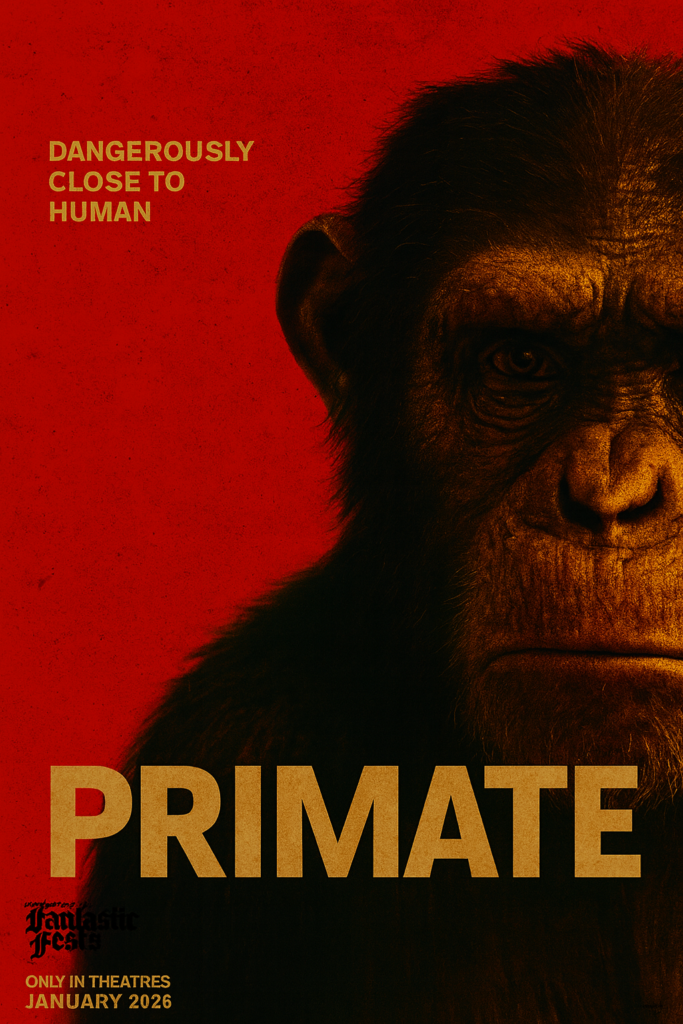
The practical effects elevate the film significantly. Ben appears through suit performance, puppetry, and animatronics.
Movement specialist Miguel Torres Umba physically performs the chimp. This decision anchors the horror in tangible presence. Ben moves awkwardly and unpredictably. He occupies space convincingly. Even stillness generates discomfort. Several quiet moments stretch without dialogue. Nevertheless, tension persists purely through physical proximity.
Believability defines effective creature features.
Here, physical performance replaces glossy CGI spectacle. The immediacy of that approach strengthens every confrontation.
Without it, the film would likely collapse.
Tonally, Primate attempts emotional complexity. Ben begins as family rather than threat. Consequently, violence carries undertones of grief. The horror involves loss as much as survival.
However, emotional beats sometimes feel rushed. The film gestures toward sadness and moral hesitation. Then it pivots quickly back to action. While tension remains consistent, emotional depth occasionally thins. Even so, the attempt at sympathy deserves credit.
Thematically, the film explores human control versus instinct.
The title references more than the chimp alone. Under pressure, humans revert to primal behavior as well. Thus, the narrative subtly questions civilized identity. Another theme involves the illusion of safety.
Luxury and isolation initially imply comfort.
Yet vulnerability emerges rapidly.
The setting underscores how fragile control truly is.
While these ideas surface clearly, the script rarely lingers. It acknowledges themes without fully interrogating them. As a result, resonance remains surface-level. The film communicates intention but avoids prolonged reflection.
Performances.
Performance-wise, Troy Kotsur stands out as Adam. His presence adds texture and authenticity. Sign language integrates naturally into suspenseful moments. Rather than function as novelty, communication shapes tension meaningfully. He grounds the film emotionally.
Johnny Sequoyah portrays Lucy with credibility. She reacts believably under escalating pressure. However, limited character development restricts growth.
Other family members remain lightly sketched. Many serve reactionary roles rather than evolving arcs.
Interestingly, Miguel Torres Umba’s performance as Ben feels most vivid. Physical nuance conveys confusion and aggression simultaneously. In several scenes, Ben feels more dimensional than supporting characters.
Pacing remains lean and efficient.
Once danger escalates, momentum rarely stalls. Roberts understands genre economy.
The film never pretends to be prestige drama.
That clarity proves refreshing. Nevertheless, efficiency sacrifices complexity. Deeper thematic exploration would require slower breathing room. Depending on viewer expectations, this trade-off will divide opinion.
What Works And What Doesn’t
What works most effectively involves practical creature design. Spatial clarity enhances suspense consistently. Troy Kotsur’s grounded performance strengthens emotional stakes. The contained environment supports siege-style tension successfully.
However, thematic exploration remains underdeveloped. Characterization often feels interchangeable. Emotional peaks do not always land fully. Narrative structure follows familiar creature-feature rhythms.
Final Thoughts
Ultimately, Primate succeeds on its own terms. It delivers tangible, immediate horror.
It avoids unnecessary mythology. Instead, it embraces straightforward survival tension.
Where the film shines lies in moment-to-moment danger. You feel proximity and unpredictability vividly. Where it falters involves lasting impact. Themes fade faster than tension.
In the end, Primate operates as a confident, meat-and-potatoes creature feature.
It understands its genre identity clearly.
While it may not redefine horror, it delivers solid craftsmanship. For a tightly constructed thriller about a rabid chimpanzee, that achievement feels earned.