The Mandalorian Review: Why the Star Wars Disney+ Series Works So Well
Introduction (Warning contains Spoilers)
The Mandalorian stands as a space Western adventure inside the wider Star Wars universe. Jon Favreau created the series for Disney+. Importantly, the show marked the first live-action Star Wars television series.
The story unfolds five years after Return of the Jedi. However, the narrative avoids galaxy-saving heroics and massive wars.
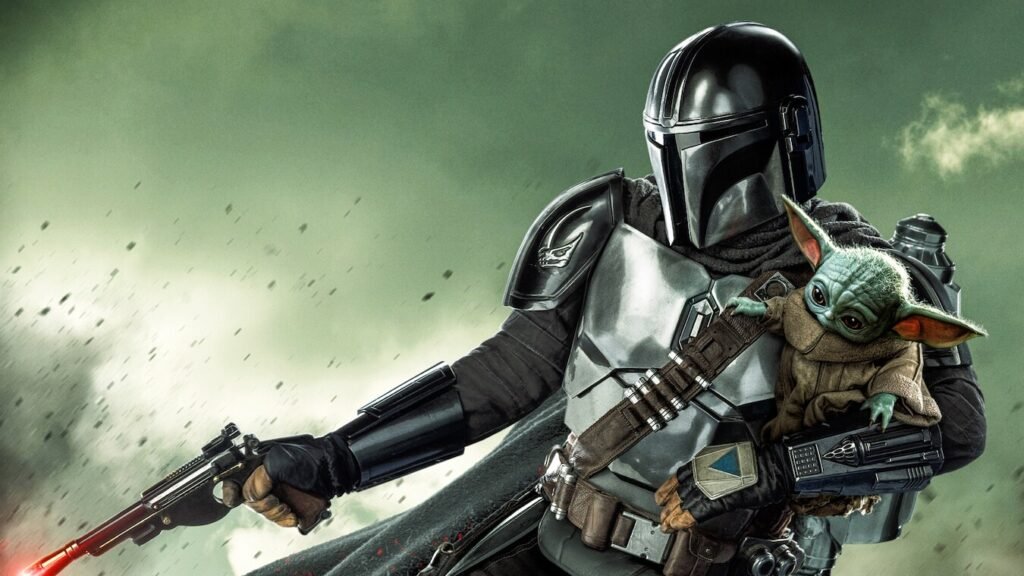
Instead, the story follows the lone bounty hunter Din Djarin.
Soon afterward, Din encounters the mysterious Force-sensitive child Grogu.
Consequently, that meeting reshapes both of their lives.
From the very first episode, the show signals a different creative direction. Instead of overwhelming spectacle, the series chooses patience and atmosphere. Because of that decision, the story feels intimate and grounded. Ultimately, that restraint becomes the show’s greatest strength.
A Right Place, Right Time Moment for Star Wars
When The Mandalorian launched in 2019, Star Wars faced a difficult moment.
The sequel trilogy divided audiences and sparked endless debate. Therefore, uncertainty surrounded the future direction of the franchise.
At that moment, The Mandalorian arrived with perfect timing. More importantly, the show stabilized audience confidence in Star Wars storytelling. At the same time, it gave Disney+ a powerful flagship series.
What impressed me most involved the confidence behind the storytelling.
The show never begged viewers for approval through constant nostalgia references.
Instead, it trusted its own identity and pacing.
Furthermore, the series slowed down and embraced quiet storytelling.
Because of that approach, the tone echoed the original trilogy’s spirit. Consequently, the show felt closer to classic Star Wars than many recent projects.
How the Show Came Together
The idea behind The Mandalorian did not appear overnight. Earlier, George Lucas attempted to develop a live-action series titled Star Wars: Underworld.
However, production technology and budgets limited that earlier project. Years later, those technological barriers finally disappeared.
Eventually, Jon Favreau pitched a bold concept to Lucasfilm. He wanted a gritty space Western inspired by samurai cinema and spaghetti Western films.
Instead of Jedi and Sith politics, Favreau focused on ordinary people across the galaxy. That creative decision immediately gave the show a fresh perspective.
Equally important, Lucasfilm paired Favreau with Dave Filoni. Favreau brought cinematic structure and production experience. Meanwhile, Filoni contributed deep knowledge of Star Wars mythology.
Because of that partnership, the show achieved a rare balance. It respects established lore while exploring new territory. Therefore, the series feels authentic without becoming trapped by nostalgia.
The Technology That Changed Everything
Another major achievement involves the show’s groundbreaking production technology. The Mandalorian uses a system called StageCraft. Many filmmakers also call the system The Volume.
Instead of green screens, actors perform inside massive LED walls. Those screens display digital environments in real time.
Consequently, actors interact with realistic lighting and reflections.
As a viewer, I immediately noticed the visual difference. Light behaves naturally on armor, helmets, and metallic surfaces. Additionally, characters appear fully integrated with their surroundings.
Because of this system, each episode maintains a cinematic visual quality.
The show also uses widescreen framing and anamorphic lenses. Therefore, every episode feels like a short film rather than standard television.
A Simple Story That Actually Works
At its core, The Mandalorian tells a simple story. A bounty hunter accepts a job and discovers an unusual child. Then he chooses to protect that child at all costs.
Importantly, the show avoids massive prophecies and galaxy-ending threats.
Instead, it focuses on personal decisions and small missions.
In my opinion, this simplicity explains the show’s success. Early episodes follow a mission-of-the-week structure. For example, Mando searches for fuel, information, or allies.
Therefore, every episode builds momentum through practical goals. The grounded stakes help viewers follow the story easily.
The writing also values silence and visual storytelling. Din Djarin rarely delivers long speeches or emotional monologues.
Instead, subtle gestures reveal his internal conflict.
A helmet tilt, a pause, or a small decision communicates meaning. Because of that restraint, the show respects the viewer’s intelligence.
Din Djarin and the Power of Restraint
Din Djarin ranks among the most fascinating Star Wars protagonists. Ironically, he achieves that impact while speaking very little.
The performance combines multiple actors.
Pedro Pascal provides the character’s voice.
Meanwhile, Brendan Wayne and Lateef Crowder handle physical performance.
Despite that shared role, the character always feels cohesive. Every movement communicates purpose and discipline.
For example, Mando often pauses before drawing his blaster. He also nods subtly instead of speaking. Furthermore, he treats Grogu with careful attention.
Through those choices, the character slowly reveals his humanity. Gradually, the hardened bounty hunter becomes a reluctant father figure.
Grogu and the Importance of Practical Effects
Grogu quickly became the emotional heart of the series. Many viewers first knew him as “Baby Yoda.” However, the character works because of smart creative decisions.
The production team chose a physical puppet instead of full CGI.
Because of that choice, Grogu feels physically present. Actors interact with him naturally during scenes. Small gestures create powerful emotional moments. His ears move, his eyes widen, and curiosity drives his behavior.
Over time, viewers naturally grow attached to him. Even quiet scenes become emotionally engaging.
Found Family and Fatherhood
The central relationship in The Mandalorian involves Din and Grogu. Initially, Din treats the child as a bounty target. However, repeated choices gradually change that relationship.
Soon, responsibility replaces professional detachment. Eventually, Din chooses protection over profit. The series explores the theme of found family. Din himself grew up as a Mandalorian foundling. Other warriors rescued him after tragedy.
Therefore, his protection of Grogu reflects his own past. He attempts to offer the same safety he once received. Importantly, the show never rushes this emotional transformation. Instead, small actions build the father-son dynamic.
Creed, Identity, and Belief
The Mandalorian also explores belief systems and cultural identity. Din follows a strict interpretation of Mandalorian tradition.
Specifically, his creed forbids removing his helmet.
Later, he encounters Mandalorians who reject that rule. Consequently, Din begins questioning his upbringing. This conflict drives some of the show’s strongest moments.
One scene becomes especially powerful.
Din removes his helmet to help Grogu.
That decision sacrifices his religious identity.
However, love motivates the sacrifice. Because the story builds patiently, the moment feels earned.
Life After the Empire
The series takes place after the fall of the Galactic Empire. Therefore, the galaxy enters a chaotic rebuilding period. Power vacuums appear across distant planets. Criminal networks and opportunistic leaders seize control.
Characters like Greef Karga attempt to rebuild order. Meanwhile, former soldier Cara Dune searches for purpose. Importantly, the show avoids simple moral categories.
Former criminals sometimes become community leaders. Meanwhile, Imperial remnants quietly reorganize. Because of that complexity, the galaxy feels politically unstable and realistic.
Supporting Characters and Performances
The supporting cast adds personality and depth. Carl Weathers brings charm and authority to Greef Karga. Likewise, Gina Carano gives Cara Dune powerful physical presence.
Another standout performance comes from Katee Sackhoff. She successfully transitions her animated role into live action.
Her portrayal of Bo-Katan Kryze feels authentic and confident.
Meanwhile, Giancarlo Esposito delivers a chilling villain. His character Moff Gideon rarely shouts or loses control.
Instead, he plans carefully and waits patiently. Instead, he plans carefully and waits patiently. That quiet menace makes him especially dangerous.
The series also benefits from memorable guest performances. Bill Burr delivers an unexpectedly emotional episode.
Similarly, Rosario Dawson portrays Ahsoka Tano with calm authority.
Even brief appearances leave lasting impressions.
Music and Atmosphere
The music plays a crucial role in the show’s atmosphere. Composer Ludwig Göransson created the unique score.
Instead of traditional orchestral Star Wars music, the soundtrack experiments with unusual instruments. For example, electronic tones mix with Western-inspired melodies.
As a result, the music feels lonely, mysterious, and adventurous. The main theme immediately establishes the show’s identity. Within seconds, viewers understand the tone of the series.
Where the Show Stumbles
Despite its strengths, The Mandalorian has a few weaknesses. Some episodes function as side quests. Consequently, the larger storyline occasionally slows down.
Early seasons handle that structure effectively. However, later seasons highlight the pacing problem more clearly.
Another issue involves interconnected storytelling across multiple shows.
For example, Din and Grogu reunite during The Book of Boba Fett.
Viewers who skipped that series may feel confused. Because of that choice, Season Three begins with narrative gaps.
Additionally, the galaxy gradually feels smaller. Familiar characters appear more frequently. Although those appearances excite fans, they sometimes weaken the lone-gunslinger atmosphere.
The Overall Impact
Even with imperfections, The Mandalorian reshaped Star Wars television.
The series proved that character-driven storytelling still works.
Instead of endless escalation, the show focuses on atmosphere and emotional stakes.
Consequently, viewers reconnect with the sense of wonder.
For me, The Mandalorian stands among the strongest modern Star Wars projects.
It introduces memorable new characters while respecting established lore.
Most importantly, it reminds audiences why Star Wars captured imaginations decades ago.
Final Thoughts
Ultimately, The Mandalorian succeeds through simplicity and restraint.
A quiet warrior protects a vulnerable child across a dangerous galaxy.
Every episode explores loyalty, identity, and personal responsibility. Because of those themes, the story feels surprisingly human.
The show may never achieve perfection.
However, it consistently delivers emotional storytelling and cinematic presentation.
Finally, fans should keep watching the franchise closely. A new film titled The Mandalorian & Grogu will arrive later this year.
When that movie releases, make sure to check the movie reviews page for my review