Faces of Death (2026) Review
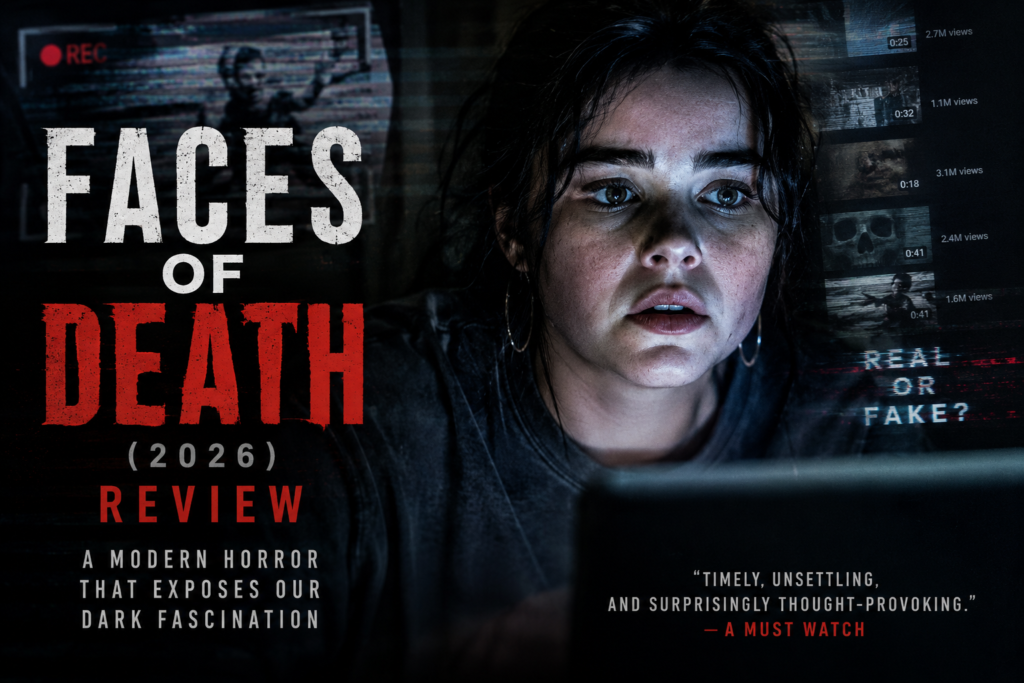
Introduction (Warning Contains Spoilers)
Rarely do horror movies have such a reputation like Faces of Death does. The movie was released in 1978 and was notorious for the way it crossed the boundary between reality and fiction. It was difficult to determine the credibility of what the audience watched.
As far as its controversial side is concerned, it is this aspect that gave the movie its iconic status in the genre. Almost five decades later, filmmaker Daniel Goldhaber picks up where the original left off with Faces of Death (2026).
However rather than attempting a direct remake, Goldhaber reimagines the original film’s ideas for a generation shaped by social media and digital culture.
Prior to watching the movie, I was not sure if this was really a movie that could use a remake at all. This was certainly a product of its era. However, Goldhaber manages to bring new meaning to the movie.
Rather than just using shock tactics, he considers current preoccupations with graphic material, voyeurism, and constant barrage of horrific content that can be accessed via the internet. Despite the fact that the movie does not consider all its themes, it is surprisingly intelligent and captivating.
A Modern Reimagining of a Cult Classic
Among Goldhaber’s best moves is his realization that the world has become quite different from the way it was back in 1978. What made the original Faces of Death popular was the fact that many people thought they were actually witnessing a death in real time.
In today’s world, there is nothing surprising about the availability of shocking videos; the real puzzle lies in the motivation behind their search and consumption.
Goldhaber does not seek to remake the original movie in terms of plot; instead, he bases his remake on the themes of the original. Faces of Death is more of a thematic remake than a remake in the conventional sense of the word.
The link to the original is based on its themes rather than plot. The society’s obsession with death is examined once again, but from a modern technological perspective.
In my opinion, this strategy was quite innovative. Most remakes do not have much to say for themselves. They are mostly based on nostalgia or certain imagery.
Faces of Death managed to get past this problem and ask an important question. It understands the controversy surrounding the original and seeks to find out how it would apply to today’s world.
Visual Style and Directorial Approach
Daniel Goldhaber has created a body of work that focuses on modern day problems. For example, in Cam, he explored the topic of online identity and performance.
In How to Blow Up a Pipeline, he explored political frustrations and activism. All these movies show that the artist is interested in modern day issues and favors realism.
The director does not employ hyperbolic imagery typical of mainstream horror. On the contrary, the director uses realism that allows viewers to see realistic events unfolding before their eyes.
What scares the audience is the familiar world of the film. It is scary because of the way in which social media plays an important role in it.
One major element responsible for the success of the film is cinematography by Isaac Bauman. The work of Bauman goes hand in hand with the directorial vision of Goldhaber.
The camera remains close to the characters, which creates an intimate and intense effect. As a result, viewers find themselves immersed in the process of the investigation and not watching it from the distance.
Moreover, Bauman uses screens, various digital interfaces and online media in his visual language. These tools are never used in a gimmicky manner. On the contrary, they complement the themes presented naturally.
Nowadays, our lives are intertwined with technological devices and this element is reflected through cinematography. The images often have a natural and documentary style, which adds to the realism of the movie.
It is also important to mention the influence of the original film. The 1978 version made the audience uncomfortable because people had doubts concerning the authenticity of what was happening on screen.
Similarly, Goldhaber and Bauman try to make their audience uncomfortable using contemporary means.
Themes of Voyeurism and Social Media
The most notable element of “Faces of Death” is that it has an incredibly strong theme. Ultimately, the theme revolves around voyeurism and the way society handles images that are disturbing to look at.
These themes are by no means original; however, they seem particularly appropriate in light of recent developments in our world.
Social networking websites have changed the way people gather information. Graphic images travel the globe within minutes, while algorithms are designed to reward user engagement, regardless of any other factors.
The thing that makes this premise compelling is its relevance. While the original movie focused on the attraction to death in humans, Goldhaber’s Faces of Death focuses on how technology enhances this aspect.
Nowadays, thanks to the internet, shocking footage has become more available than ever. The movie acknowledges this phenomenon and bases its horror around it.
In many aspects, I find this adaptation necessary. Otherwise, the Faces of Death would have appeared to be too outdated to appeal to modern audiences.
This film addresses problems that people nowadays face, having seen the disturbing footage online and understanding how fast it spreads.
However, this is precisely what I thought about the film – it missed some important points here. The notions themselves are truly interesting and the commentary is insightful.
Nevertheless, sometimes the script does not elaborate on them, leaving room for deeper exploration.
Occasionally, the plot touches upon some more extensive debates on internet culture, desensitization, and ethics. This is an intriguing aspect of the movie.
However, these aspects tend to be mentioned only briefly before returning to the plot of the mystery. Thus, although interesting, social commentary is rather superficial.
It does not render the film useless by any means. Indeed, the issues raised give additional depth to the movie. Yet it did leave me yearning for more. It seemed that there was a potential to delve deeper into the issues raised.
Performances
Performances is another aspect where the movie is successful. The movie has great acting from Barbie Ferreira and she steals the show through her acting. Her performance is emotional because it makes it possible for one to relate to her.
The aspect that fascinated me the most was the sense of grounding that Ferreira portrayed throughout the film.
Ferreira never portrays a stereotypical horror heroine; rather, she is an average individual facing increasing disturbing situations. Her responses are realistic, thereby making the film more realistic.
The performance of Ferreira is especially significant for the film since the themes might become too abstract.
The presence of Ferreira helps to add emotion to the film. Even if the screenplay fails to capture the ideas, her portrayal still makes the film engaging.
The rest of the cast does a commendable job too. Dacre Montgomery gives a compelling performance. He offers more than just the straight forward serial killer
Josie Totah, Jermaine Fowler, Aaron Holliday, and Charli XCX bring modern-day energy to the film. With their help, the movie creates a plausible setting inhabited not by horror clichés but by relatable people.
Even though some of the supporting actors could have been further developed, all of them do excellent jobs delivering believable performances.
What Worked and What Did Not
I liked the idea behind the movie and how they made it contemporary. Goldhaber was able to adapt Faces of Death for our time and age.
It seems that there is something quite significant about social media, voyeurism, and viewing unpleasant images online.
Atmosphere is also an incredibly strong point. Goldhaber and Bauman were able to make an environment that seems very real and uncomfortable.
It is helped by the realistic photography style used in the movie. The film does not use gore to scare but rather uncertainty and realism.
It would also be unfair not to acknowledge the good work done by the performers in the movie. Barbie Ferreira delivers a stellar performance as the protagonist and supplies the emotional component of the film. This character allows viewers to relate to the film regardless of the dark turns it takes.
The plot of the mystery is exciting and keeps viewers interested. The gradual process of revealing information ensures the suspense and keeps the audience engaged.
The film knows how to build up tension in its plot without relying on shocking imagery.
What fails to satisfy in the movie is the degree to which it explores the themes raised. Good points are made that could be further analyzed.
The criticism of internet culture and desensitization seems timely but lacks a deeper analysis in the film.
Several secondary characters seem underdeveloped despite the good acting from the part of the entire cast.
Some extra attention would be helpful for the film in order to develop the theme and the emotional component.
But none of these detract from the enjoyment. They just stop the film from fulfilling its maximum potential.
The foundation is solid. The execution is strong. I just think that there was more here than could have been explored.
Final Verdict
Faces of Death (2026) exceeded my expectations. Not exploiting the fame of the original movie, Daniel Goldhaber offers a profound and rather contemporary horror thriller.
Updating the core issues of the plot to the modern age, he manages to turn the provocative cult film into a statement about modern media culture.
This movie features good direction, brilliant cinematography by Isaac Bauman, and splendid acting by Barbie Ferreira.
The atmosphere is consistently well-kept, and the intrigue is maintained throughout the whole picture.
However, above all, the movie recognizes how the society’s attitude towards disturbing materials changed since 1978.
The main drawback in this movie is that it does not delve into the concepts that are raised by it. The concepts are interesting, but they are not always analyzed in depth. Nevertheless, it manages to succeed on more occasions than fail.
In the end, Faces of Death is not a remake; it is a reimagining of the original in its true essence. Despite not being as controversial as it set out to be, the film is quite an intelligent, well-acted, visually stunning movie that turned out to be much more interesting than its concept would suggest.
In my view, it exceeded my expectations and proved that even the most unlikely horror franchises could become relevant again.