In The Lost Lands: dark fantasy-action hybrid
Warning: Spoiler Alert
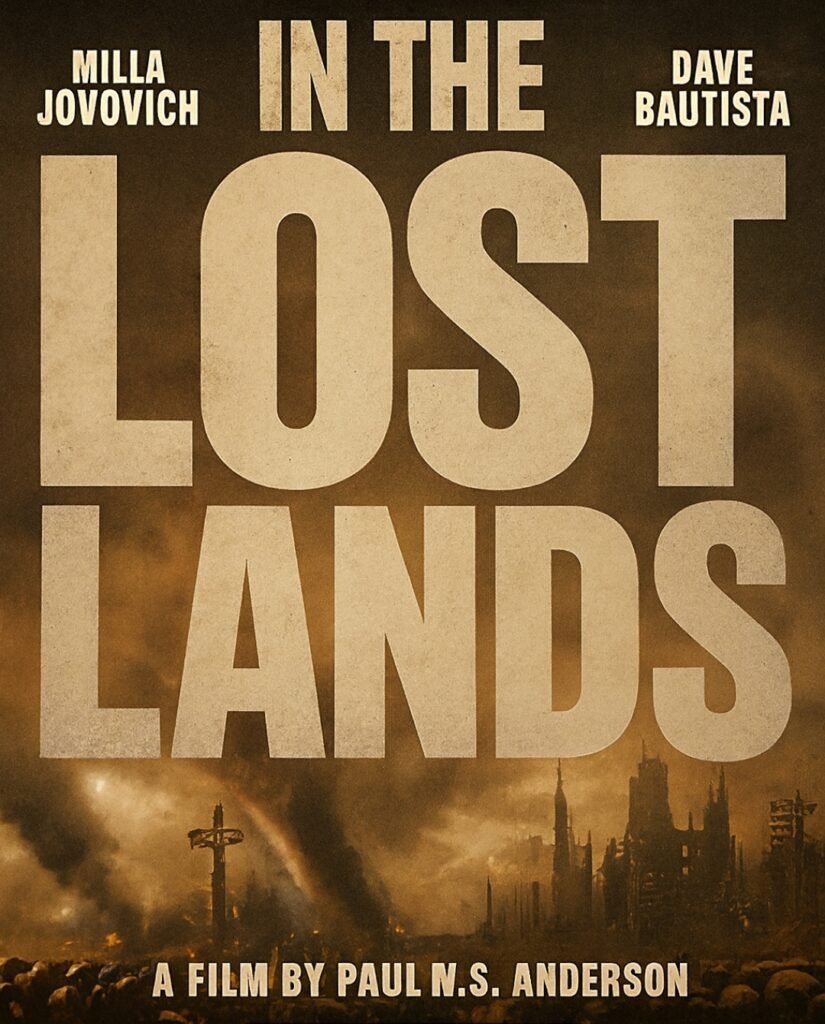
In The Lost Lands is a film I got around to watching a few weeks after its release and honestly, it left me feeling pretty conflicted. Because this is one of those movies where I admire the ambition and effort behind it more than the final result. Directed by Paul W.S. Anderson (Event Horizon) and stars Milla Jovovich and Dave Bautista.
In The Lost Lands adapts a short story by George R.R. Martin and turns it into a dark fantasy-action hybrid with western and post-apocalyptic influences.
The story follows Gray Alys (Jovovich), a mysterious sorceress. Hired by a desperate queen To retrieve the secret of shapeshifting from a cursed wilderness known as the Lost Lands.
Along the way, she teams up with Boyce (Bautista), a hardened hunter with a tragic past. What unfolds is a visually aggressive, tonally strange journey that constantly teeters between inspired and exhausting.
Even before watching the film, everything behind the scenes already had my attention. Anderson spent nearly seven years developing this project, clearly seeing it as something deeply personal. Interestingly, he and Jovovich were drawn to this particular George R.R. Martin short story precisely because it didn’t resemble Game of Thrones. Instead, they described it as a “post-apocalyptic spaghetti western which seemed like a wild and promising direction.
Choosing a short story from 1982 gave them creative freedom to build a new world. Removing the pressure of replicating an existing franchise aesthetic. In theory, that decision makes sense. In practice, I felt like the film never figured out how to expand such a compact piece of source material. Into a full-length feature without padding or tonal whiplash.
A fascinating aspect of the film — at least from a filmmaking perspective — is how it was made. In the Lost Lands served as an experimental playground for real-time virtual production using Unreal Engine. Rather than relying entirely on green screens, the digital environments were rendered live on massive screens during filming, which allowed the actors and crew to see the world in real time.
As someone interested in film tech, I genuinely found this impressive. It’s clear Anderson wanted to avoid the floaty, disconnected feel that plagues a lot of CGI-heavy movies. In theory, this approach should ground performances and lighting in something tangible.
Visually, this movie is impossible to ignore. The entire thing has a heavily stylized, painterly look inspired by medieval art — especially Hieronymus Bosch. The color palette leans hard into sepia tones, rusted browns, sickly yellows, and muted grays. Giving the film an almost graphic-novel-meets-nightmare quality.
This was both the movie’s greatest strength and its biggest obstacle. On a frame-by-frame level, some shots genuinely look like twisted fantasy paintings. The constant visual intensity became overwhelming and everything blended together after a while, making it hard to emotionally connect to what was happening.
The film throws witches, werewolves, ruined reactors, gunslingers, and environmental collapse into the same pot. Sometimes that mashup feels daring and imaginative. Other times, it feels like a collection of cool ideas that never fully merge into a cohesive world.
This movie unmistakably feels like a Paul W.S. Anderson film — for better and worse. His obsession with symmetry, speed-ramping, dramatic posing, and hyper-stylized action is on full display. Every fight scene is staged to look cool first and make sense second. However I’ll give him credit for keeping the action spatially readable despite the chaos.
He leaned heavily into spaghetti western influences. He even using vintage 1970s anamorphic lenses to give the film a dusty, cinematic texture. The result is a strange fusion of Mad Max, Heavy Metal magazine art, and gothic fantasy. I could tell he was aiming for something that felt like a graphic novel brought to life. It’s dense, surreal, and intentionally excessive.
For me, though, the constant color shifts meant to signal environmental changes were more distracting than immersive. And instead of guiding my emotions, they pulled me out of the story.
Technically speaking, the film is ambitious. The camera tracked hundreds of reference points in the studio ceiling to allow real-time compositing. And the lighting was matched to virtual suns and skies. Anderson also made a point of building physical sets in the foreground and midground. So the actors had something real to interact with.
The film keeps the core idea of Martin’s short story intact. Gray Alys grants wishes, but every wish comes with a cruel twist. That “human monkey’s paw” is the strongest thematic throughline in the movie.
However, the tone is drastically different. Martin’s original story is quiet, poetic, and unsettling. The film replaces that mood with action-heavy set pieces, campy one-liners, and western archetypes. This shift undermines what made the story interesting in the first place. Instead of simmering dread, we get aloud spectacle
Dave Bautista completely carried this movie for me. He brought a sense of weariness and sadness to Boyce. It made him feel like a real person in a very unreal world. Even when the dialogue was clunky, he sold the emotion behind it. His performance gave the film a grounded center it desperately needed
Milla Jovovich, unfortunately, didn’t work for me here. Her performance felt recycled from previous Anderson films, complete with the same whispery delivery and stoic posing. She never fully embodies Gray Alys as a character — she just performed the role.
The lack of chemistry between the two leads was impossible to ignore. The movie positions their relationship as its emotional spine, yet it never feels earned or believable. That emotional disconnect did serious damage to the story.
Supporting performances were uneven. Fraser James was memorable as The Patriarch. Other characters felt underwritten or cartoonish, which I blame more on the script than the actors themselves.
Despite my issues, there were elements I genuinely appreciated. The commitment to a bold visual identity deserves respect, even if it didn’t always work for me. The creature designs and practical effects during certain monster encounters were striking and occasionally brutal in a satisfying way. Bautista’s performance elevated scenes that otherwise would have fallen flat. And the sheer ambition behind the production made the film interesting to watch, if not always enjoyable.
In my opinion, the biggest problem was the script. Expanding a short story into a feature-length film exposed major weaknesses in pacing, structure, and dialogue. Conversations felt stiff and unnatural, and emotional beats were rushed or skipped entirely. The film never gave its world or characters enough breathing room. Which made it hard for me to care about the stakes. Everything felt like it was happening too fast and without enough context.
In the Lost Lands is a fascinating failure. I admire its technical ambition and respect the swing it took stylistically, but the execution just didn’t land. The visuals overwhelmed the story, the dialogue lacked weight, and the emotional core never fully formed. If you’re a fan of Paul W.S. Anderson’s style or enjoy visually aggressive fantasy films that play better as background spectacle. Then you might find something to enjoy here — especially at home rather than in a cinema. As a George R.R. Martin adaptation, though, it left me disappointed. I’m glad I watched it once, mostly out of curiosity, but it’s not a film I feel compelled to revisit.