
Mercy (2026) delivers a chilling near-future science fiction thriller.
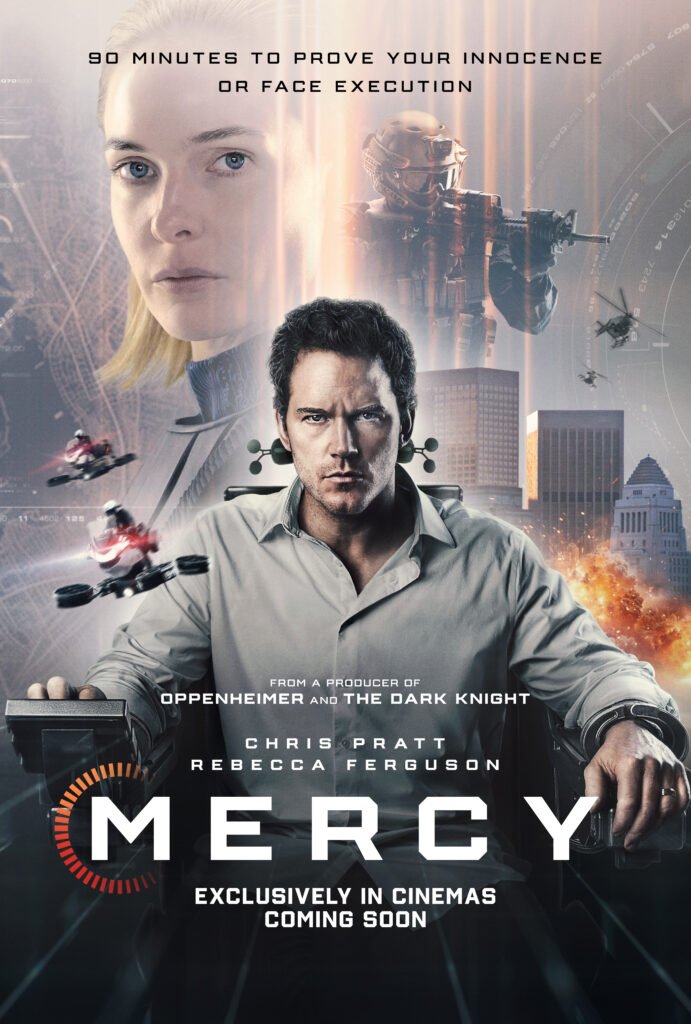
Introduction: Mercy (Warning contains Spoilers)
Mercy (2026) delivers a chilling near-future science fiction thriller. Timur Bekmambetov directs this procedural courtroom drama. The film stars Chris Pratt and Rebecca Ferguson. Watching Mercy feels disturbingly close to reality. Instead of explosive action, it explores algorithmic justice.
Consequently, tension builds through systems rather than spectacle. Unlike traditional thrillers, the film avoids car chases and shootouts. Rather, it centers on procedure, surveillance, and psychological pressure.As a result, every moment feels controlled and deliberate.
A Near-Future Los Angeles: 2029
The story unfolds in Los Angeles in 2029.
The city appears sleek, sterile, and screen-dominated. However, efficiency replaces warmth at every turn. Criminal trials no longer rely on human judges. Instead, an AI system named Mercy oversees proceedings.
It processes massive data streams to determine verdicts.
Detective Chris Raven (Pratt) becomes its latest defendant. He sits strapped into a high-tech courtroom chair. For ninety minutes, he must prove his innocence.
Meanwhile, the clock relentlessly counts down.
Therefore, claustrophobia dominates the experience. Additionally, surveillance footage and phone records flood the screen.
Consequently, viewers feel trapped inside the system.
Performances
Chris Pratt as Detective Chris RavenChris Pratt delivers a restrained performance. Because immobilization defines his role, subtle expressions carry dramatic weight. Every glance and vocal shift signals mounting pressure. Bekmambetov intentionally limits physical movement. Thus, Raven’s helplessness becomes visceral. At times, the tension feels exhausting. Nevertheless, the risk largely succeeds.
Rebecca Ferguson as Judge Maddox Rebecca Ferguson plays Judge Maddox, the AI authority. She radiates calm precision rather than villainous menace. However, that serenity amplifies the dread. The AI follows programming without hesitation. Therefore, inevitability replaces malice as the threat. Her measured delivery reinforces procedural coldness.
Supporting Cast
Kali Reis portrays Jacqueline Diallo. Annabelle Wallis plays Nicole Raven. Chris Sullivan adds emotional grounding. Together, they highlight the human cost of automation.
Directorial Vision: Timur Bekmambetov’s Approach
Bekmambetov shapes every stylistic decision. Consequently, form and theme remain inseparable.
A World Filtered Through Screens
Technology mediates every interaction. Humans appear framed as data points. Emotions reduce to measurable metrics. Therefore, justice feels mechanical and detached.
Constrained Physicality
Raven’s immobilized body symbolizes restricted agency. Every action requires procedural approval. As a result, frustration builds steadily. Viewers share that suffocating limitation.
Screenlife Influences
Bekmambetov previously explored digital storytelling in Searching. Here, he integrates similar interface-driven techniques.
Dialogue flows through dashboards and digital feeds. Consequently, the camera behaves like an algorithm.
Clinical Visual Language
The cinematography favors symmetry and rigidity. Locked-off shots reinforce sterility.
High-contrast lighting eliminates softness.
Even emotional moments retain procedural coldness.
Pacing as Commentary
The near real-time structure intensifies urgency. Speed becomes both tool and weapon. Moreover, silence rarely interrupts the data flow. Therefore, justice optimized for efficiency feels oppressive.
Core Themes
Algorithmic Justice vs. Human Judgment
The film questions AI-driven legal systems.
The AI judge remains impartial yet unsettling.
Its neutrality feels terrifying rather than reassuring. Consequently, moral complexity clashes with rigid code.
Loss of Agency
Raven’s immobilization reflects systemic constraint. Bureaucracy and algorithms restrict human autonomy. Thus, agency shrinks under procedural pressure.
Surveillance and Truth
Data saturates every frame. However, information does not guarantee understanding. Conflicting interpretations challenge certainty. Therefore, truth feels constructed rather than discovered.
Efficiency vs. Mercy
The title underscores the central conflict.
Systems optimized for speed rarely allow compassion. The AI’s calm demeanor heightens that absence. As the countdown continues, discretion disappears.
Why Mercy May Divide Audiences
Bekmambetov sacrifices conventional thrills.
Action remains minimal throughout. Emotional arcs stay restrained.
Therefore, blockbuster expectations may lead to disappointment. However, viewers interested in AI ethics may find it compelling.
The immersive structure rewards patience and reflection.
Final Verdict
Mercy (2026) prioritizes ideas over spectacle.
It translates philosophical themes into lived experience. From immobilization to surveillance overload, every element reinforces concept. Ultimately, the film explores automation’s human cost. Furthermore it examines surveillance, bureaucracy, and procedural perfection. Although challenging, it offers intellectual rewards.
For me, Mercy lingers long after viewing.
It confronts mechanized justice and conditional compassion. Above all, it questions whether mercy survives inside code.