Saipan Movie Review: Roy Keane, Mick McCarthy and the 2002 World Cup Fallout
Introduction (Warning contains Spoilers)
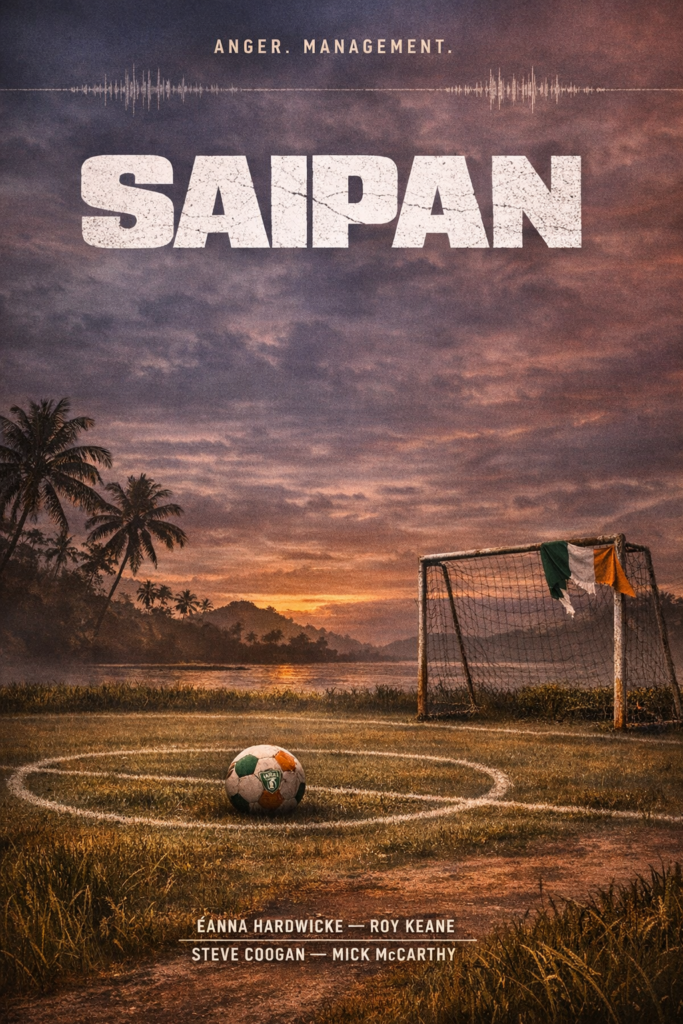
Saipan Movie revisits one of the most controversial moments in Irish football history. Specifically, the film explores the fallout between Roy Keane and Mick McCarthy before the 2002 FIFA World Cup.
Directors Glenn Leyburn and Lisa Barros D’Sa bring this famous dispute to the screen.
Meanwhile, Éanna Hardwicke plays Keane and Steve Coogan portrays McCarthy.
However, the Saipan Movie does not focus on football action. Instead, the story explores personality, pride, leadership, and national identity.
However, the film does not focus on football action. Instead, the story explores personality, pride, leadership, and national identity.
The film opened in Ireland during late 2025.
Shortly afterward, it reached the United Kingdom in early 2026.
Rather than recreating famous matches, Saipan examines the emotional shockwave surrounding the infamous training camp.
That training camp took place on the Pacific island of Saipan.
Consequently, Ireland’s World Cup campaign began to collapse before the tournament even started.
The Story and Its Significance
At its core, Saipan explores a clash between two powerful personalities. First, Roy Keane enters the story as Ireland’s captain. At that time, he ranked among the best midfielders in world football.
However, the film shows his frustration from the very beginning. His experience with Manchester United shapes his expectations and standards.
Because of that background, Keane demands elite professionalism from everyone around him. Meanwhile, Mick McCarthy leads the Irish team as a steady and traditional manager. He focuses on unity and calm leadership.
However, he must also manage limited resources and relentless media pressure.
Eventually, tensions explode during the training camp in Saipan.
The confrontation sends Roy Keane home before the World Cup begins. As a result, the decision divides Ireland almost instantly.
Many fans support Keane’s demands for professionalism..Meanwhile, others defend McCarthy’s authority as manager.
While watching the film, the argument clearly represents something larger. The conflict reflects deeper tensions inside Irish sport. Specifically, it questions ambition, leadership, and expectations.
Ultimately, the story asks an uncomfortable question. Does demanding excellence show leadership or selfishness?
A Film About Fallout, Not Football
One striking aspect of Saipan involves its limited football action. The film avoids long match scenes and heroic sports moments.
Instead, the drama unfolds in quiet and uncomfortable spaces.
Hotel rooms host tense conversations.
Meeting rooms contain heated arguments.
Training grounds reveal growing frustration.
Meanwhile, press conferences add constant media pressure.
This approach works because the real drama never occurred on a football pitch. Instead, the crisis developed behind closed doors.
Consequently, the film focuses heavily on conversation and confrontation. Silence also plays an important role. Awkward pauses and lingering looks build tension throughout the film.
Furthermore, explosive arguments carry emotional weight. Because the film removes the spectacle of football, the story becomes universal. Even viewers without football knowledge can understand the conflict.
Performances That Carry the Film
The performances drive the entire film.
Éanna Hardwicke delivers a powerful portrayal of Roy Keane. Importantly, he avoids turning Keane into a simple villain.
Instead, Hardwicke presents him as intense, obsessive, and deeply frustrated. However, the performance also reveals humour and vulnerability.
Therefore, Keane sometimes appears surprisingly likeable. At other times, his behaviour isolates him from everyone around him. Hardwicke captures the feeling of a man trapped in a flawed system.
Keane sees problems clearly and refuses compromise. His anger often grows from disappointment rather than pure ego.
Several scenes show him pacing or staring silently.
During those moments, chaos unfolds around him. Meanwhile, Steve Coogan delivers a restrained performance as Mick McCarthy.
Coogan avoids caricature and plays McCarthy as grounded and human.
His version of McCarthy appears decent but stubborn. However, pressure slowly overwhelms him. Many scenes show McCarthy struggling to maintain control.
Meanwhile, the situation grows increasingly chaotic. The contrast between both performances drives the film’s tension.
Hardwicke brings volatility and intensity.
Coogan responds with restraint and quiet frustration.
Consequently, every scene between them feels emotionally charged. Their arguments rarely feel scripted. Instead, they resemble two people who simply cannot understand each other
Tone, Style, and Creative Choices
Saipan adopts a stylised tone rather than strict realism. Some scenes exaggerate emotions and reactions slightly. However, this approach strengthens the atmosphere.
The island setting plays an important role in that tone. Saipan appears isolated, strange, and frustrating. Poor facilities and confusing logistics increase the tension.
Therefore, the environment mirrors the chaos surrounding the team. Several scenes even feel surreal. Those moments highlight the absurd nature of the situation.
At the same time, the film uses dark humour carefully. Awkward conversations create unexpected laughs. Similarly, bizarre circumstances expose the ridiculous side of the crisis.
These moments prevent the film from becoming overly heavy. The directors clearly prioritise emotional truth. They shape scenes for dramatic impact rather than historical precision. Therefore, Saipan never pretends to act as a documentary.
Instead, the film openly embraces dramatic storytelling.
Themes Beneath the Surface
Beyond the famous argument, Saipan explores several deeper themes. First, the film examines the conflict between individuals and institutions. Roy Keane represents personal standards and elite professionalism.
Meanwhile, management and football authorities represent compromise and limitation. Leadership forms another central theme. The film repeatedly questions what strong leadership actually means.
Does leadership require harmony and authority? Or does leadership demand uncomfortable honesty? Importantly, the film refuses to provide simple answers.
Neither Keane nor McCarthy appears completely right or wrong. Because of that balance, the conflict feels far more compelling. National identity also shapes the narrative.
Football holds deep cultural significance in Ireland. Therefore, the Saipan incident triggers widespread public debate.
Media coverage increases the pressure dramatically.
Television debates, newspaper headlines, and public arguments follow the story.
Consequently, the conflict grows beyond sport. Instead, it becomes a reflection of Irish pride and self-image.
What Works and What Doesn’t
The film succeeds most when it focuses on Keane and McCarthy. Their conversations generate constant tension. Furthermore, the performances remain gripping throughout the film.
The stylised approach also works well. It reflects the almost mythical reputation of the real incident. However, some supporting characters receive limited development.
Several players and staff members remain background figures. Therefore, the wider team rarely feels fully explored.
Occasionally, the tone also shifts unevenly.
The film moves between drama, humour, and surreal elements. Sometimes those transitions feel abrupt. Consequently, certain scenes lose emotional momentum.
Overall Impression
Overall, Saipan Movie works best as a character study. It also succeeds as a cultural reflection on Irish sport. The film captures the intensity and absurdity of the real event.
More importantly, it explores the long-lasting impact of the conflict. Watching Saipan feels like witnessing a slow collision.
Ego, principle, and national expectation collide in dramatic fashion.
Some viewers may want a precise historical recreation. However, the film never aims for strict accuracy. Instead, it focuses on emotional truth and human conflict.
For that reason, Saipan Movie leaves a lasting impression long after the final scene.