Savage House Review
Introduction
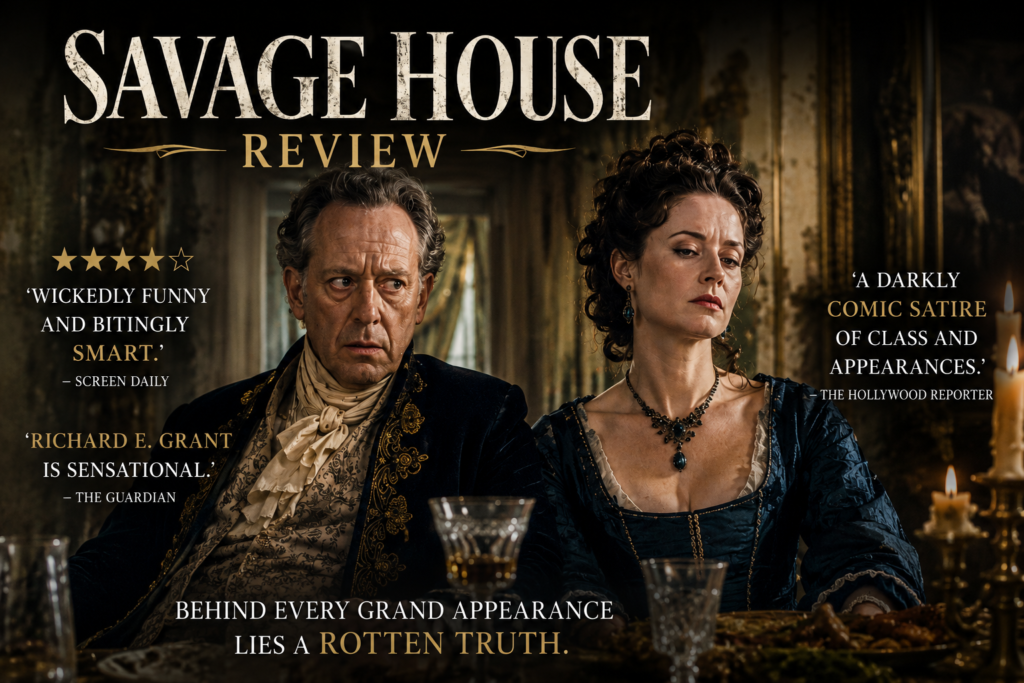
“House Savage” is a 2026 black comedy directed by Peter Glanz. The movie features such actors as Richard E. Grant, Claire Foy, Jack Farthing, Bel Powley, and Kíla Lord Cassidy.
The film combines the genre elements of historical film with the black comedy and discusses how difficult it is to be rich and wealthy. Instead of praising people with high social position and good status, the movie raises some doubts about their moral values.
The story is about Sir Chauncey and Lady Savage who have lost all their wealth and their beautiful house starts falling apart. The situation gets worse and worse because the Duke and Duchess of Devonshire are going to visit their estate.
Taking this opportunity to increase their social status and make themselves look rich, the couple borrow money they do not have and prepare for the grand party.
From the outset, Savage House is not just another period piece. With a mix of gorgeous costumes and beautiful sets, there are also images of deterioration, dirt, and black comedy.
The combination gives the film a unique identity and helps reinforce its social critique. While its unique approach may alienate some viewers, it makes for a very memorable experience.
Storyline and Themes
In essence, one of the most crucial themes in the movie is the risks associated with seeking popularity at all costs. Chauncey wants to use money and noble titles to forget about his humble origins.
Almost all decisions of Sir Chauncey are determined by his concern of being found out. He stops embracing himself in favor of his outward appearance and what other people think about him.
Similar to Sir Chauncey, Lady Savage is concerned with the preservation of her image. Hiding her feelings behind a mask of confidence, she helps to build a marriage of pretense in which the main characters are just acting according to roles predetermined for each of them.
Another theme explored in the movie concerns inherited advantages and their fragility. Noble titles have not saved the Savage family from being deeply in debt and behaving dishonestly.
Their luxurious life style exists thanks only to pretense that everything is all right. Coming of important guests only serves to reveal existing flaws.
Savage House had the same kind of feel as the film The Favourite. While both films use satire and humour to undermine the romanticised picture of aristocratic life, they do so by employing morally dubious characters.
In spite of their similarity, Savage House gains its character due to its depiction of physical decay and humour.
Both these films uncover the underlying instability behind the position of power. Humour is balanced with vulnerability amid the stress of societal expectations.
Peter Glanz’s Directorial Vision
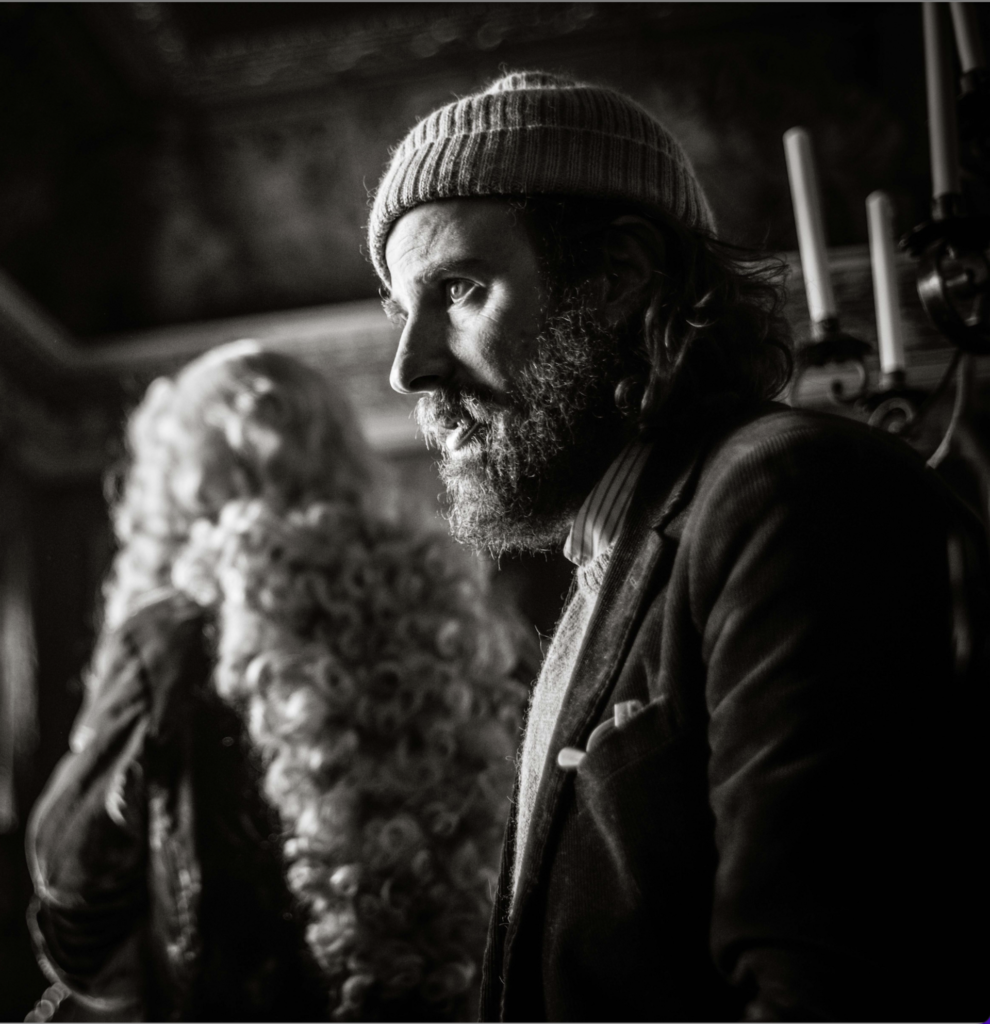
There are a number of original choices made by Peter Glanz which help to distinguish Savage House from the traditional historical drama.
In his movie, he does not portray the period of Georgian times as romantic; instead, Glanz shows its grim side. The dirtiness, mold, rotten food and physical discomfort play an essential role in the plot.
By doing so, the director always reminds us that there is usually something wrong behind the glamour and wealth. Any beautiful room is full of neglect.
Any luxurious outfit is always accompanied by the presence of poverty or personal distress. These images make the film more satirical without using the dialogue as much.
At last, Peter Glanz unites black humor with dramatic images. A number of scenes invite laughter at first and then they turn out to be uncomfortable.
Thus, there is uncertainty about what can happen next. The humor makes the subject matter even more serious.
Also, the hallucinations of Sir Chauncey present an interesting directorial decision. The repeated images of the pigs symbolise the past that he needs to get away from at all costs.
Instead of talking about his fears in detail, the director shows him in visual form and thus helps us to comprehend Chauncey’s insecurities.
The characters in the film are never idealised or made to look likable. On the contrary, their imperfections are embraced by Glanz and make us question their motives.
Even in absurd situations, the characters come off as truly human due to their very human fears and aspirations.
Cinematography
The cinematographic work of Adriano Goldman contributes significantly to defining the image of Savage House. Everything seems to be meticulously thought out, but everything is overshadowed by chaos.
The soft lighting provides the viewers with amazing pictures that remind historical paintings. Lighting candles inside creates a feeling of period and warmth in increasingly unpleasant conditions.
There are many cases of elegant decay in Goldman’s cinematography. At first, viewers see how large the mansion is, and then they see broken furniture, cracked walls, and dirty details. This helps to show the main themes without any further commentary.
The use of close-ups is another significant component of the film. Expressions of faces are extremely important at those moments when characters have embarrassing conversations and find themselves in embarrassing social situations. This allows for transmitting emotions non-verbally.
In many cases, the camera captures occurrences with little action. This kind of style will make it possible for the performance and set to stand out. Once there is more action on the part of the camera, it represents the increasing disorder in the surroundings.
One thing I liked most about the film was its aesthetic appeal. The way that the film looks elegant yet distasteful makes it a very memorable film to watch.
Performances
The acting performances can be considered among the best parts of the movie. Each and every actor is completely involved in the strange atmosphere that Peter Glanz managed to create. Despite the strange actions of the characters, their emotions appear to be genuine.

©Creative Commons Attribution-Share Alike 2.0
Richard E. Grant gives an excellent performance in the role of Sir Chauncey Savage. Chauncey is portrayed as a man who is a victim of his insecurities and desire to win the approval of those around him.
At the very start of the movie, Richard E. Grant manages to convince the audience that Chauncey’s confidence is nothing but a façade. Beneath all the polite manners and lofty speeches hides a man who is scared to death that his secret past is going to be revealed.
With the stress connected with the visit of the Duke and Duchess getting more intense, the actor gradually makes Chauncey crack under the pressure.
His increasing paranoia never seems artificial because each emotional outburst happens in a logical way after the previous one. The recurring hallucinations of pigs could easily appear to be a distraction from the plot.
However, Richard E. Grant plays these scenes in an absolutely convincing way so that they symbolize Chauncey’s shame, guilt, and fears about going back to his old ways of life. The audience laughs at Chauncey’s behavior, but understands why he is scared.

Similarly, Claire Foy gives an equally impressive performance as Lady Savage. The difference is that, unlike Chauncey, she keeps her feelings concealed most of the time.
She uses her facial expressions, dialogue, and body language to convey what she feels inside. For Lady Savage, keeping everything under control and maintaining an impression that everything is fine seems to be the priority for most of the movie.
Nevertheless, her hesitation and moments of frustration and disappointment hint at how well she knows the family situation.
Through Foy’s performance, we can see that strength does not necessarily come from loud speeches and breakdowns.
Her calmness makes her one of the dominant characters in the movie and lets her take control of a situation without even using her voice. When things start to fall apart for the family, her emotions are revealed little by little.
It is the connection between Richard E. Grant and Claire Foy that turns out to be one of the most fascinating elements in the movie. The way they interact gives an impression that their marriage is formed based on convenience, prestige, and common goals, rather than real love.
It looks like they spend much time together in public life, but personal communication indicates the lack of emotions and growing irritation between them. Moreover, different acting styles of these two actors perfectly complement each other.
Jack Farthing adds value to the cast of characters. His energy and confidence add to the fast pace of the film in various key scenes. His acting is perfectly in place and not overly exaggerated for the genre.
He knows exactly when to be funny and when to leave some room for developing quiet scenes. His exchanges with other characters also showcase the selfishness and lies that are common in the family.
Bel Powley brings warmth and sharp humor to the narrative. Her comic delivery is natural and does not make her dialogue look over-the-top.
She also offers a great contrast to the desperate nature of the leading characters. The performance of Bel Powley is a reminder that the actions of the Savage family have repercussions beyond Sir Chauncey and Lady Savage.
Kíla Lord Cassidy does not get much screen time compared to other members of the main cast; however, she makes an enduring impression as well.
She acts maturely and confidently, and her each appearance is memorable. Unlike many minor characters, she reinforces the mood of the household and helps to create an impression of chaos emerging gradually.
Another strong point about the acting is the fact that the whole cast plays as one. The scenes when multiple characters talk to each other involve many different conversations happening simultaneously, and all of the actors remain completely absorbed in what they are doing.
This makes the household look always full of intrigue, gossips, and secrets. Even minor reactions contribute to the scene without distracting from it.
The manner of the movie could have easily tempted the cast to overact. However, all the actors know that satirical performance is not possible without the reality of emotions.
The characters behave in such an exaggerated manner because they all desperately want something – to be accepted, to feel safe, loved, or powerful.
On the whole, these performances raise the level of this movie far above its stunning comedy. Richard E. Grant offers one of the best performances of his career, combining both humor and emotion in his acting, and Claire Foy balances him perfectly with her restrained yet convincing performance.
Jack Farthing, Bel Powley, and Kíla Lord Cassidy round up an outstanding supporting cast which never looks inferior to its superstars. Thus, this ensemble succeeds in turning an odd satire screenplay into a fascinating and emotionally believable narrative.
What Worked and What Did Not
Several elements about Savage House were particularly effective for me. First, the black comedy was witty rather than contrived.
Quite often, the humor came out as natural reactions of people in desperate situations rather than in the form of punchlines. Furthermore, the humor served the social satire by highlighting the craziness of the cult of classes.
It is worth noting that the production design deserves an extra credit as all locations appear real and meticulously designed. The decadent estate becomes an additional character of the movie with its cracked walls and forgotten rooms.
Finally, the cinematography was consistently impressive with Adriano Goldman being the one who creates gorgeous pictures without idealizing the aristocracy.
Nevertheless, there was a problem with the pacing of the first half. In fact, a few scenes were too long and covered almost the same information. These scenes were crucial to creating essential relationships but dragged the pace of the narrative.
It all started to get better when preparations for the king’s arrival began. Everything got more and more tense while the comedy became more biting and funnier. All this action came in the last act which had been missing from the start.
Another controversial aspect of this film can be the use of gross-out humor. Personally, I enjoyed how well it worked to create satire in almost all scenes. But some people might consider those scenes unnecessary or distracting.
Final Thoughts
Savage House works since it does not conform to a typical period piece. It stands out for its dark humor, visuals, and characters. The aristocracy is shown by Peter Glanz in all its reality, without glorifying money or privilege. The director forces us to reflect on how much our reputation means in life.
It may start slowly, but it will be worth waiting until the end for this exciting film. What works the best in the movie are the humorous but very deep scenes. Richard E. Grant and Claire Foy give amazing performances that contribute to making the film unique in its approach.
In particular, I liked the juxtaposition of elegance and decay which is seen throughout the movie. Such a visual theme is present almost in all scenes and enhances the overall social message.
I also liked the balance between absurd humor and character development. The reason why the comparison of this film with The Favourite is valid is obvious since both movies use satire to demonstrate the shortcomings of aristocracy.
Nevertheless, Savage House proves to be unique thanks to its dark visual aesthetics and focus on degradation.
Summing up, I can say that Savage House is a captivating and smart satire which will definitely please all those who appreciate such films.
Sometimes it is a bit inconsistent and suffers from pacing problems (mainly at the first hour). Nonetheless, good acting, great cinematography, excellent production design and interesting social critique make such flaws less noticeable.
This movie gives the audience an opportunity to get acquainted with an original vision of class, ambition and identity issues while being visually appealing all the time.
I can recommend the movie to all the fans of dark comedies and satirical films set in historical period. My personal score for it would be 4 out of 5.