The Alto Knights (2025) A Review
Warning: Spoiler Alert
The Alto Knights: Overview and Premise
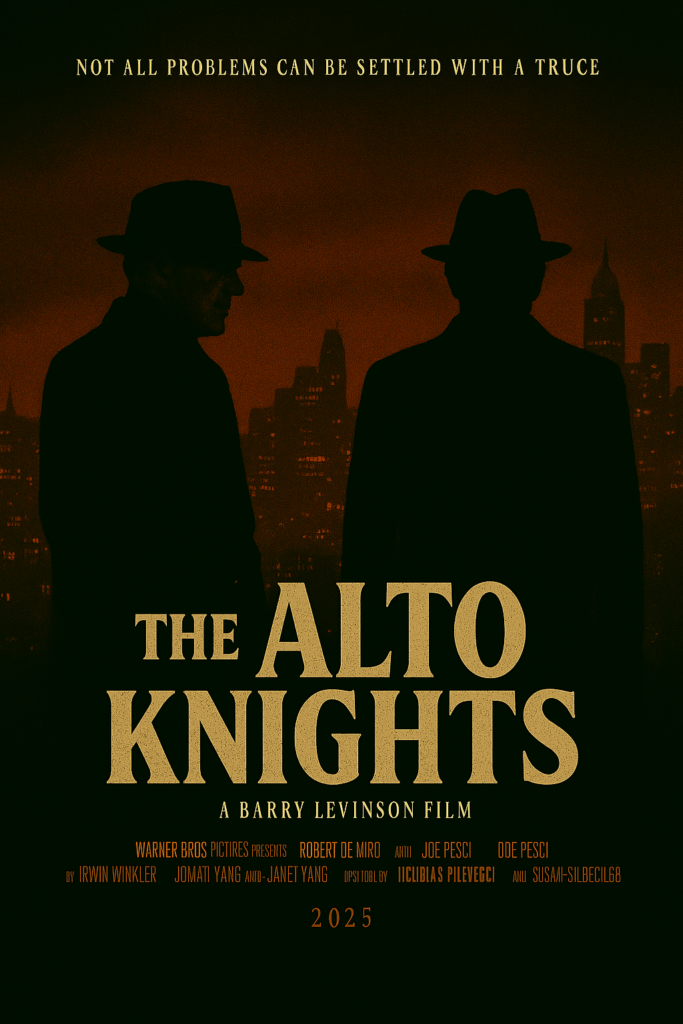
Set primarily in 1950s New York. The Alto Knights explores the internal power struggles of the American Mafia during a period of transition and paranoia. Rather than focusing on street-level crime. The Alto Knights leans into strategy, betrayal, and the slow erosion of trust between men who once considered each other brothers. The director rooted the story in real historical events. Charting how personal ambition and suspicion reshaped organized crime in America.
Robert De Niro in Dual Roles
As someone who has always admired Robert De Niro, seeing him step back into the gangster genre felt like a full-circle moment. Some of his most legendary performances—Goodfellas, The Godfather Part II, and Casino have defined what mob films look and feel like. The Alto Knights clearly wants to tap into that legacy.
De Niro portrays Frank in a restrained and calculated manner. This version of Costello comes across as thoughtful, pragmatic, and quietly authoritative. He’s a man who believes survival comes from diplomacy and patience rather than brute force. On the other end of the spectrum, Vito Genovese is unpredictable, hot-tempered, and driven by paranoia. De Niro leans hard into this instability, making Genovese feel dangerous even when he’s standing still.
At first, I was skeptical about one actor playing both roles. It seemed like a risky choice that could easily turn into a distracting gimmick. But as the film unfolds, the differences between the two men become increasingly clear. Their posture, speech patterns, and emotional rhythms are distinct enough that I eventually stopped thinking about the casting decision altogether. By the midpoint of the film, I am fully invested in them as separate characters rather than two versions of the same performance.
Supporting Cast and Emotional Grounding
Debra Messing plays Bobbie Costello, Frank’s wife, and her performance adds much-needed emotional weight to the story. In my opinion, she brings warmth and sincerity to a film dominated by power struggles and ego. Bobbie represents the personal cost of Frank’s choices, constantly pushing him to consider a life outside organized crime.
Her scenes provide breathing room from the relentless tension of mob politics. They help humanize Frank in a way that makes his eventual fate feel more tragic. Michael Rispoli also delivers a solid supporting performance. Fitting comfortably into the familiar world of Mafia cinema without feeling like a caricature.
Direction, Tone, and Atmosphere
Barry Levinson’s direction leans heavily into a somber, old-school tone. The film is deliberately paced, favoring long conversations and quiet standoffs over action-heavy sequences. While this approach suits the subject matter, it does make the movie feel slow in places. There were moments where I felt scenes lingered longer than necessary, slightly dulling the tension instead of sharpening it.
Visually, the film does a good job capturing the era. The production design, costumes, and muted color palette reinforce the sense of a decaying underworld built on mistrust and fading loyalty. The atmosphere feels authentic, though it never quite reaches the operatic heights of the genre’s greatest entries.
Storytelling and Narrative Challenges
Where The Alto Knights struggles most, is narrative clarity. The film introduces a large number of characters, alliances, and historical details in quick succession. Even with close attention, it can be difficult to keep track of who is aligned with whom at any given moment.
The script assumes a certain level of familiarity with the Costello–Genovese rivalry. However without that background knowledge, some plot developments feel rushed or underexplained. I found myself needing to actively concentrate just to stay oriented, which occasionally pulled me out of the experience. The story is ambitious, but its complexity sometimes works against it.
Final Thoughts
The Alto Knights is a film driven almost entirely by performance, and Robert De Niro is the clear highlight. Watching him embody two radically different figures within the same criminal ecosystem is fascinating and often impressive. Debra Messing’s performance adds emotional depth, and the film’s commitment to historical authenticity is evident throughout.
That said, the uneven pacing and dense storytelling prevent it from reaching the level of the mob classics it wants to stand alongside. It’s a worthwhile watch for fans of De Niro and Mafia films. Ultimately though it feels more like a thoughtful reflection on the genre than a defining entry within it.
While it doesn’t reinvent the gangster movie, The Alto Knights still offers enough strong moments and performances to make the journey worthwhile—even if the road there is occasionally a bit winding.