
The Pout-Pout Fish Review
Introduction
Transforming an adored children’s picture book character into a full-length movie is not an easy task. The character needs to be embedded within a plot while retaining his or her initial charm.
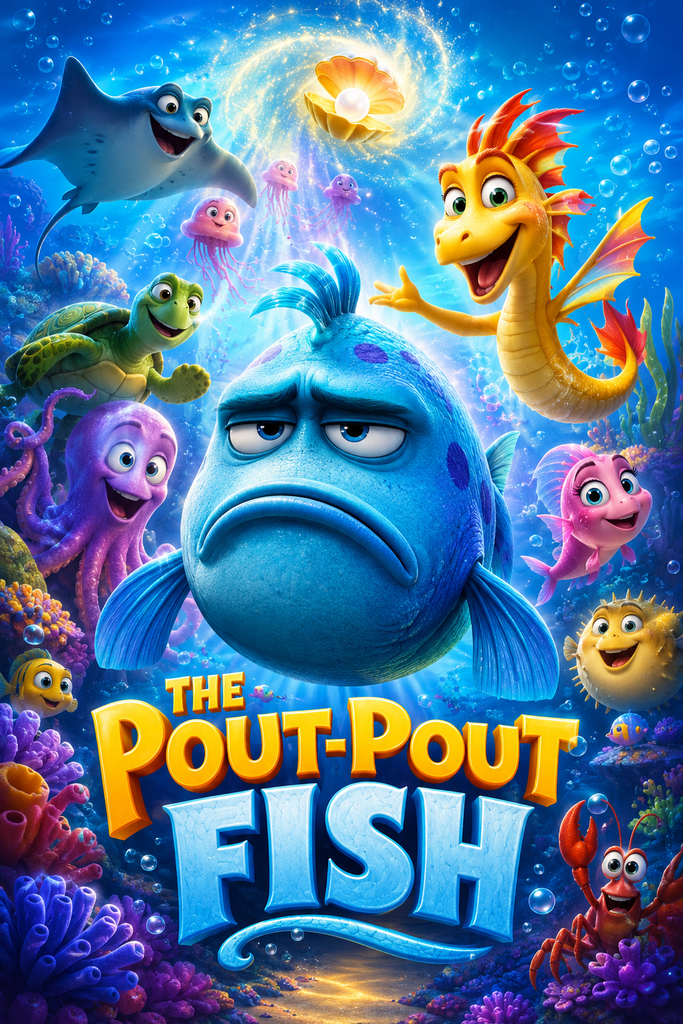
The Pout-Pout Fish takes up this task by creating a marine adventure based on friendship and self-transformation. This 2026 animated comedy features Mr. Fish and Pip in an unusual journey.
Mr. Fish is portrayed as a sullen and introverted fish, preferring solitude. Pip is a super excited sea dragon with much more energy.
An accidental incident forces these two characters to go searching for a fish called Shimmer, said to be able to make wishes come true.
The premise provides a perfect starting point for a children’s adventure film. It also offers a natural connection between two characters that are complete opposites.
Nick Offerman is the voice of Mr. Fish, while Pip is voiced by Nina Oyama. Miranda Otto, Jordin Sparks and Amy Sedaris are other voices used in the film.
The movie is directed by Ricard Cussó, with Rio Harrington as co-director. MIMO Studios and Like a Photon Creative have produced the film.
It is a loose adaptation of the popular book series by Deborah Diesen and Dan Hanna. This series started in 2008 and has become a big children’s publishing franchise
The task is, therefore, not an easy one. The filmmakers need to please their young audience while paying respect to the known characters.
Unfortunately, The Pout-Pout Fish does not always manage that balance. It contains an appealing central friendship and several entertaining performances.
However, its storytelling and animation often feel less ambitious than the material deserves.
Direction and Storytelling
Ricard Cussó and Rio Harrington view the movie as a regular animated adventure tale. It is a classic quest story line, which will be quite easy for young viewers to comprehend.
Mr. Fish and Pip start off with completely opposite personalities. Over time, however, their interaction will cause their personalities to change.
It adds a common emotional pattern to the film. The grumpy character needs to learn how to trust others.
The energetic character also needs to learn about responsibility and patience. Their differences create opportunities for both conflict and comedy.
It makes sense that the film should take such an approach, as kids will be able to comprehend clearly the different characters and their significance in the end.
The problem is that the plot never really develops beyond certain points. The lessons learned by the main characters are pretty much what we have seen before in all kinds of animated films.
The search for Shimmer serves as the main goal of the movie. It gives the characters the chance to explore various underwater areas.
But the adventure often seems more like something to do than something interesting. Events occur one after another but don’t really bring any kind of development.
It becomes more obvious since the original storybooks are less complex. For turning a picture book into a film, one needs extra characters and complications.
Some of them work well. Some others feel like they were added just to fill out the time needed for the movie.
The outcome is a story which is understandable but not surprising. The younger kids will like the simplicity of the plot, while the older audience may find it predictable.
Animation and Visual Style
The animation could be seen as the most crucial part of adapting the property from its picture-book version. Indeed, the Pout-Pout Fish stories have been famous for their unique illustration style and colorful world under the water.
The animated movie aims to transfer the colorful world into three-dimensional animation. The underwater environment gives a lot of room for movement and diversity of the visuals.
There are colorful fish, strange sea animals and wide environments under the ocean. In addition, the aquatic world offers an opportunity for moving which would not be possible in case of live-action production.
It all creates visually appealing moments. The underwater world has got enough variety to entertain children.
Nevertheless, the animation does not always manage to preserve the charm of the source material. The recent criticism of the film has said that the animation lacks inspiration.
It is an especially weak point because the books already offer a very solid artistic foundation. The adaptation should ideally build upon the visual language, rather than just reproduce it in CGI.
While the computer animation in the film is technically proficient enough to convey the action, the characters are always clearly moving around, the environments are comprehensible, and the action scenes make sense.
Technical proficiency is not the same as visual imagination. The animation does not convey the magic present in the best modern animated movies.
There is even a difference in how the characters are designed in the movie. Mr. Fish and Pip each have their own personality based on their looks.
Some other characters may be quite generic, which makes the main characters memorable but deprives the overall underwater universe of its individuality.
Consequently, the film seems entirely satisfactory in terms of its target audience, although it does not always manage to provide the visual depth that theatrical animation should have.
Comedy and Tone
Another dual effect can be seen in the comedic elements of the movie. First of all, the goal of the movie is both entertaining the children and providing some references to the adults.
It is possible to point out some elements of humour, which appear naturally because of the differences between Mr. Fish and Pip. Their contradictory temperaments create an opportunity for some natural comedy.
Mr. Fish is very grumpy and sad, whereas Pip is full of incredible enthusiasm. This situation gives an opportunity for the movie to include some humorous elements easily.
But there is also a moment, where the element of comedy appears less clear. It is possible to say about the group of pink dolphins, whose attitude resembles the attitude of the Mean Girls characters.
That brings into question the target audience of this movie. Clearly made for kids, there are a number of jokes directed at their accompanying parents.
However, family animation can certainly entertain both generations. The most successful films manage to do it through humour that is different for kids and grownups.
In case of the Pout-Pout Fish, sometimes this approach fails. There are quite a few adult-oriented jokes that distract from the kids’ adventure.
The movie also tends to use physical jokes. There is a lot of falling down, clashing together and reacting to various situations.
It is alright for little kids. Though, the repetition makes the jokes predictable.
Hence, it is not totally devoid of humour. It is rather that the best jokes are found in character interactions, not in references and complicated gags.
It is important since the main relationship in the movie has plenty of comic potential. The reluctance of Mr. Fish and the enthusiasm of Pip create a funny situation every time.
The directors could have relied on it more often. Instead, there are jokes in some scenes that are not directly related to the characters.
Voice Performances
Another aspect which comes out strongly in this movie is the voice cast. Nick Offerman makes Mr. Fish an easily identifiable character through his voice work.
The dry delivery of lines that Offerman brings to the role works well for a character that is perpetually irked.
Offerman doesn’t have to go overboard with the delivery of each line since the contrast between his character’s delivery and that of other louder characters makes for some comic relief.
This especially works well when Mr. Fish is placed in uncomfortable positions.
Miranda Otto, Jordin Sparks, and Amy Sedaris also add their voices to the underwater characters. The casting of these actors adds some vocal personality to the supporting characters.
But the supporting characters have not been developed in such a way as to warrant the presence of these actors. Many actors have had to make up for weak material.
In essence, this forms another case of the voice acting being better than the script itself.
The voice acting in the movie works well as long as it relates back to the character. The worst parts happen when the actors are simply making jokes without being attached to their character.
Nick Offerman stands out as an actor for his voice acting skills which allow him to give Mr. Fish a personality that goes beyond just what the character looks like.
He becomes one of the best aspects of the film.
Character Development
The connection between Mr. Fish and Pip becomes the emotional core of the film. The contrasts in their characters become the strongest development factor of the whole story.
Firstly, Mr. Fish starts as a lonely person who is happy to be alone. His destroyed home makes him face the situation he has never experienced before.
Secondly, Pip turns out to be an energetic and impulsive girl who creates troubles rather than solves them.
However, throughout the whole journey, their connections start changing. Mr. Fish becomes more open to people and able to feel good in company.
At the same time, Pip realizes that not everything can be solved with just enthusiasm.
The biggest flaw is that these developments seem too predictable. The audience will know the lessons well before the characters do.
There are also a number of minor characters introduced in the film that don’t get developed enough. These characters are present only to further the plot along.
This can be considered acceptable for a children’s movie lasting just 92 minutes. It reduces the emotional weight of the ending, however.
A better screenplay would provide the characters with more personal challenges to overcome. This would tie into their character development.
What happens instead is that the external quest tends to overshadow the internal one. Finding Shimmer takes priority over the characters’ motivations.
The movie thus presents character development but not in a complicated way.
It is entirely proper for the young audience to have such an easy-to-understand progression. The older viewers would consider it predictable.
Themes
A number of themes are presented in this film which are appropriate for children. Friendship is the theme most easily recognizable and effectively addressed in the film.
The story begins with Mr. Fish all alone in the world. His friendship with Pip illustrates the significance of having connections.
Another theme covered by the film concerns how one should accept people who act differently. Mr. Fish and Pip could not be more different.
These differences create problems at first but eventually become sources of strength in their partnership.
Theme of home is also present in the story since both characters have lost their homes and need to find a way forward.
This creates a reason for their journey besides the fact that they are looking for Shimmer.
Home is a thing they desire. This theme could have given the film a strong emotional basis.
Regrettably, home is only touched upon in the context of adventure and not in the meaning of the term.
Another aspect is that the film has positive messages and is emotionally open-minded. These messages align well with the general nature of the book.
Nevertheless, these messages are stated straightforwardly. There is little subtlety about the things that the viewer should learn.
Once again, this is not a bad thing if we talk about children’s films. However, in some places, the film seems to tell its audience about its themes explicitly.
This results in an emotionally meaningful film that does not develop its themes adequately.
Pacing and Adventure
The film is 92 minutes long, which is not very long. Its rather short runtime suits its young target audience well.
The pace of the film is quite even. The characters have a goal, and the plot always makes them pursue it.
It helps the film remain simple enough. The children will have no problems following the adventure.
Yet, the pace can be somewhat uneven at times. There are some fast-paced parts where the characters do not get developed enough.
These sequences appear as though they were created only to add another layer of difficulty.
The structure of an adventure in the film is also well-known. Characters run into difficulties, resolve them, and keep going on their search.
There is no problem with this approach to making an adventure film for kids. But the absence of any surprises might decrease its attractiveness for adults.
It needed more varied rhythm. The scenes with characters could have been a good counterpoint to big adventure sequences.
They would also help to create a deeper emotional connection between Mr. Fish and Pip.
Instead, the film often hurries to the next event of the plot. It helps to create a movement but not always a momentum.
There is a difference between creating a fast and an interesting film. The Pout-Pout Fish sometimes mixes them up.
What Worked and What Did Not
One of the key strengths of The Pout-Pout Fish is definitely its pairing. Mr. Fish and Pip have opposite personalities, which inevitably brings conflict between them.
Another strength is definitely the voice acting of Nick Offerman, who successfully adds personality to his character, even when the script lacks it.
The energy opposition created by Nina Oyama through her character Pip is also interesting.
The underwater environment can also be regarded as one of the strong points of the film, since it allows having colorful characters and exotic settings.
It also has a positive message about friendship and feeling like you belong to somewhere, which is appropriate for its audience.
One of the weaknesses of the movie is the lack of its uniqueness both visually and narratively.
The writing also relies heavily on familiar children’s adventure conventions. The audience can often predict where the story is heading.
The humor in the film is rather inconsistent; some character-based jokes are successful whereas some adult allusions appear to be unnecessary.
Also, there are only few secondary characters developed in the film.
All this makes the impression of the film relying on a certain pattern that provides it with sufficient individuality but not enough originality to be outstanding.
Thus, the film will probably appeal to young children but not to adults expecting sophisticated family entertainment.
The parents may like the positive message of the film as well as the short running time but at the same time they may be more involved in Offerman’s acting than in the whole story.
It does not mean that the casting of the film is bad; on the contrary, it means that the material given for actors is not sufficient.
Final Verdict
Pout-Pout Fish is an enjoyable family film that boasts of a very good friendship theme. The two key assets of the film include its voice acting and the appropriate themes of the movie.
Nick Offerman makes Mr. Fish very charismatic through voice acting. Another notable performance comes from Nina Oyama who makes Pip energetic enough to complement his conservative style of narration.
The friendship, acceptance and belonging themes of the film are suitable for children. An undersea world allows the filmmakers to explore colorful adventures.
Nevertheless, the filmmakers cannot use these ingredients to create something special. Animation fails to match imagination of the original.
Moreover, the film makes use of clichéd plot structures and clichéd emotions. While the comedy of the film is entertaining for the adults, it might not be very satisfying for the adults.
In case of the young viewers, the flaws might not be as disturbing. There is a great clarity of characters, adventure and the message delivered.
However, in case of older audience, they will find nothing new in the film. This is because there is no visual sophistication and depth of characterization in it.
Overall, The Pout-Pout Fish is an ordinary adaptation of the story rather than an exciting animated film. It manages to understand the basic elements of the story but fails to capture its full potential.
The friendship is one of the key strengths of the movie. However, the adventure around it does not live up to that promise emotionally.
Therefore, it is better to look at the film as a typical children’s movie rather than animated film.
There is a lot for the younger audience to enjoy in the film. However, it needed better writing and animation in order to make its adventure memorable.
The Pout-Pout Fish succeeds at being pleasant, accessible and family-friendly. It struggles to become distinctive, surprising or particularly memorable.