
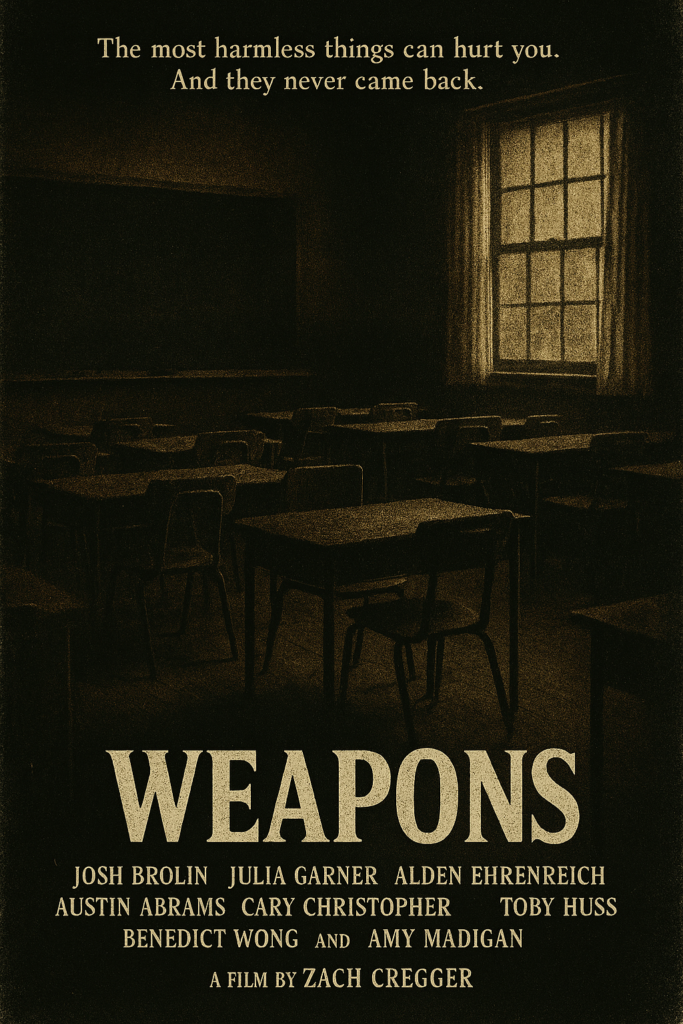
Weapons Review – A Grief-Soaked Mystery Horror That Lingers Long After the Credits (Warning Spoilers)
Weapons (2025), directed by Zach Cregger, combines mystery, grief, and psychological thriller elements. However, instead of trying to scare viewers with shock scenes, it creates horror through emotional disintegration.
The movie’s plot revolves around the disappearance of seventeen children at precisely 2:17 in the morning. This one moment shatters the entire town of Maybrook immediately. However, it does not provide any answers for those seeking them. On the contrary, it is a complex exploration of trauma and guilt.
First Impressions – Horror Through Absence
From the opening scene, Weapons signals something different. The disappearances happen quietly, without spectacle. In particular, the cinematography steers clear of sensationalized visuals.
This helps it achieve a frightening kind of realism. What scares us is not visible but what we can’t see. In consequence, suspense pervades every shot. It is not shocking but unsettling.
A Non-Linear Mystery Structure
Structurally, the film functions as a six-chapter character study. Every chapter unveils the events from a unique point of view. Hence, Weapons becomes a puzzle created emotionally, rather than chronologically.
Such an unconventional plot structure reflects community anxiety. Individuals perceive disasters through prejudice and fear. Thus, Weapons becomes an imperfect reflection of town experiences.
The changing tone makes the story unpredictable.
There are some chapters that are psychological thrillers. Some other chapters are dark comedies or horror. As a result of this structure, Weapons requires an active viewer.
Justine Gandy – Guilt Under Public Scrutiny
Julia Garner stars as teacher Justine Gandy, and the actress exudes an aura of anxiety and repressed sorrow. Guilt presses on her from all angles. Garner has an acute ability to convey moments of emotional collapse. Thus, it is not surprising that Justine’s section of the film seems emotionally claustrophobic.
Archer Graff – Grief Turned Violent
Josh Brolin‘s performance as Archer Graff is an intense one. The character uses the power of grief to fuel his revenge. Thus, the film Weapons deals with the theme of love being twisted into destruction. Josh Brolin does a great job of balancing the rage and vulnerability.
Paul Morgan – Authority in Conflict
Ambiguity permeates Alden Ehrenreich‘s performance as Officer Paul Morgan. Conflict between duty and personal allegiance is a recurring theme. Thus, the chapter is brimming with underlying tension. Highly framed scenes emphasize the character’s inner turmoil. Hence, Weapons explores the impact of emotion on authority.
James – Chaos in the Margins
Austin Abrams brings unpredictability to the table. He makes some vital discoveries through sheer luck. But on the other hand, his addiction drives his erratic behavior. Humor creeps in his part in the story but then again, tragedy is lurking in every single moment for him. Therefore, Weapons escapes being one-dimensional.
Marcus Miller – Institutional Pressure
Weapons is anchored in its humanness by Benedict Wong. He plays Marcus Miller, who tries to protect the remaining child. He shows calmness while the entire town has gone into panic mode. HuThe film uses him to comment on institutional failings. It cannot prevent a panic no matter how well-intentioned.
Alex Lilly – The Film’s Most Devastating Chapter
Cary Christopher is heartbreakingly vulnerable as Alex Lilly. His scene is the most psychologically disturbing. Trapped under Aunt Gladys, he is the essence of silent pain. This is when it turns into domestic horror. It is slow and relentless build-up. Thus, it becomes the emotional climax of the movie.
Zach Cregger’s Personal Vision
Weapons was a very personal project created by Zach Cregger. The time stamp 2:17 a.m. indicates the author’s connection to real tragedy. Consequently, all the storylines are filled with pain.
Unlike traditional horror movies, it is concerned with the truth of emotions. Zach Cregger makes sure not to include any clichéd horror elements.
Rather, he creates a horror masterpiece based on human tragedies.
Visual Style and Sound Design
Visually, the film has a dark and washed look. Dull colors add to the feeling of fatigue. Wide shots highlight feelings of isolation despite being surrounded by people.
Larkin Seiple who is the cinematographer for the movie, adds to this feeling. As for the sound design, it is just as important as visual effects.
Themes – Grief, Addiction, and Moral Panic
Thematic wise, the movie is an analysis of community breakdown. Each individual deals with loss in his/her unique way.
Justine feels guilty.
Anger possesses Archer.
Alex feels lonely.
Moreover, Aunt Gladys shows the choking effects of addiction. She shows control and generational trauma in the story.
More importantly, it shows the culture of scapegoating. Consequently, the title of the movie is very significant.
Amy Madigan as Aunt Gladys
The standout performance is that of Amy Madigan. She manages to marry menace with tragedy, while her commitment to physicality makes every scene memorable. Aunt Gladys is a truly scary person but she is far from being a caricatured villain. It is all thanks to Madigan’s subtlety.
What Works Exceptionally Well
The atmosphere is consistent throughout the movie. The multi-faceted approach to filmmaking requires a lot of attention from the viewer. All performances seem realistic and believable. The themes transcend the boundaries of the genre.
Also, the movie does not follow standard horror tropes. That is what makes the movie stand out.
Final Verdict
In all, Weapons is one of the most ambitious films in the horror genre from 2025. It tests audiences in more ways than one. Despite its flaws, Weapons is fearless.
The performances make up for great writing. Cregger has put his heart into the film.
In all, Weapons demonstrates that horror can be intelligent about grief.
It is unsettling without resorting to gimmicks.
It is disturbing without exploiting the audience.
Above all else, Weapons lingers long after the end credits have rolled.


Pingback: If You Like Weapons Then You Will Love These 7 Movies!