Warfare (2025) – Review
A War Film That Feels Remembered Rather Than Written
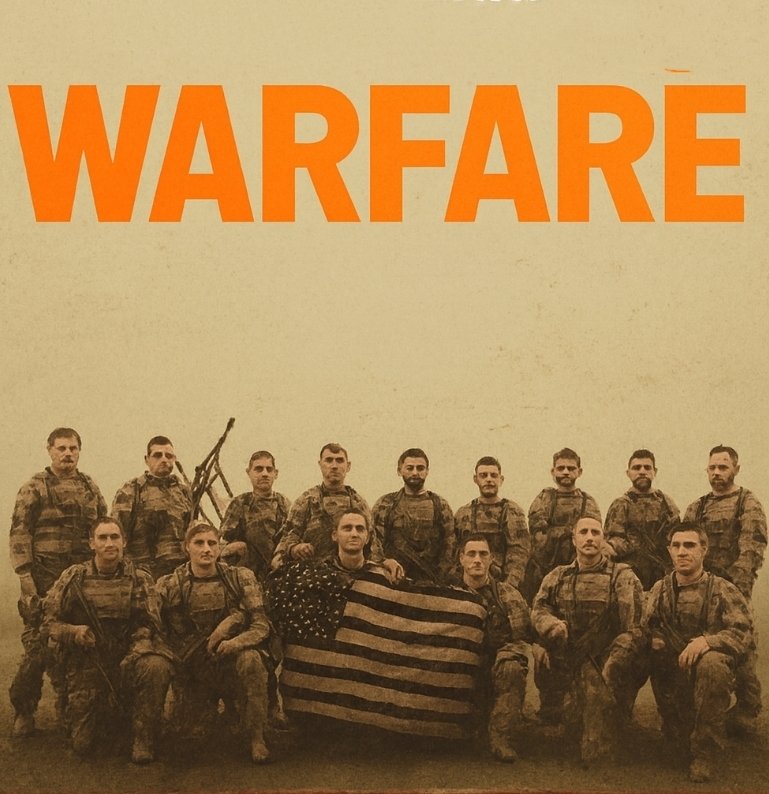
From the moment Warfare begins, it’s clear this isn’t a war movie trying to entertain in a conventional sense. It feels closer to someone reconstructing a memory than telling a story. Directed by Ray Mendoza and Alex Garland (Civil War), the film is based directly on Mendoza’s experiences as a U.S. Navy SEAL during the Iraq War. Specifically an operation that took place on November 19, 2006, in the aftermath of the Battle of Ramadi.
What stood out to me immediately is how little the film seems interested in explaining itself. There’s no framing device, no voiceover, no attempt to contextualize the conflict in political or historical terms. Instead, Warfare drops you straight into the situation and asks you to keep up. In my opinion, that choice defines the entire film. It doesn’t want to guide you. Infact it wants you to feel what it was like to be there, without the benefit of hindsight.
The script draws directly on testimonies from the platoon members who experienced the incident. The events unfold in real time. That structure strips away almost everything we expect from the genre. There’s no dramatic shaping of events, no clear “act breaks,” no narrative relief. Time passes the way it does in real life — slowly, painfully, and without regard for pacing.
The Weight of Knowing This Actually Happened
Watching Warfare, I constantly found myself thinking about the fact that this isn’t a hypothetical scenario. The writer doesn’t place fictional characters in danger for the sake of drama. These moments happened to real people. The film treats that reality with a kind of restrained seriousness that never tips into sentimentality.
The dedication to Elliott Miller, who lost his leg and his ability to speak during the real incident, hangs over the film like a quiet ghost. The movie never pauses to underline this or manipulate the audience emotionally. However knowing it adds a layer of gravity that’s impossible to shake. In my opinion, this restraint is one of the film’s most admirable qualities. It trusts the reality of what happened to speak for itself.
An Ensemble That Prioritizes Authenticity Over Stardom
The cast has many recognizable names. D’Pharaoh Woon-A-Tai as Ray Mendoza, alongside Will Poulter, Cosmo Jarvis, Kit Connor, Finn Bennett, Joseph Quinn, and Charles Melton. Despite this, Warfare never feels like a showcase for any one actor. The actors deliver their performances in a deliberately subdued, almost anti-dramatic way.
What I appreciated most is how little the film tries to make these men “likable” or “memorable” in traditional ways. The film doesn’t introduce them with defining traits or personal anecdotes. Instead, it shows who they are through how they communicate under pressure, how they follow procedure, and how they react when plans collapse. In my opinion, that makes them feel more real than if the film had stopped to flesh out their backstories.
At times, it can be difficult to tell the characters apart, and I think that’s a deliberate choice. In the chaos of combat, individuality blurs. Names matter less than roles. Faces become familiar not because of personality, but because of proximity and shared danger.
The Mission and the Slow Collapse of Control
The plot of Warfare is straightforward on paper. A surveillance mission in Ramadi goes wrong. An explosion triggers an ambush, trapping a platoon of Navy SEALs inside a house surrounded by insurgents. But the film focuses less on plot progression and more on process
What unfolds feels less like a sequence of events and more like a sustained emergency. The soldiers make decisions quickly and sometimes incorrectly. Communication breaks down. Time stretches. Waiting becomes its own form of torture. In my opinion, the real-time format makes this unbearable in the most effective way possible.
There’s no sense of escalation toward a traditional climax. Instead, the tension plateaus and stays there. The danger doesn’t spike and fall — it just persists. Watching it, I felt a constant low-level dread, the kind that doesn’t allow emotional release
Cinematography That Traps You Inside the Space
Visually, Warfare is claustrophobic by design. The camera stays close to the soldiers, often at eye level or lower, making the environment feel tight and suffocating. Even outdoor moments feel boxed in, as if escape is always just out of reach.
There are brief flashes of visual beauty. light cutting through dust, quiet moments where nothing happens. Such moments never feel intentional or comforting. They feel accidental, like something you notice only because everything else is so overwhelming. In my opinion, this shows that no one seeks out beauty in war; people stumble upon it and lose it quickly
Sound as a Weapon Against the Viewer
The sound design might be the most impactful element of the film. Gunfire, explosions, radio chatter, shouting — it all overlaps and collides in ways that feel aggressively realistic. Dialogue is often hard to hear, and I found myself straining to catch fragments of conversation.
Silence, when it appears, is just as unnerving. It never feels safe. It feels like something terrible could happen at any second. This manipulation of sound does more to place you in the soldiers’ mindset than any visual trick ever could.
The Emotional Distance — Intentional but Challenging
One of the most debated aspects of Warfare will likely be its emotional distance. The film doesn’t slow down to let you bond with the characters, and there’s very little overt emotional expression. Fear, pain, and shock appear, but the soldiers often internalize them or push them aside in favor of procedure.
Personally, I found this both powerful and limiting. On one hand, it feels brutally honest. These men don’t have time to process their emotions in the moment, so why should the film pause for us? There were times when I wished the film gave me a little more space to connect on a human level. Especially as the consequences of the mission became clearer.
A Film That Refuses to Be Comforting
What ultimately defines Warfare, in my opinion, is its refusal to offer comfort. There’s no triumphant resolution and no attempt to justify or explain the events through a larger message. The film ends not with a statement, but with an absence. There’s a feeling that something terrible has happened and life will continue anyway. This isn’t a movie about heroism in the traditional sense. The film explores survival, confusion, and the cost of being placed in an impossible situation. It doesn’t ask you to admire what you’re seeing. It asks you to witness it.
Final Thoughts: Difficult, Demanding, and Deeply Unsettling
I respected Warfare as much as I struggled with it. It’s technically impressive, emotionally exhausting, and intentionally uncompromising. In my opinion, it succeeds most as an experience rather than a narrative — something you endure rather than enjoy.
It won’t appeal to viewers looking for clear storytelling, emotional payoff, or conventional war-movie thrills. Warfare offers something rare: a film that feels honest, even when that honesty is uncomfortable.
Long after it ended, I found myself thinking less about specific scenes and more about the feeling it left behind. A sense of tension, confusion, and quiet grief. That lingering effect, more than anything else, is what makes Warfare stick with you.