The Wizard of the Kremlin Review
Introduction
Politically oriented movies sometimes face the challenge of being both entertaining and historically intricate. The Wizard of the Kremlin tries to meet this double challenge. Directed by Olivier Assayas, the movie is based on the political novel by Giuliano da Empoli. In the movie, there is an investigation of failing systems, rising ambitions, and shifting identities.
The plot is seen from the fall of the Soviet Union through the early stages of the birth of Russia. Real historical figures interact with fictional people in this movie. Through this technique, there is both detachment and emotional involvement in the story.
Instead of simply reproducing history, the movie explores the way power works. It deals with topics such as influence, propaganda, and political performance. This theme permeates every aspect of the plot. Through hard questions for its viewers, the movie does not provide any ready answers.
Directorial Style and Decisions
The films of Olivier Assayas are restrained rather than extravagant. The style of the director focuses on creating an ambience rather than on dramatic and political events. Talks usually have more significance than physical actions.
Assayas avoids creating a traditional political thriller. Instead, he builds tension through uncertainty and observation. Characters often appear trapped within systems larger than themselves. This creates a persistent feeling of instability.
One important decision involves narrative perspective. The film follows fictional strategist Vadim Baranov instead of Vladimir Putin directly. This choice creates emotional distance from historical events. It also allows audiences greater interpretive freedom.
The fictional perspective works surprisingly well. Political history becomes easier to process through personal experiences. Historical events remain important without dominating every scene. Audiences experience change through individuals rather than institutions.
Assayas also avoids sensationalism. Major political events rarely receive grand cinematic treatment. Instead, private meetings and quiet interactions dominate screen time. This decision reinforces the film’s central themes.
His pacing may divide audiences. Some viewers may appreciate the slower rhythm. Others may struggle with its deliberate structure. The film values reflection over constant momentum.
Overall, Assayas creates a film focused on psychology and atmosphere. His choices shape a world built on uncertainty. The direction favours complexity over accessibility. That ambition defines the film’s identity
Cinematography and Visual Identity
Yorick Le Saux‘s cinematography defines the emotional climate from the beginning. Through his visuals, instability, separation, and bureaucratic force are evident. Everything is staged with meticulous precision. There is no waste of imagery in the film.
The color scheme is consistently subdued. Cold colors abound indoors and even in the urban landscapes. All these elements create a sense of political and societal apprehension.
Russia is less geographic and more mood-oriented. Cityscapes seem sterile and transient. Offices seem confined and emotionally distant. Public areas seem oddly deserted.
Such an aesthetic approach leads to questioning the accuracy. Is the representation of Russia authentic? It depends on individual expectations. Le Saux succeeds in depicting emotions rather than geographical features.
The director steers clear from conventional visual cliches. Large monuments rarely feature prominently. In their place, mundane environments acquire a new meaning. Corridors and offices generate great tension.
Physical detachment seems prominent in his work. Individuals find themselves isolated by architecture and space. Such an aesthetic reflects the thematic content. Power constantly generates isolation.
The cinematographic style conveys transition effectively. Everything looks incomplete and uncertain. That was due to the ongoing political transformation within Russia at that time. Visual narratives play a central role.
Some people could see the use of such aesthetics as excessive. On the other hand, some people would appreciate its symbolic nature. Nevertheless, the aesthetic proves powerful.
Themes and Adaptation
Adapting such a story was not an easy task. It touches on various issues including politics, philosophy, and psychological observation. In adapting such concepts to film, one had to make some decisions. This involved making complicated matters simple.
In the adaptation, most themes have been kept intact. Issues such as power and image remain dominant in the story. Propaganda is also very important. The perception of characters is political. Often public appearance is more important than reality. This is why most of the narrative conflicts arise.
The fictional point of view is very helpful. In fact, Vadim Baranov becomes a medium for the audience to understand political systems.
Historical background still plays a role even at this point in the movie. The fall of the Soviets influences all decisions that people take. Politics play an essential part in individual relations. History becomes emotional.
The movie makes an excellent choice in limiting the use of exposition. There is very little information provided to viewers about history. All the necessary information is shown through experience of characters.
This film, however, is successful despite this difficulty. Its approach to politics is well-calibrated. Historical happenings serve the story rather than dictate it. Ambitious themes are still intelligible.
But above all else, politics comes alive in this film. Institutions are important for the simple reason that people are working within them. Ambition makes history happen.
Acting Performances
Performance plays an important role in the film. Scenes with a lot of talking require great acting from all cast members. Thankfully, the cast generally excels. The ability to remain emotionally restrained emerges as a significant virtue.
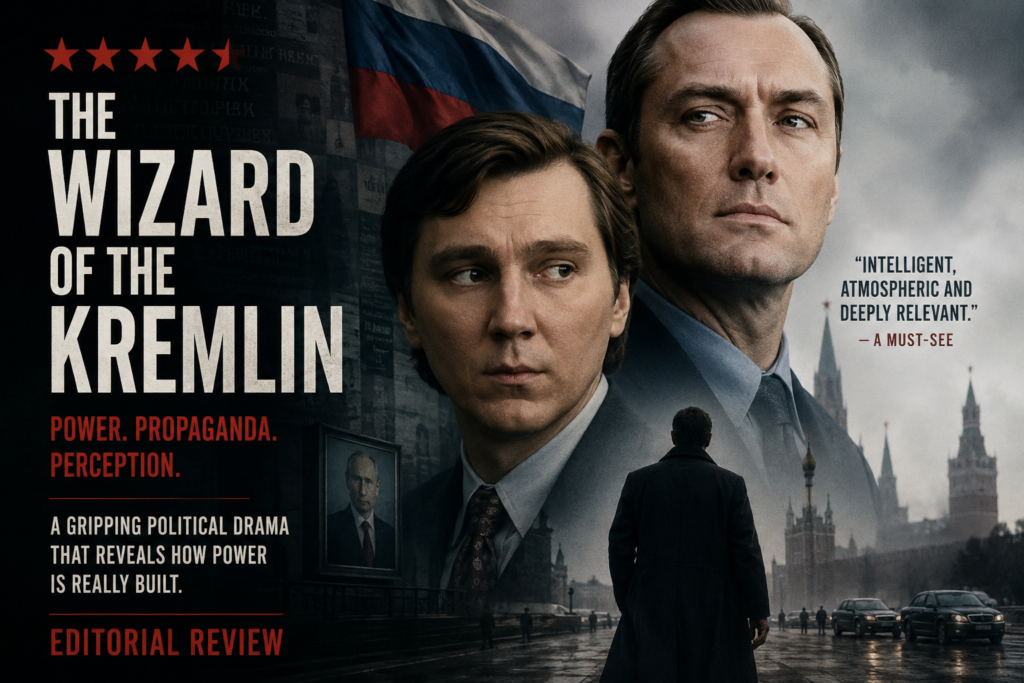
One of the best performances in the film comes from Paul Dano. He performs Vadim Baranov intelligently and with control. He never overacts at any point. Contradictions are well brought out by Dano in this film. Baranov is near the seat of power but does not have total control. His acting style is perfect for the script of this political movie. Dano brings out contradictions well with his acting. He observes the action while taking part at the same time.
Jude Law has to deal with more obstacles. There is no way around the fact that there will be comparisons made to the real thing from the get-go when playing Vladimir Putin. Playing this part requires both a certain amount of restraint and authority at the same time. Law handles this with care.
From a physical point of view, Law executes this flawlessly. It comes off well whenever he needs to convey stillness. The mannerisms he uses in the film appear well-controlled. The presence of the actor trumps any need for mimicry in this instance.
There is one problem with accent work in some instances. Jude Law’s British accent pops up on occasion. Such moments detract from the viewer’s suspension of disbelief.
Supporting performances also contribute effectively. Nobody feels significantly out of place. The ensemble supports the film’s quieter moments. Collective chemistry strengthens difficult scenes.
What Worked and What Did Not
The atmosphere of the movie is particularly effective. Assayas and Le Saux have done an amazing job of creating tension on a political level. Everything about the cinematography is linked to the themes.
Acting in the movie is also commendable. Paul Dano brings stability and emotion to all of his scenes. Jude Law gives a sense of strength.
As for themes, the movie is really great. Politics does not seem alienated from people’s lives. Events have an emotional context. The thoughts come up organically.
Credit must be given to the adaptation as well. No matter how complex the source material is, the movie remains comprehensible. Audience members can think without being confused constantly. The achievement of balance will become another strength of the film.
On the other hand, there are problems with the pace. Some sequences seem too slow and take away the energy of the picture. Sometimes reflection replaces action.
Access to the movie also becomes problematic. Some audience members may find it difficult to follow the philosophical aspects. At times, historical background is taken for granted. Audience members have to focus throughout the movie.
Certain stylistic decisions may seem controversial. At times, Russia is represented symbolically rather than realistically. Such an approach may irritate some viewers. On the other hand, others may find such an approach justified.
Sometimes Jude Law’s accent becomes distracting. Such moments happen infrequently but they cannot be missed. In historical movies, such scenes are to be expected naturally.
Nevertheless, the drawbacks do not overcome the advantages of the picture. It remains captivating anyway. Ambition compensates for certain mistakes made. Few political films strive for such grandiosity.
Final Verdict
In terms of ambition and atmosphere, The Wizard of the Kremlin wins the prize. Indeed, the film eschews conventional approaches of telling politics and power stories on screen purposefully. The psychological analysis of power becomes its foundation for creativity.
The film resists any simplifications on many levels. Political events from its plot cannot be understood clearly. Characters do not always have their roles defined. And morals cannot be easily established.
Dano’s acting can be described as excellent indeed. It never fails to deliver emotions. As for Jude Law, his powerful physicality enhances the movie.
With its unique vision of politics, Assayas directs an unusual movie. Le Saux’s visual approach makes political instability visible. This makes the film what it is.
This feature film may disappoint many viewers. People looking for fast political thrillers will probably be disappointed. They will need a lot of patience to watch the film.
Nevertheless, the ones who wish to watch movies about politics attentively will be satisfied. They will definitely appreciate how topical it is. Many questions raised by the movie stay relevant indeed.
Overall, The Wizard of the Kremlin should be seen as a film for political contemplation. The film explores the influence of power instead of historical facts.