
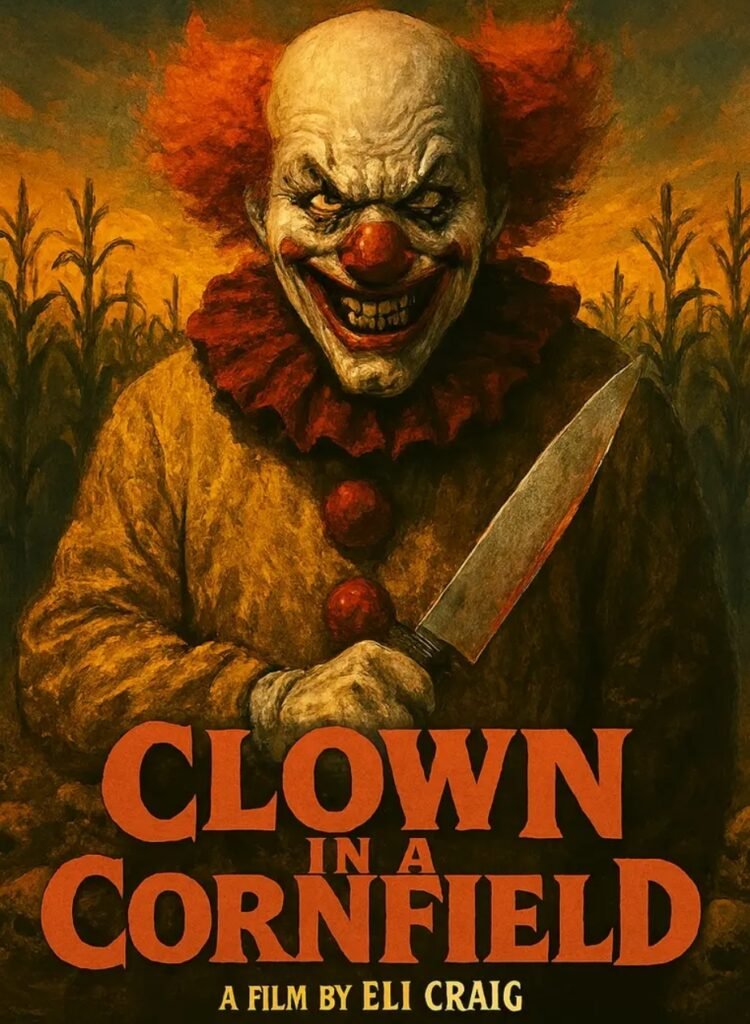
Clown In A Cornfield: First Impressions and Basic Info (Warning This Review Contains Spoilers)
Clown in a Cornfield is a 2025 American slasher film. It is directed by Eli Craig, best known for Tucker & Dale vs. Evil. The screenplay, written by Craig alongside Carter Blanchard, adapts Adam Cesare’s 2020 novel of the same name. The cast includes Katie Douglas as Quinn, with supporting performances from Aaron Abrams, Carson MacCormac, Kevin Durand, and Will Sasso.
Clown In A Cornfield, premiered at South by Southwest on March 10, 2025. Before getting a wide theatrical release on May 9. Going in, I was curious to see how a beloved modern horror novel would translate to the screen. Especially one that already had a strong reputation among slasher fans. After watching it, I walked away feeling pretty mixed. There was flashes of something great buried under a lot of missed opportunities.
The Setup: A Familiar but Effective Premise
Clown In A Cornfield follows Quinn, a teenage girl dealing with the recent death of her mother. She moves with her father to the dying town of Kettle Springs, Missouri, hoping for a fresh start. Instead, she finds herself trapped in a place stuck in the past—both economically and culturally.
It doesn’t take long before Quinn, along with her new group of friends, becomes the target of a masked killer. The former mascot of the town’s now-abandoned corn syrup factory. From there, the movie leans into classic slasher territory. Isolated teens, a creepy small town, and a killer who represents something far bigger than just body count.
Why This Adaptation Was Made
This movie didn’t come out of nowhere. Adam Cesare’s novel Clown In A Cornfield, was a huge success in the horror world. And even won the Bram Stoker Award for Best Young Adult Novel. That built-in fanbase alone made an adaptation inevitable.
Eli Craig has openly declared his mission to make a fresh, thrilling slasher movie designed specifically for Gen Z audiences. He aimed to create something “smart but dumb,” blending laugh-out-loud fun with sharp commentary on generational tension and society’s changes. The film also explores fear of cultural displacement, identity struggles, and anxieties young people face navigating a rapidly shifting world.
Watching Clown In A Cornfield, that intent is obvious. The clash between young people pushing forward and older adults clinging desperately to the past forms the central backbone of the story. The timing also feels intentional, especially after recent box-office success for gory clown horror. On paper, it all makes sense.
Direction and Tone: A Shift for Eli Craig
Unlike Tucker & Dale vs. Evil, which leaned heavily into absurdist comedy, Craig plays things much straighter here. The humor is still present, but it’s more self-aware and satirical than outright slapstick. One thing I appreciated was the commitment to practical effects.
The kills, when they happen, mostly rely on in-camera tricks rather than heavy CGI, giving the movie a gritty, old-school slasher feel. Craig also uses the cornfields effectively, clearly drawing inspiration from Jaws—Frendo is often unseen, lurking just out of sight, which builds tension when the movie actually lets it.
Structurally, this is Craig’s most traditional film. It follows a clear three-act progression and saves its biggest confrontations for the finale. Unfortunately, while that restraint works early on, it also makes the middle stretch feel sluggish at times.
Frendo and the Film’s Visual Identity
Frendo the Clown is intentionally grounded. He’s not supernatural, not mystical—just unsettling in a very American, industrial way. The design feels cheap, plasticky, and mass-produced, which fits the story’s themes of decaying industry and hollow nostalgia.
Visually, Clown In A Cornfield blends classic slasher aesthetics like stylish tracking shots and moody lighting with modern true-crime, teen-focused elements. The result is a movie that looks solid and occasionally inspired, even when the script lets it down.
There’s also a lot of self-aware humor sprinkled throughout, particularly jokes about generational gaps. Some of these landed for me, but others felt forced. Especially when the movie paused the tension just to make a point.
Book vs. Movie: What Changed and Why It Matters
The Clown In A Cornfield follows the novel’s broad strokes. However while making several major changes that noticeably alter the story’s overall impact. Cole’s backstory is rewritten to make him more sympathetic, shifting blame away from youthful recklessness and onto older authority figures.
One change is the idea that the town’s violence against youth is a recurring tradition rather than a one-time eruption. While that concept is interesting, the movie doesn’t explore it deeply enough to justify the added lore. The body count is also much lower than in the book. What felt like a full-scale massacre on the page becomes something far smaller onscreen. Which made the stakes feel oddly muted for a slasher.
Themes and Social Commentary
Both the book and the movie revolve around generational conflict. Frendo represents outdated Americana weaponized against young people who refuse to inherit a broken system. Kettle Springs itself is a symbol of economic collapse and cultural stagnation.
Where the book leans dark and uncomfortable, the movie often undercuts its own message with humor. In my opinion, this makes the themes easier to digest but also far less impactful. The commentary frequently feels spelled out rather than earned, especially in the final act.
One notable difference is the inclusion of a supportive older character who actively learns from the younger generation. While I appreciated the attempt at hope, it also softened the story’s bite and made the ending feel safer than it should have.
Performances: The Movie’s Strongest Asset
Katie Douglas absolutely carries the film. She brings real emotion to Quinn and gives the movie a grounded center it desperately needs. Her arc from grieving outsider to capable final girl feels earned, and she easily stands out as the best performance.
Kevin Durand is memorable as the authoritarian mayor, delivering a big, intense performance. That borders on cartoonish but still works most of the time.
Aaron Abrams brings warmth and sincerity as Quinn’s father. However the script gives him too much to do by the end.
Will Sasso’s performance is divisive. I personally found his energy entertaining in small doses. Yet the character often feels like he belongs in a different movie. Among the teens, Vincent Miller stands out, though the script doesn’t give him nearly enough to work with.
Where the Movie Falls Apart
The biggest issue for me was how heavy-handed everything felt. The generational conflict is so blunt that it stops feeling like commentary and starts feeling like a lecture.
The mystery is also painfully predictable. I had the killer figured out early on, and the movie never does anything clever enough to subvert expectations. The finale is especially disappointing, grinding the momentum to a halt with long exposition dumps that completely deflate the tension.
Despite the R rating, the violence feels restrained. For a movie about a murderous clown, Frendo never becomes truly iconic or terrifying. Compared to recent slasher villains, he feels oddly tame.
Adaptation and Supporting Cast Issues
As someone familiar with the book, I found the adaptation frustrating. Important characters are sidelined, combined, or stripped of their most meaningful moments. Rust, in particular, is done dirty—his heroic actions are reassigned, robbing him of his impact.
The supporting teens blur together, lacking distinct personalities or meaningful development. Dialogue often sounds stiff and unnatural, making some performances feel amateurish despite capable actors.
Final Thoughts
At the end of the day, Clown in a Cornfield is fine—but frustrating. There’s a good movie buried in here somewhere. The premise is strong, the lead performance is excellent, and the themes are timely. If you’re looking for a straightforward slasher to throw on during spooky season, it’s worth a watch. Katie Douglas alone makes it worthwhile. If you’re hoping a faithful adaptation of the novel’s darker edge, this will likely leave you disappointed.
It’s a movie with ambition that plays it too safe. Entertaining in the moment, but unlikely to linger once the credits roll.

Pingback: 5 Movies That Have A Human Killer In A Mask - Film Misfits