
Exit 8 Horror Film Review: A Masterful Unsettling Watch
Introduction (Warning Contains Spoilers)
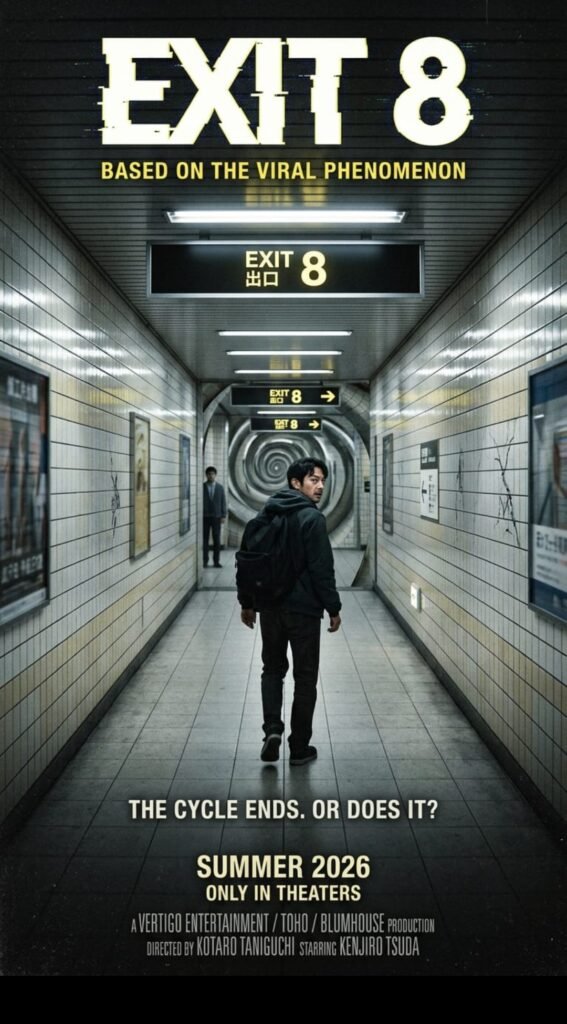
Exit 8 is one of the most unsettling adaptations in recent memory. Kotake Create released the original indie game in 2023, aggressively winning the hearts of gamers. The concept is brutally simple — navigate a looping underground corridor and spot subtle anomalies. Get it wrong and the loop resets. The film keeps that same quiet psychological pressure by turning the act of observation into something genuinely unsettling.
Direction and style
Genki Kawamura directs with a restraint that suits the material perfectly. He built his reputation producing emotionally rich, visually inventive Japanese films like Duality and A Hundred Flowers. Here, he strips everything back. No jump scares. No heavy exposition. No hand-holding. Just long static shots that force you to scan the frame like a player would in the game. That choice creates a specific kind of unease — a kind that builds slowly and refuses to leave, a kind that never announces itself. It hides in plain sight, waiting for you to notice.

Kawamura also resists the temptation to expand the premise beyond what it needs. He resists the urge to add backstory, mythology, and a wider cast. He trusts the loop, and that, not surprisingly, makes the film work. It stays disciplined where other horror adaptations tend to overcomplicate things and lose themselves.
Visuals and cinematography
Cinematographer Keisuke Imamura keeps the camera almost completely still. The corridor looks symmetrical, clean, and almost too perfect. That rigid visual order makes every tiny deviation feel deeply wrong. Lighting stays flat and clinical throughout — fluorescent, neutral, faintly suffocating. When the colour temperature shifts even slightly, you sense it before you consciously register it. Background details stay sharp, so you spend the entire film scanning every corner of the frame.
The visual effects stay deliberately minimal. Changes between loops are small and practical — a light is slightly dimmer, a sign faces the wrong way, a shadow does not quite match its source. That grounded approach makes every anomaly feel plausible. Plausible is far scarier than spectacular. You can almost convince yourself you imagined it, which is exactly the point. The film weaponises your own doubt against you.
Symmetry and deep focus work together to make the space feel both familiar and faintly hostile. You get the sense that the corridor follows rules—you just cannot figure out what they are. That architectural unease underpins everything else the film does.
Sound design
There is no dominant musical score. The film builds its atmosphere almost entirely through ambient noise — footsteps, distant echoes, and the low hum of fluorescent lighting. Silence does the heaviest lifting. When something does intrude on that quiet, it hits hard precisely because you have been lulled into expecting nothing. That restraint keeps the tension internal. The dread does not come from outside the character. It grows inside him and inside you.
This approach also reflects a smart understanding of the source material. The game was unsettling partly because it sounded mundane. The film preserves that quality. Mundane, in the right hands, becomes deeply sinister.
Performance
Kazunari Ninomiya carries nearly every scene alone. He reacts to an environment rather than to other characters. His performance builds almost entirely through physicality — posture, eye movement, the subtle tightening of his jaw. Early on, he reads as curious and mildly confused. That is the right starting point. By the later loops, quiet desperation takes over. You track that shift without needing a single word of explanation.

What makes the performance particularly impressive is how universal it feels. It works across languages entirely. Subtitle readers lose nothing. The emotional arc lives in his body and his timing, not in dialogue. He also makes the corridor feel like an active presence — something he is in conversation with, not just trapped inside. That distinction matters as it stops the film from feeling like a gimmick and grounds it in something genuinely human.
Themes and meaning
The looping corridor works as a visual metaphor for modern routine. Most people drift through repetitive days without questioning them. Spotting anomalies mirrors real moments of awareness — small disruptions that force you to notice how passive you have become. The film frames attention itself as a survival skill. Miss the details, and you stay stuck. Notice them, and patterns start to emerge.
The film also plays constantly with perception versus reality. The longer the loop continues, the less the protagonist trusts his own senses. That psychological fragility feels specific and earned. It taps into a particular kind of anxiety — not fear of something external, but doubt in your own ability to read the world correctly.
The film also plays constantly with perception versus reality. The longer the loop continues, the less the protagonist trusts his own senses. That psychological fragility feels specific and earned. It taps into a particular kind of anxiety — not fear of something external, but doubt in your own ability to read the world correctly.
Control sits at the heart of the film too. The rules governing the space never get explained. Progress depends on reading vague signals correctly. That reflects a quiet existential helplessness — navigating systems you did not design and cannot fully understand. Minimalism strips away every distraction until only observation and decision-making remain. That is where the film locates its meaning.
Pacing and weaknesses
The film knows exactly what it wants to do, and that focus is its greatest strength. Everything — set design, performance, sound, cinematography — pulls in the same direction. But the single-location structure and looping mechanic do test patience in places. Some stretches circle the same idea without adding quite enough variation. Deliberate pacing occasionally tips into dragging. For viewers locked into detail-orientated watching, the small differences between loops feel compelling. For others, they risk feeling negligible. That is an inherent tension in the concept, and the film does not always resolve it cleanly.
Final verdict
Exit 8 is not a film that hands you meaning. It rewards active, attentive watching. The concept translates from game to screen with its identity completely intact — a rare thing for video game adaptations. Atmosphere, repetition, and precise visual discipline do the work that dialogue and plot normally would. It strips horror back to something primal: the fear of not quite understanding what is wrong.
Exit 8 leaves a genuinely lingering dread. That kind of unease is harder to manufacture than it looks and this film accomplishes that.


Pingback: 4 Top Rated Movies You Must watch This Friday - Film Misfits