I Play Rocky Movie Review: An Inspiring Underdog Story
Introduction
There are very few movies with as huge of a legacy as Rocky. Sylvester Stallone’s sports drama became one of the greatest examples of an underdog story in film history.
It won Stallone three Academy Awards including Best Picture, but before Rocky Balboa became a household name Sylvester Stallone was a struggling actor with very little funds to his name.
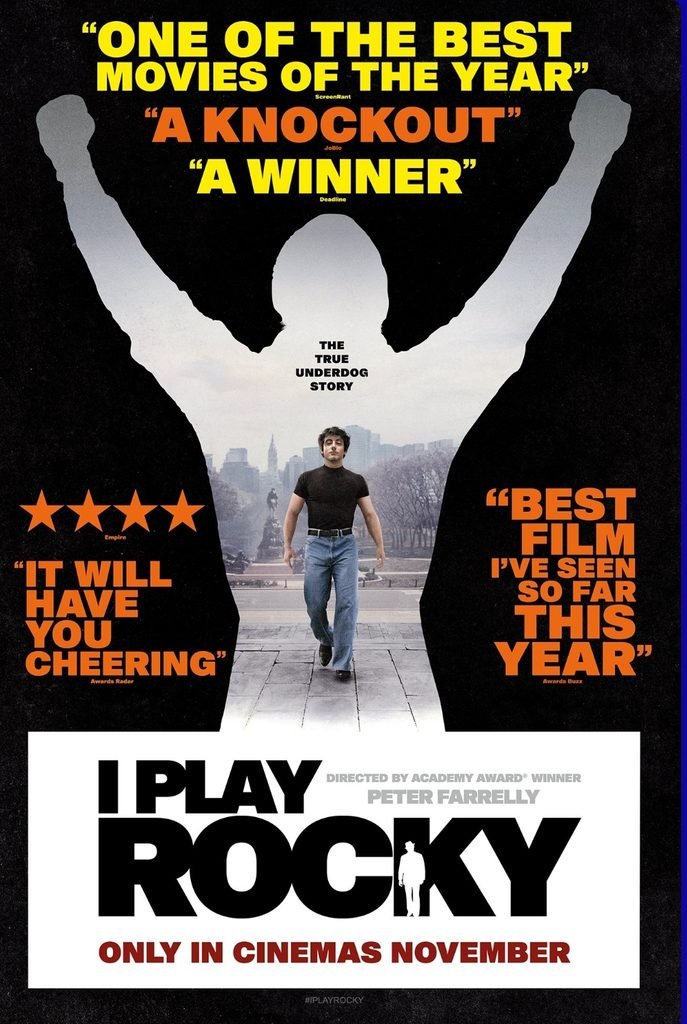
He had written a script no one wanted to make, but had incredible determination. I Play Rocky tells the story behind Stallone’s rise to fame.
Directed by Peter Farrelly, this 2026 biographical drama sees Anthony Ippolito play a young Sylvester Stallone as he fights to convince Hollywood that he is the man to Play Rocky Balboa.
I will be reviewing the original Rocky after watching this film, and I am curious to see how learning more about its creation influences my experience of revisiting it.
Knowing the real-life struggles, compromises and creative decisions behind such an iconic film could make watching it again an entirely different experience.
This movie is so captivating as it is another underdog story. But instead of fighting in a boxing ring, Stallone fought in Hollywood.
The passion and determination shown by a man who truly believed in himself despite almost everyone thinking he was making the worst decision ever.
Whilst the movie does fall into some tropes of biographical dramas, it is still an entertaining and inspiring look into one of the most rememberable productions in cinematic history.
The Making of an Underdog
Stallone is a struggling actor who is nearing his 30th birthday and living in poverty. He is extremely determined to get his big break but struggles due to there not being many opportunities available.
His unique speech and slight facial palsy has also stopped him from getting the roles he wants. While doing any job he can find, including some embarrassing acting roles, Stallone never gives up on his dream.
After watching a famous boxing match between Chuck Wepner and Muhammad Ali, Stallone gets inspired to start writing a script.
He creates a script based around an average boxer who suddenly gets the once in a lifetime opportunity to fight the heavyweight champion in 3 and a half days. This created the character known as Rocky Balboa.
The script had great potential and Hollywood executives saw this. However, they wanted different actors to star in the main role.
Well-known actors such as Burt Reynolds and Ryan O’Neal were being considered. Studios were offering Stallone large amounts of money for his script. Some of which would have changed his life.
However, Stallone only agreed to sell if he could play Rocky. He knew the character was very personal to him and that if someone else played the role he would lose something vital. He would not back down even when offered around $360,000.
This was a massive risk to take, especially considering how close he came to going broke. Eventually Stallone agreed to a deal with the producers Irwin Winkler and Robert Chartoff.
This meant the film could be made for a relatively low budget of around $1 million. He finally got his chance to play the character.
The story is brilliant as we know how it ends. We know Rocky becomes a massive success but this still makes it exciting.
We get to see what challenges Stallone faces. Every time he gets rejected, goes into debt and has arguments with the executives, it is like another round in a fight he is not willing to lose.
Anthony Ippolito Is Outstanding as Sylvester Stallone
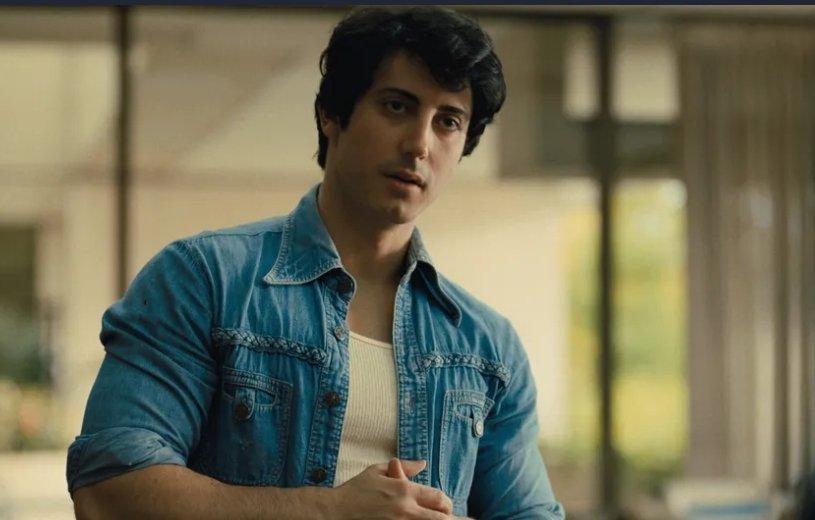
This would certainly struggle without a believable performance at the centre. However, Anthony Ippolito is a great casting choice.
It can be very difficult to play someone so recognisable like Sylvester Stallone. You have a risk of coming across as too much of an impression, however Ippolito does not do this.
He does capture the way Stallone talks, his mannerisms and his clear determination, but still makes us believe it is a believable performance. As well as this, we can see his vulnerability.
This is not the international star we know, but a young man who has faced many rejections and is desperately trying to prove he deserves a chance.
One of the best things about this performance is how Ippolito plays his speech. Stallone has nerve damage from birth which affects the way he speaks.
Instead of using this as a gimmick, Ippolito plays this with a lot of care. This helps to show how Stallone did not let this stop him from achieving what he could.
There is a real determination within this performance. We can really understand why Stallone is willing to risk everything instead of taking up the offers from the studio.
Ippolito makes us understand that Stallone truly believes he is the only person who can play this character.
Overall this is an impressive performance and easily the best thing about the film. Ippolito manages to play Stallone in a way that shows us his recognisable traits but also his insecurity as a struggling actor.
Peter Farrelly’s Restrained Direction and 1970s Atmosphere
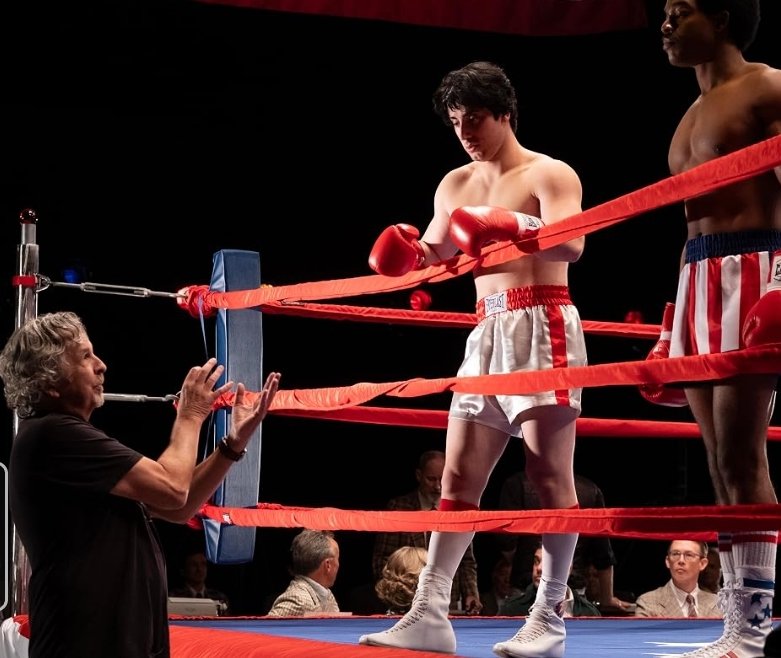
Whilst Peter Farrelly may be most well known for his slapstick comedy films such as Dumb and Dumber and There’s Something About Mary, this film displays a more serious side to him as a filmmaker. This continues with I Play Rocky, which takes a surprisingly grounded approach to the story.
Farrelly doesn’t try to push the audience into feeling high emotions. Instead, much of the tension comes from Stallone’s situation. The stress of money, uncertainty and disappointment are sufficient for the film.
The period setting works really well. The cinematography does not look too perfect like many modern films. The colour palette is warm, a little grainy and washed-out to give it a similar look to the 70s.
This gives the film a realistic feel and the set design has been done very well to recreate the streets, shops and environments seen in the period.
The locations help to give the film a working class feel, linking to the original Rocky. There is a strong working class New York vibe throughout the story.
Farrelly also understands that the most important part of the story is not the success of the film but the struggle to make it.
The negotiation with the studios is almost as tense as a boxing match. Stallone is constantly up against people with much more money and power than him.
Although there are some cliché moments in the direction, Farrelly has thought this through well. He lets the story flow and does not make scenes overly dramatic.
The Steadicam and the Birth of an Iconic Sequence
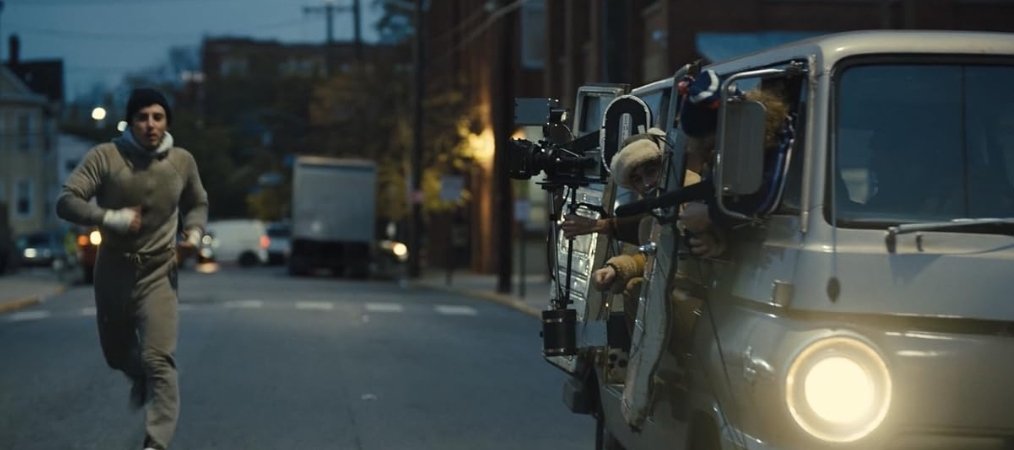
One of the most interesting aspects of I Play Rocky is how much attention is paid to the technical difficulties faced during the making of the original film.
The inclusion of the Steadicam is a brilliant scene. Whilst now known as a tool used in some of the most iconic tracking shots in cinema history, for Rocky it was incredibly important. The production didn’t have much money or much time to work with.
This scene shows how John Avildsen (played by Jay Duplass) and Garrett Brown worked together to find a way to make use of the technology. They realised that the Steadicam could actually help solve their issues with money.
The scene where Garrett Brown shows them test footage of his wife running up the steps of the Philadelphia Museum of Art is interesting to watch.
Once they see the footage they start to realise how they can make use of the technology to capture Stallone running up the stairs.
This is such a great example of thinking outside the box. It really feels like they made a breakthrough when creating the iconic training sequence.
Whilst the Steadicam went on to become an iconic piece of cinema history, what’s so interesting about it being included here is that it helped a low budget film achieve something that looked much more ambitious.
If you’re into filmmaking this is one of the most rewarding parts of I Play Rocky. It reminds us that some of the most iconic moments in cinema are not necessarily down to huge amounts of money or complicated technology, but filmmakers thinking creatively to overcome difficult problems.
A Strong Supporting Cast
Although Anthony Ippolito carries the film, the supporting cast provides plenty of personality and helps recreate the complicated world surrounding Stallone.
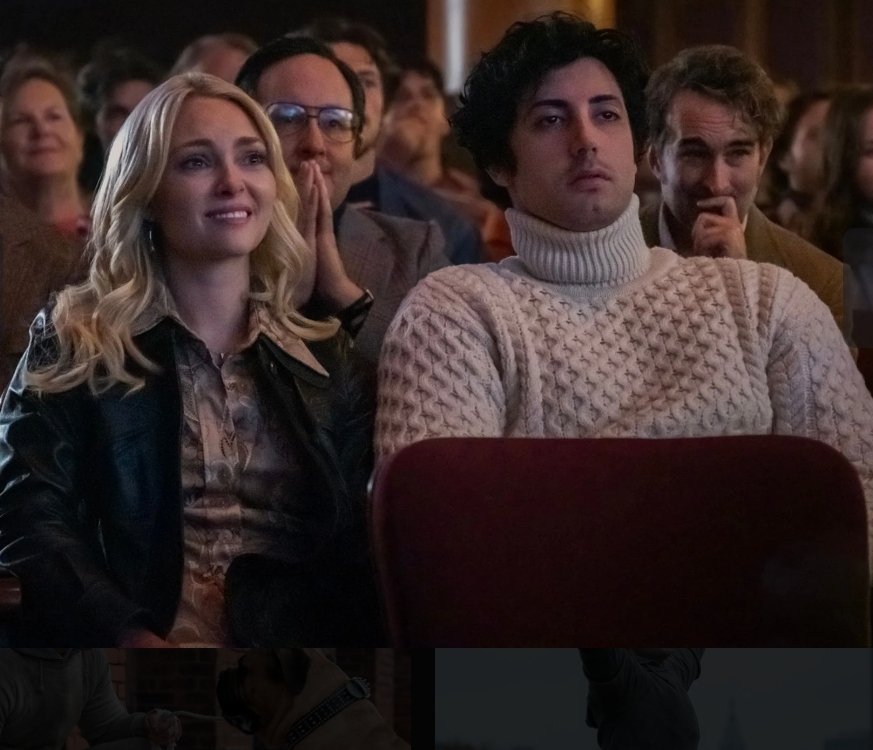
AnnaSophia Robb stands out as Sasha Czack; Stallone’s love interest and emotional support throughout the film.
Their relationship helps to create a stark contrast between Stallone and the increasing pressure he feels when negotiating with Hollywood. Sasha helps to ground Stallone in the real world as he gets lost in his screenplay.
The relationship also has a nice parallel with the main relationship in Rocky. This helps add more depth to the film especially in the way that Adrian supports Rocky emotionally throughout the film.
I would have liked to have seen Sasha develop a bit more as an individual but overall it was good.
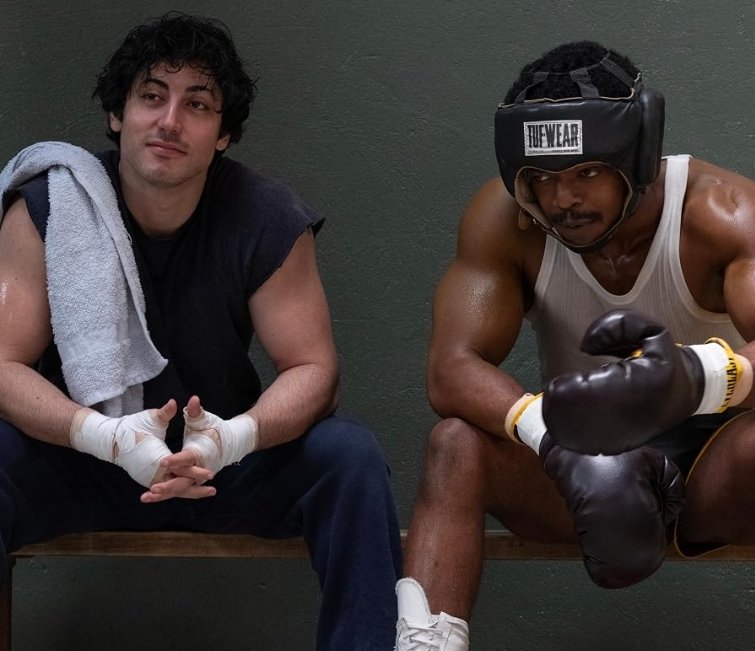
Stephan James does a great job playing Carl Weathers. His charisma and physique really fit the role of Carl Weathers who would go onto become Apollo Creed.
It’s nice to see that this connects back to the creation of the original movie and the whole casting process and how these iconic characters were developed.
Matt Dillon brings a more complicated energy to the role of Frank Stallone Sr. The relationship between father and son provides some of the film’s more uncomfortable moments, helping explain the emotional pressures that contributed to Stallone’s determination to succeed.
The film also benefits from the performances of P.J. Byrne and Toby Kebbell as producers Irwin Winkler and Robert Chartoff.
They capture the difficult position of two filmmakers trying to make a film with limited resources while negotiating with an increasingly stubborn writer who refuses to give up the leading role.
Tracy Letts is very entertaining as Sandy Maddox, the Corporate type that Stallone has to deal with. Whilst he adds some comic relief to the board room scenes, he also shows how the film often oversimplifies complicated real life scenarios.
How Much of the Story Is Hollywood Legend?
One thing that’s quite interesting about I Play Rocky is how much of a loose adaptation it actually is.
Whilst the film tries to show an entertaining story, there are some exaggerations made throughout the film.
Whilst this is not unusual for a Hollywood biopic, if you’ve read Stallone’s autobiography then you may notice some notable changes.
Jackie Stallone (his mother) is not present and his complicated relationship with his dad has been simplified.
The complex negotiations with the studio have also been simplified; several real-life executives have been combined to make clearer characters.
Certain parts of the script have been exaggerated. His process of writing the script has turned into a physical challenge.
He has late nights whilst frantically writing his script and taking ice baths, which has become like a boxing match.
This is an entertaining visual concept but shows that the film favours exaggerated symbolism over realism.
Whilst writing a script is not usually as exciting as a boxing match, the film clearly wants to show the physicality and passion he put into his work.
Whilst this does not spoil the experience, it should be noted that this is not an exact account of events and should be seen as a dramatised version.
It shows a general overview of the incredible story but simplifies the more complex personal aspects.
However, this is where I feel the film could have been bolder. The true story is fascinating enough without having to fit everything into a typical biopic template.
An Underdog Story Worth Telling
What makes I Play Rocky so effective is the way it mirrors the film that inspired it. The original Rocky is about an ordinary man who receives an extraordinary opportunity and refuses to give up, even when the odds are stacked against him.
The story of Stallone’s attempt to get that film made follows almost exactly the same pattern.
There is something wonderfully fitting about the idea that a man who created one of cinema’s greatest underdog characters had to become an underdog himself to get the story onto the screen.
The film also offers an interesting perspective on creative ownership. Stallone’s refusal to sell his screenplay without playing the lead could easily have been interpreted as arrogance or stubbornness, particularly when he was being offered money that could have changed his life.
However, the film makes a convincing case that his insistence was essential to preserving the character’s identity.
It is ultimately a story about believing in yourself when nobody else is prepared to take a chance. Stallone was not an established star, and there was no guarantee that audiences would respond to his performance. He simply believed that he understood Rocky better than anyone else could.
That determination is what makes the film so inspiring, and it also gives the story a relevance beyond the film industry.
Whether you are an aspiring filmmaker, writer, actor or simply someone trying to pursue an ambition, there is something appealing about watching someone refuse to abandon their vision.
Final Verdict
I Play Rocky is an amusing and inspirational film which shows just how much of a fighter Sylvester Stallone was.
Peter Farrelly does a surprisingly low-key job directing this biopic aided by some great set designs and cinematography showing the 70s.
Anthony Ippolito is incredible in this movie. He really does capture Sylvester Stallones quirks and his style of speaking.
He is also very vulnerable and determined with his character having been constantly told he is not good enough.
The rest of the cast do well too especially AnnaSophia Robb, Stephan James and Matt Dillon.
Also a highlight of the film is the insight into the Steadicam and the cleverness used with the original Rocky.
It is an interesting insight into how filmmakers can make something iconic with very little resources. The only downside to this movie is that sometimes it is too safe.
Some of Stallones more complex family relationships have been simplified and it feels very typical of a Hollywood biopic.
Overall this is a great film to watch. It is an uplifting story about determination, creativity and being confident in your own skills.
One of the main things I have taken away from this movie is wanting to rewatch the original Rocky. I will be reviewing it next and am interested to see if knowing more about the struggles means I will view it differently.
After watching how hard Sylvester fought to get this movie made, I feel like some scenes, performances and choices made may mean completely different things.
Overall this is not just a behind the scenes movie. This is an underdog story and a great tribute to how determined they were to create Rocky Balboa.