
John Carpenter vs Wes Craven: The Ultimate Horror Showdown
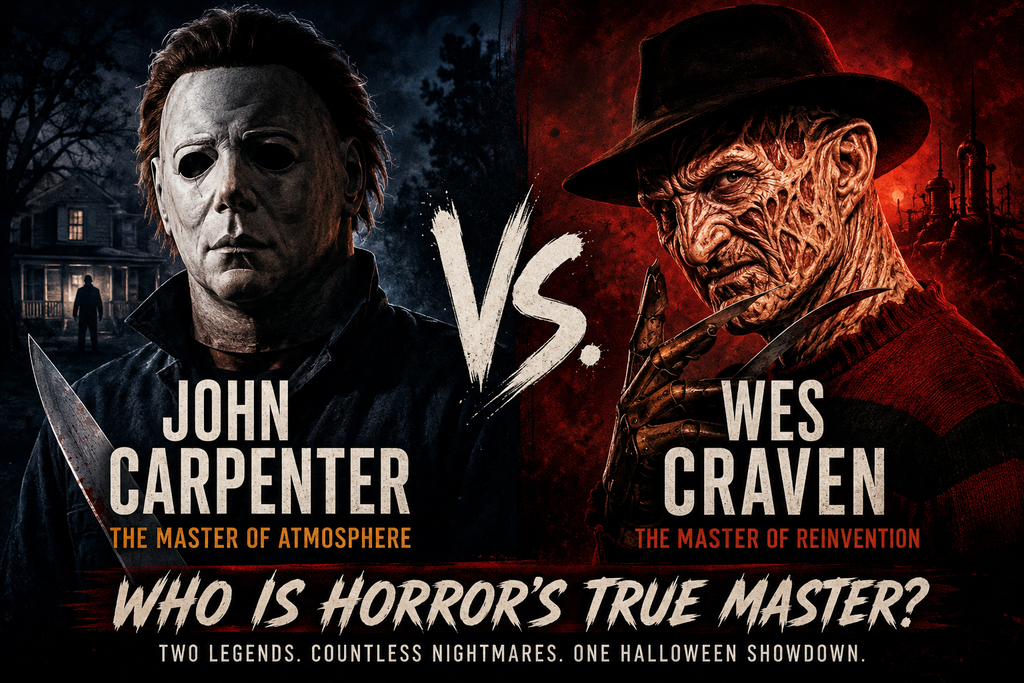
Halloween is the ideal opportunity for us to remember the directors who shaped horror movies into what we know now.
There are few directors who can match the level of influence of John Carpenter and Wes Craven. Both of them have created unforgettable villains and scared audiences, but the way they made horror was completely different.
Carpenter built his reputation through atmosphere, suspense, and an almost unmatched understanding of cinematic tension.
Craven challenged audiences with disturbing stories, inventive nightmares, and films that questioned horror’s own rules.
Both men deserve their place among the genre’s greatest directors. However, if we put their most iconic films head to head, who comes out on top?
Let’s settle this Halloween showdown.
Round One: The Slasher Revolution — Halloween vs A Nightmare on Elm Street

Halloween, directed by John Carpenter in 1978, became one of the most influential movies to create an archetype of a typical slasher movie.
Although the plot of the movie seems pretty basic, featuring Michael Myers stalking teenagers in the suburbs of Haddonfield, it became rather frightening.
Many scary moments of the movie depend on what the viewer does not see. Many times, Michael lurks in the background and watches his future victims without them noticing him.
Slow camera shots and an unsettling music score add up to make the everyday streets seem scary.
Thus, the movie shows that sometimes fear does not imply any violence. The appearance of a mask-wearing silent character in a film can scare people just as much as anything else.
The movie has become a pioneer in the use of many elements of slasher movies.
Exactly six years later, Wes Craven would unleash his own unique nightmare with his film entitled A Nightmare on Elm Street.
Rather than pursuing teenagers in their own neighborhood, Krueger stalks his victims in their dreams.
This is the simple premise that makes A Nightmare on Elm Street a dream-come-true for Craven and allows him the ability to craft some very creepy and surreal nightmares within his horror film.
Sleep is now the enemy in A Nightmare on Elm Street, transforming something that is an integral part of our daily lives into something dangerous and even deadly.
Freddy Krueger soon became a horror icon, offering up something gruesome and menacing along with a definite personality.
The character helped launch the franchise that exists even today and made Craven one of Hollywood’s most famous villains.
The winner: John Carpenter, narrowly.
Halloween established a remarkably influential formula through precision and restraint. Craven’s film is more imaginative in its nightmare sequences, but Carpenter’s influence on the slasher genre gives him the edge.
Round Two: Fear Beyond the Human Mind — The Thing vs The Last House on the Left
The Thing directed by John Carpenter was released in 1982 but didn’t manage to win immediate recognition. Nowadays, it is one of the best science fiction horror movies ever created.
The plot takes place in Antarctica and centers on a group of male scientists who have to deal with an alien creature that is able to transform into people.
It’s difficult to name paranoia as the best tool used to create suspense, but the fear of betrayal is the most effective technique in this movie. Everything can become dangerous in such an environment and nothing is clear.
The practical creature effects in the film are truly astonishing and show the process of transformations and terrifying creatures.
However, it’s important to say that the mystery of the identity of the creature is the real key to the scary feeling.
The Last House on the Left directed by Wes Craven is a completely different type of horror movie. This was his first feature and it was released back in 1972.
This movie is not about some supernatural creatures but about real human cruelty and brutality, which was shown in this revenge movie.
Instead of using supernatural beings as the cause of fear, Craven has shown violent acts in a realistic setting that makes it more frightening.
According to the British Film Institute, the film is a contradictory movie that addresses both social and confronting horror themes. (BFI)
These two movies show two distinctively scared directors. Carpenter questions the integrity of those close to us while Craven shows us the horrors humans can commit.
The winner: John Carpenter.
The Thing is a fantastic mix of mood, suspense, special effects, and psychological scare. The former is certainly significant, but the latter is a fuller representation of the horror genre.
Round Three: The Power of the Sequel — Halloween’s Legacy vs Scream
Very few films of this genre have influenced other films as significantly as Halloween did. Its success contributed to the rise of the slasher subgenre.
Michael Myers would become an everlasting symbol of evil, and the musical theme by John Carpenter would become iconic.
In addition, this movie made a significant contribution into the concept of the final girl, the girl who survives and confronts the killer at the end.
Unfortunately, John Carpenter was not the only director who managed to break the laws of this genre.
Scream directed by Wes Craven was released in 1996 and gave the genre a good push forward.
Already in the middle of the 1990s, the audience was bored with countless masked killers, threatened teenagers, and horror clichés.
But in Scream, the directors used the knowledge about the genre conventions for the benefit of their characters.
Self-awareness became one of the greatest advantages of this movie.
Craven also struck the right balance between humour and suspense. This is because the film shows from its beginning sequence that anyone, including famous actors, could be killed.
The outcome was a huge successo and one that rejuvenated the slasher genre of films. Scream also became the inspiration for several other self-aware horror films.
The winner: Both
Carpenter helped establish the slasher formula, but Craven demonstrated how effectively it could be dismantled and rebuilt.
Scream remains a brilliant example of a filmmaker challenging the very conventions he helped popularise.
Round Four: Who Created the More Lasting Horror Legacy?
However, comparing these two directors outside of their individual works is extremely difficult, since both of them have been influential for the horror genre but in different ways.
The main advantage of John Carpenter is that he knew how to work with visual storytelling and create tension through silence, limited information, and unusual music.
Also, he realized the importance of memorable pictures: a simple scene with Michael Myers standing underneath the street light can scare a viewer more than a complex and violent scene.
The alien transformations shown in The Thing is an example of such combination of shock and tension.
Also, one should note that Carpenter was not only a great director, he was a talented composer of music and created electronic scores for his movies.
As for Craven, he constantly reinvented himself throughout his career: The Last House on the Left scared people with human brutality; A Nightmare on Elm Street showed supernatural fear through the medium of dreams. Finally, the director made fun of the horror movie genre in Scream.
Moreover, Craven was able to entertain a viewer while at the same time making him feel uncomfortable because of issues of violence, morality, and society.
Craven also demonstrated that horror could evolve alongside its audience. When familiar conventions became predictable, he found ways to challenge them.
Neither filmmaker can claim every victory. Their greatest achievements come from doing different things exceptionally well.
The Final Verdict: John Carpenter vs Wes Craven
So, who deserves the crown as horror’s true master?
In my opinion, John Carpenter wins, but barely. His mastery of atmosphere, suspense, sound design, and visual storytelling is what makes his best movies so powerful.
Halloween is part of the birth of the modern slasher movie, whereas The Thing is a paragon of paranoia and practical effects.
He shows through his films how a basic premise becomes unforgettable when handled right.
Nonetheless, Wes Craven should be credited for being creative enough and having the guts to break boundaries. He continually showed us how horror was going places thanks to him.
If the contest were based purely on reinvention, Craven might take the crown. Few directors have successfully reshaped the genre across so many different eras.
Ultimately, both filmmakers helped define what horror could achieve. Carpenter showed us how to make audiences afraid of what they couldn’t see.
Craven showed us that even our dreams and favourite movie conventions could become nightmares.
This Halloween, I’d happily recommend a double bill featuring both directors. Start with Halloween, follow it with A Nightmare on Elm Street, and finish with The Thing or Scream.
Just remember to leave the lights on afterwards.
But what do you think? Is John Carpenter the ultimate master of suspense, or does Wes Craven deserve the horror crown? Let me know which director wins your Halloween showdown.