Lady Movie Review
Introduction (Warning Contains Spoilers)
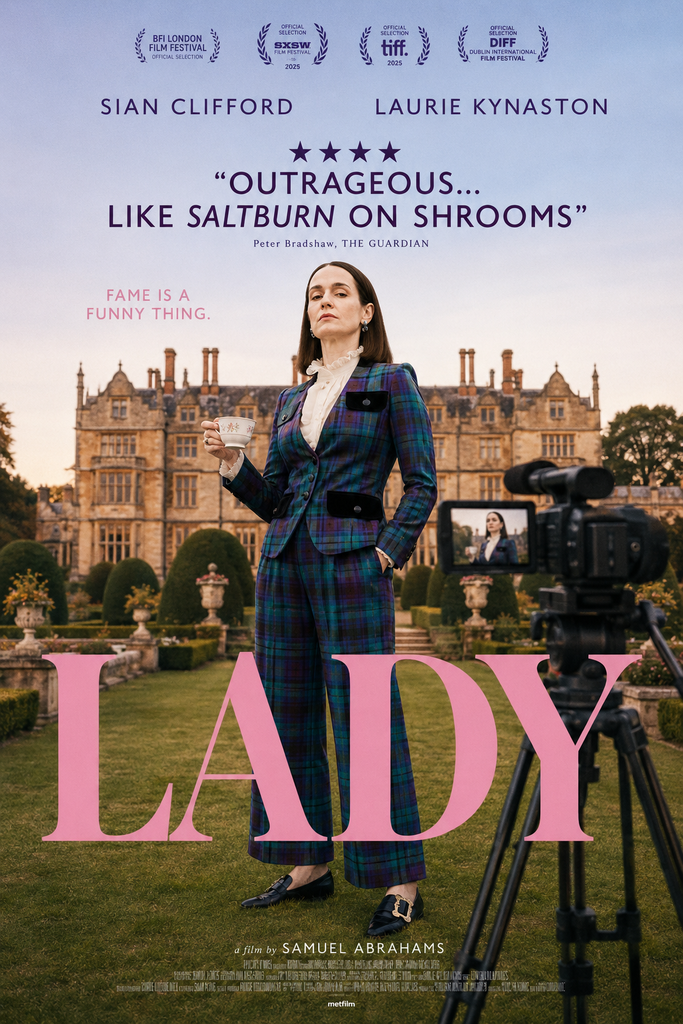
There is something fitting about a film obsessed with being seen. Lady arrives as a British satirical mockumentary about fame, privilege and personal ambition.
The film revolves around Lady Isabella Ravenhyde, brilliantly portrayed by Sian Clifford.
Isabella feels that she deserves recognition though there is not much evidence in favour of her belief.
She enlists the help of a struggling filmmaker named Sam, brilliantly acted by Laurie Kynaston, in order to document her life.
Additionally, she says that Netflix has already approved their project. That is an utter lie. Nonetheless, Isabella’s confidence does not falter at all.
The next chance for her comes through a local talent show called Stately Stars. However, it is supposed to be for underprivileged children only.
This fact immediately points towards the extraordinary lack of self-awareness in Isabella. However, Lady is not just a comedy revolving around an incredibly narcissistic aristocrat.
Samuel Abrahams uses the rather unbelievable premise in order to examine certain uncomfortable issues.
The film explores themes of fame, loneliness, identity, privilege, and the obsession with visibility.
Furthermore, it talks about the way people perform different versions of themselves before the audience.
This explains why a mockumentary format is used in the film. The camera serves as more than a means of capturing Isabella’s actions in the film.
The camera turns into the manifestation of her desire to be recognized. Thus, this is an unusually ambitious debut.
It may not have been entirely successful. However, its flaws often stem from its interesting risks.
A Strong Premise
The premise of Lady is immediately appealing. Isabella wants to become famous and believes that fame is already waiting for her.
Sam thinks that he can use this situation for his own filmmaking career, which is suffering.
So, from the very beginning their connection is based on exploitation.
Isabella wants Sam to shape her ideal image. Sam wants Isabella to give him the project that will make him famous.
Neither character is totally innocent. This makes their connection more complicated than it appears at first glance.
Moreover, this makes it possible for the mockumentary format to work..Sam must continue filming because it is the opportunity for him.
Isabella must have him filming because without camera her importance would disappear.
The camera thus links their interests. It also raises the interesting issue of who directs this documentary.
Isabella thinks that she is controlling the situation by creating her own public image.
Sam thinks that he is just filming her objectively. Neither of them is right. And this tension makes the movie really strong.
Samuel Abrahams’ Direction
Lady is Samuel Abrahams’ first feature-length film as a director. It is clear how ambitious the film is.
Instead of shooting a predictable mockumentary, Abrahams decides to introduce some innovations.
First of all, he creates the usual conventions and then starts to subvert them.
At first, the camera looks observational and controlled. It films Isabella misbehaving without pointing at the obvious joke.
Thus, the awkwardness is allowed to emerge naturally.
The humor in the film comes from Isabella’s total self-confidence. She does not understand how silly she looks.
In that way, the comedy is more believable than excessive exaggerations could be.
Moreover, the director realizes the role of the camera.
The documentary footage shows the attitude of the main character to the attention of people.
Isabella wants to be in charge of the way she is perceived by the viewers.
Unfortunately for her, the camera often shows another side of the situation. It reveals Isabella’s insecurity despite all her confidence.
It becomes more important as the plot goes on. Abrahams’ most intriguing step is in the use of different visual language.
Gradually, the film moves beyond the borders of mockumentary. Magical realism starts to appear in the story.
Isabella starts to disappear when she gets outside of the spotlight. The idea is absurd. But it works as a metaphor.
Isabella is scared of being irrelevant. Eventually, she starts to feel it physically. And thus, this bizarre development gains an emotional sense.
A Promising Directorial Debut
Samuel Abrahams’ direction I would say is rather promising than fully realized at this stage. There is certainly a point of view behind the camera here.
It is of huge importance in a first feature film. Some first-time directors create quite competent films that lack visual specificity.
“Lady” does not suffer from this flaw. It has certain vision of how the camera should function.
It tries different approaches in terms of tone and form. Also it shows understanding of the correlation between visual and characters.
The mockumentary approach fits the character of Isabella obsessed with attention. Magical realism suits the character of Isabella afraid of vanishing into oblivion.
Changes in the visual approach suit her attempts to create her identity. All this proves certain directorial thinking.
But still there is a slight problem with making all these things fit together. The film shifts through comedy, satire, drama and surrealism.
Sometimes these transitions look quite abrupt.
And some scenes seem more concerned with eccentricity than with moving forward the narrative.
This especially true of the middle part of the movie. Sometimes the film looks like trying how far it can go.
Such experimentation can be thrilling. But sometimes it makes the narrative somewhat unfocused.
Nevertheless, this is a good problem to have for a debutant. Abrahams certainly has a vision.
Now the question is to make it controllable while keeping it original.
The Mockumentary Style
The mockumentary style is one of the key elements making the film stand out. Abrahams applies this style as more than just a vehicle for comedy.
The documentary-style camera becomes a tool of storytelling. It builds up the distance between Isabella’s impression and the viewers’ perception.
While believing herself to be creating a masterpiece of portrait, Isabella constantly exposes her weaknesses.
It creates a major part of comedy in the film. At the same time, it contributes to building up the main themes of the film.
The desire to control the presentation of oneself is easily understood by the contemporary audience. In the era of social media, such an idea is common practice.
A person selects pictures, texts and videos to make his or her own version. Isabella takes this behavior to its extreme.
The very existence of Isabella becomes a kind of a performance.
She does not need just attention but rather a confirmation of her value.
That is what gives an interesting contemporary element to the film’s mockumentary style.
The camera is a symbol of the audience she needs desperately..In the absence of the camera, Isabella starts feeling irrelevant.
That way, the film manages to connect the celebrity culture and the practices of the contemporary world.
Without becoming a mockery of the social media itself.
The Cinematography
Cinematography by Korsshan Schlauer is essential to defining the identity of this film. The photography is crucial for the maintenance of the documentary illusion.
At the same time, it allows some freedom for the creation of visual expressiveness. The early visuals have an observational character.
They seem realistic enough to maintain the mockumentary approach. Moreover, the camera can be restless during certain chaotic events.
This creates the involvement of the audience into the awkward situation. Nonetheless, there is no limit to visual expressiveness.
The movie uses different techniques depending on Isabella’s evolution. One such technique includes four-by-three framing of the performance-art scenes.
They become more directed and composed. It demonstrates the constructed nature of Isabella’s self-image.
Isabella desires to make her actions appear artistic. Thus, the framing technique becomes one of her tricks.
Moreover, there is an interesting contradiction of realism and fantasy. The movie keeps its realistic photography despite the increase of the surrealism of the events.
It is very difficult to balance. If the movie will be too polished, then the mockumentary illusion will be broken.
If it is too rough, then the fantastic events may seem irrelevant. Therefore, Schlauer’s work serves as a tool to unite those two styles.
The grainy quality adds to the nostalgic feeling of the movie. On the other hand, the bright colouring makes Isabella’s reality dreamlike.
The cinematography therefore supports the film’s themes rather than merely decorating them.
Sian Clifford’s Performance
Sian Clifford definitely gives the strongest performance of the movie. She is fully devoted to Isabella.
Such devotion is necessary, because Isabella never understands how silly she looks. Clifford does not wink at the camera.
She does not hint that Isabella knows what she is doing. She is a person who believes in her myth. It makes her even funnier.
She seems to be so confident, but she never proves anything. At the same time, Clifford reveals the vulnerable side of her character.
It becomes especially important as the movie moves on. It becomes clear that Isabella’s desperation is no longer fake.
Her desire for fame is a kind of mechanism that allows her to survive. She must get attention because she feels like nobody cares about her anymore.
That makes the invisibility story much more interesting. Sian manages to reveal all these nuances, but does not lose comedic character of Isabella.
The character is still frustrating. She is still selfish. She can still make bad decisions. But we slowly realize her loneliness. It is hard work.
That is why Clifford’s acting is not just broad comedy. It provides the movie with emotional core. Without it, the plot would have been repetitive.
Instead, Isabella becomes a tragic character through the satire.
Laurie Kynaston as Sam
Laurie Kynaston presents an interesting comparison to Clifford. Sam is more down-to-earth than Isabella.
His responses allow the viewer a perspective against the absurdity. At first, he seems like a person trapped in the other one’s madness.
But his motivations become increasingly complicated. Sam wishes for his documentary to be successful.
That means that he cannot just leave behind Isabella’s craziness. Because her madness may be what he needed.
So he invests into the project even further. It forms an interesting moral dilemma.
Sam documents Isabella because he is trying to make a name for himself. He is not just an objective observer.
That adds some depth to his relationship with Isabella. Kynaston’s subtleness proves useful in this case.
He does not try to compete with Clifford’s performance. He just lets her craziness take over.
The drawback is that sometimes Sam is not developed enough compared to Isabella.
The screenplay offers Clifford more chances to portray her character. And some characters act only in response to Isabella.
So that makes the emotional range of the ensemble limited. But the performances suit the mockumentary style of the film nicely.
The Themes
Perhaps it is in these themes that Lady becomes more intriguing than the plot implies.
First of all, the idea of fame is crucial for the story.
However, this film is less concerned about the actual popularity and more interested in the need to be recognized.
Isabella wants to be important. She wants others to recognize her significance. Such feelings seem especially important in the social-media era.
These days, one’s presence can become the source of income. People evaluate their attention in followers, likes, and views.
Lady turns this desire to prove oneself into the extreme form. Isabella is living in a way which assumes that every moment requires an audience.
Nevertheless, the film does not only condemn such behavior but tries to find out the reasons for that. In this case, it is a much more interesting thing to do.
Invisibility seems to be another crucial topic of Lady. Isabella’s supernatural ability transforms emotional experience into the real one.
She is becoming invisible when she is no longer paying attention to her. Thus, Lady provides one of the most vivid metaphors for social isolation.
A person may be surrounded by people but feel unseen. There is the theme of performance and authenticity in this movie.
Isabella is performing herself for the camera while Sam tries to perform professional in order to save his career.
Thus, the film itself becomes another kind of performance.
This brings up the questions whether it is possible to stay authentic knowing that someone is watching.
Fame and Social Media
In addition, the way the film comments on fame is quite cleverly done. There is no need for constant shots of social media screens.
Isabella herself embodies this mentality to the full extent. She is always looking for validation. She is working hard on her image.
She takes attention to mean significance. These traits of character are not unique to celebrity culture.
The movie thus serves as a satire of an obsessive attitude common in society. The movie implies that anyone can become a performer.
The only difference is that of the size of the audience. Isabella wants a huge audience. Modern social media users can also be dependent on their smaller audiences.
Psychology in both cases can be pretty much the same. Thus, the movie is quite relevant. Moreover, its aristocratic context creates an interesting irony.
Isabella has money and social prominence. Nevertheless, she is feeling extremely insecure.
Thus, the movie raises the question about the ability of privilege to protect a person from loneliness.
Thus, there is definitely class satire in this movie.
Still, this point is less elaborated than the themes of identity and recognition.
Loneliness and Identity
Loneliness gets increasingly important throughout the movie. At first, Isabella looks like a woman who is surrounded by opportunities.
She has money, contacts and a tremendous sense of entitlement. However, all of that is not fulfilling her.
She stays emotionally lonely. The craving for fame becomes a compensation for lack of connections.
It makes the character more sympathetic but does not justify her actions.
The movie acknowledges that the narcissistic nature can disguise the feelings of insecurity.
It does not have to make those feelings noble. Instead, it shows the destructive cycle that it can create.
Isabella dances to get the attention. The attention does not make her happy. She starts dancing even harder.
Her sense of self becomes increasingly dependent on external validation. Ultimately, the metaphor becomes quite literal.
She vanishes because she cannot have the attention she needs. It is one of the best ideas in terms of theme.
The Storyline
The plot has an inventive premise. The fake Netflix scheme already sets up Isabella as a dubious character.
And the documentary concept makes it for Sam to stay involved. And finally, the talent show serves as a clear goal.
This way, the movie gets a certain structure of a plot. Nevertheless, the plot does become unpredictable as the movie goes on.
Sometimes, it works as a strength, and sometimes as a flaw. The increasingly surreal style keeps the film from being predictable.
But at the same time, it can make the plot seem episodic. At times, the movie stops its progress in order for another weird thing to happen.
Such situations can be funny. But they can distract the viewer from following the plot.
Fortunately, the magical-realist events that come later restore some plot sense. They give some emotional meaning to the earlier absurd.
The final plot is not about becoming famous anymore. It is about what Isabella thinks the fame would bring to her.
And that makes a more meaningful emotional goal.
Pacing
The pacing is one of the film’s more uneven aspects. The film starts with an element of curiosity.
Isabella is discovered by Sam. She becomes more fascinating with each new revelation.
It is what allows the first part of the film to move. However, the central joke ultimately gets old.
The audience knows that Isabella is delusional. The problem is in keeping the comedic tension going.
It is done successfully in some scenes. In others, the scene seems to drag. The talent show scene is especially relevant.
The film’s devotion to awkwardness can get in the way of the pacing. It is not necessarily unintentional.
In some scenes, the audience is meant to be exhausted by Isabella’s character. It is meant to reflect Sam’s feelings.
However, there is a difference between intentional discomfort and redundant elements. It is something that Lady does on occasion.
In the latter half of the film, there is more emotional weight. The film must move from the satirical into something more profound.
It requires time. The pacing has meaning when it works. When it fails, the film lacks direction.
Overall, I think it is uneven rather than slow. There is plenty of inventiveness in the film. It just could have used a bit of tightening up at times.
What Works Best
The greatest strength of Lady is the relationship between form and theme. The mockumentary film style is linked to Isabella’s obsession with attention.
The filming style is symbolic of her false identity. Magical realism makes her insecurities visible.
And finally, the performances bring these concepts to life. All these elements play off each other.
This is why the film comes off as more carefully thought out than its silly premise would suggest.
And of course, the humour is improved by Clifford’s wholehearted approach.
The film does not often need to explain why Isabella is funny. It lies in her conviction.
The most effective scenes let Isabella expose herself organically. The audience sees the joke without constant explanation.
This confidence in the material is refreshing. The film can also be applauded for not being predictable.
An easier version of Lady would stay a traditional mockumentary. However, Abrahams takes the risk of making the film stranger.
This may not suit everyone. However, it defines the film’s personality.
What Does Not Work
The major flaw in the film is its inconsistency.
Certain themes are elaborated on, but there are instances when some ideas are given much thought without developing them properly.
Class criticism is one such instance. The side characters are another. At times, the pacing is affected by the lack of focus on these issues.
There are times when the film fails to draw the line between eccentricity and depth.
Simply because something is strange doesn’t mean that it is profound.
Thankfully, there are instances when the film’s weirdest choices become meaningful. Unfortunately, not all of them get their meanings.
The tonal changes may sometimes divide the audience as well.
While some may enjoy the transitions between humor and sadness, others might find it rather jarring.
After all, the film requires a viewer to adapt to a variety of tones.
This takes time and effort. The result, for the most part, is rewarding. However, this process is not always easy.
Such weaknesses stop Lady from being a truly great first film. They do not, however, erase its strengths.
Final Verdict
Lady is an ambitious and unconventional directorial debut. First of all, Samuel Abrahams shows interest in cinematic storytelling.
Secondly, he knows how to use the form to emphasize certain characteristics of the characters and the film’s themes.
The mockumentary format fits perfectly into Isabella’s obsession with visibility.
Korsshan Schlauer’s cinematography brings another aspect of it to light.
The acting is good overall, but the stand out performance goes to Sian Clifford.
The themes add unexpected emotional depth to the comedy.
The film deals with such subjects as fame, social media, loneliness and identity.
The story is interesting and imaginative but at some moments it becomes rather episodic.
Similar to the plot, the rhythm is inconsistent as well. The tonal shifts cause problems with the coherence of the film.
Some supporting characters lack development as well. But there is always ambition.
Abrahams chooses risky decisions instead of using conventional genre clichés.
Not all of them work as good as others..But that is a fair price to pay for the debut feature.
Most important is the fact that Lady feels like the film of the author who has something to say.
It does not try to copy another successful mockumentary. It wants to develop its own voice.
This makes it much more intriguing than perfectly polished but uninteresting comedy.
The great job by Sian Clifford makes Isabella character memorable throughout the whole film.
She is annoying, amusing, vulnerable and somehow tragic.
Making this traits coexist is the greatest achievement of Lady.
Finally, the film is not about becoming famous.
It is about the fear of invisibility. Does the attention from the people on the Internet compensate for their misunderstanding?
Isabella’s problem seems very relevant in the modern age of social media.
Despite all flaws, Lady leaves a great impression.
It also hints that Samuel Abrahams may turn out to be an interesting director to watch in the future.
Lady is not a perfect debut. But it is an ambitious one.
And sometimes a film’s willingness to take risks is more exciting than its ability to play safe.