Last Breath: Background and Context
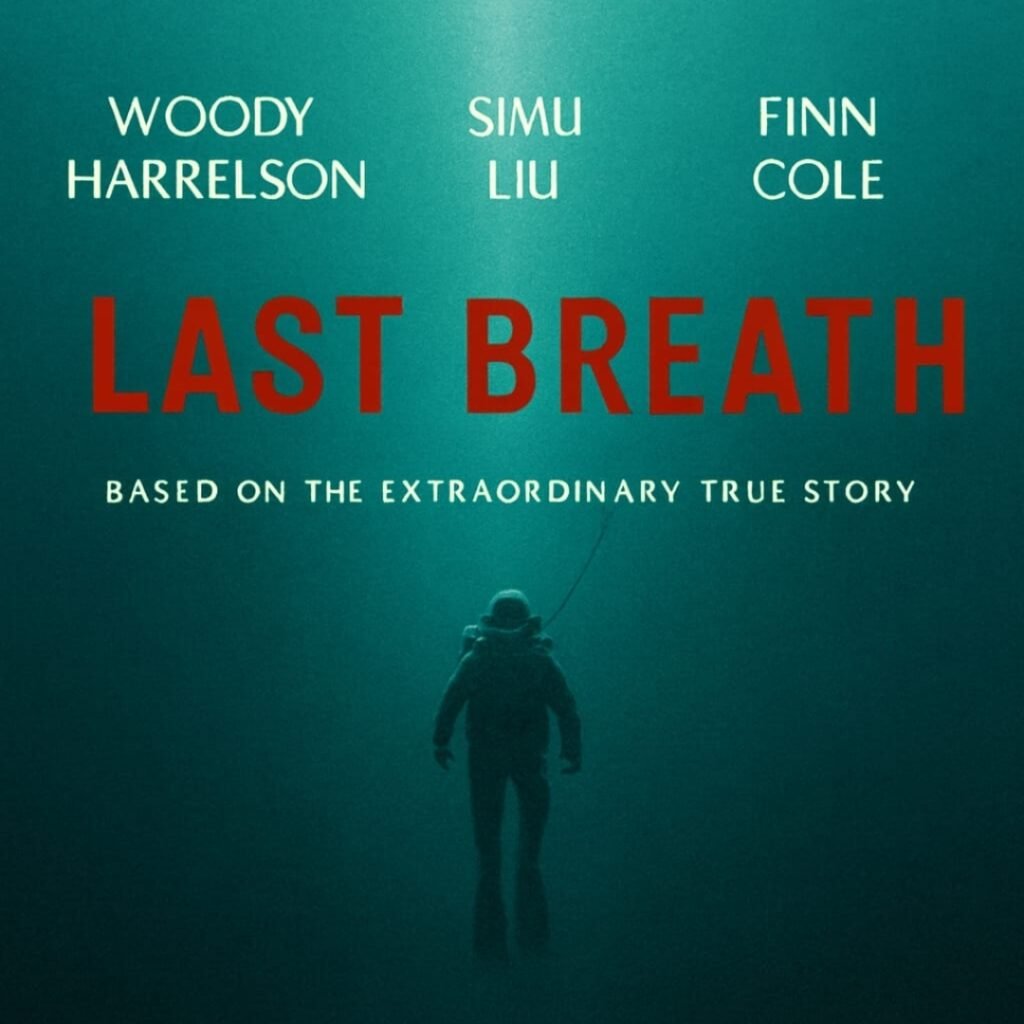
Last Breath (2025) is a narrative feature remake of the 2019 documentary directed by Alex Parkinson. He returns here to dramatize the same extraordinary real-life event. The film was released in the United States on February 28, 2025, followed by a United Kingdom release on March 14, 2025. The cast includes Woody Harrelson as veteran dive supervisor Duncan Allcock. Simu Liu as the disciplined saturation diver David Yuasa. Finn Cole as Chris Lemons, the diver at the center of this unbelievable survival story.
Last Breath is based on a true 2012 accident in the North Sea. This involved a team of saturation divers working hundreds of feet below the surface. When a violent storm causes their support ship’s dynamic positioning system to fail. Lemons’ umbilical cable—his sole source of oxygen, heat, and communication—is severed. He is left stranded roughly 300 feet underwater with only minutes of emergency oxygen and no way back to safety.
Why last Breath Works as a Feature Film
Last Breath works as a narrative film because the story itself feels almost impossible to believe. Even when you know it really happened. Watching it unfold dramatized, moment by moment, made the danger of the situation feel more immediate.
What struck me most is the sheer improbability of Chris Lemons’ survival. He lived for approximately 35 minutes with only six minutes of emergency oxygen. A feat that still defies clear medical explanation. Seeing this translated into a survival thriller made the outcome feel less like a statistic and more like a lived nightmare.
Rather than sensationalizing the event. The film’s story is a testament to teamwork, discipline, and human stubbornness in the face of overwhelming odds. This restraint is what separates Last Breath from more conventional disaster films. The danger is never exaggerated—it’s frightening precisely because it feels real.
Alex Parkinson’s Direction
Alex Parkinson’s documentary background is evident in every frame. His decision to prioritize realism over melodrama is the film’s greatest strength. The direction feels methodical and procedural, which actually heightens the tension instead of dulling it.
Last Breath sticks closely to the known timeline of the accident, avoiding unnecessary subplots or fictionalized twists. Parkinson frequently uses surveillance-style angles, wide monitors, and fixed perspectives that resemble real offshore control rooms. This grounded approach made me feel like I was watching events unfold in real time.
One particularly effective choice is the use of visual timers tracking the remaining oxygen. Watching the seconds tick away created a constant sense of dread. I found myself subconsciously counting along, fully aware that time was the true antagonist.
The Technical Craft of the Underwater Sequences
The underwater filmmaking is, nothing short of remarkable. Instead of relying heavily on green screens, the production filmed in an 11-meter-deep saltwater tank in Malta. The saltwater adds floating particles that catch the light, creating a murky, oppressive atmosphere that felt genuinely underwater.
Most of the filming took place at night to replicate the total darkness found hundreds of feet below the surface. This choice paid off immensely. The blackness feels absolute, broken only by flickering lights from helmets, machinery, and remotely operated vehicles.
Cinematographer Ian Seabrook’s lighting approach stood out to me. Lights often snap on suddenly. Illuminating parts of the environment long enough to register them before fading back into darkness. This gave the film an almost horror-like quality without ever abandoning realism.
The practical sets also deserve mention. The diving bell and underwater manifold were built at full scale, with removable panels to allow for varied camera placement. Despite this flexibility, the spaces never feel artificial. In fact, their tight confines made me increasingly uncomfortable as the film went on, which I believe was entirely intentional.
My Viewing Experience
The claustrophobia is relentless. Tight framing inside the diving bell and first-person camera angles underwater made me feel trapped. Like the ocean itself was pressing inward. Even when nothing overtly dangerous was happening, the environment alone felt hostile.
That said, I did feel the short runtime—just over 90 minutes—limited how deeply the film could explore its characters. While this didn’t ruin the experience for me, it did leave certain emotional beats feeling underdeveloped.
Themes That Resonated With Me
Several themes stood out strongly throughout the last breath, all centered on survival and human vulnerability.
The Value of a Single Life
In my opinion, the film’s most powerful message is that no life is disposable. Every decision made by the crew reinforces the idea that saving one person is worth extraordinary risk and effort.
Perseverance and Hope
The rescuers’ refusal to give up—even when logic suggests the situation is hopeless—was deeply moving. The film captures the emotional strain of continuing to act when success feels impossible.
Acceptance in the Face of Death
The film briefly explores the eerie calm that can accompany near-death experiences. This shift from panic to acceptance felt unsettling and honest rather than sentimental.
Teamwork and Brotherhood
The bonds between the divers felt authentic to me. Their loyalty isn’t expressed through grand speeches but through quiet competence and unwavering commitment.
Humanity Versus Automation
I noticed a subtle critique of overreliance on automated systems. When technology fails, it’s human instinct, sacrifice, and collaboration that ultimately matter.
How Well the Themes Landed
The film succeeds most when it leans into isolation and technical realism. The deep sea feels as alien and unforgiving as outer space. The constant focus on machinery reinforces how fragile human life is in such environments.
The theme of teamwork also worked particularly well. I appreciated how understated it was—no forced emotional breakdowns, just professionals doing everything they can for one another. Where the film is slightly weaker is in character depth. I understood who these people were in broad terms, but I wanted more insight into their inner lives beyond the crisis itself.
Performances
The performances across the board felt grounded and restrained, which suited the tone of the film.
Woody Harrelson (Duncan Allcock)
In my opinion, Harrelson delivers the film’s most emotionally resonant performance. He brings warmth, experience, and quiet dread to the role of a supervisor facing what may be his final mission.
Finn Cole (Chris Lemons)
Cole does impressive work despite spending much of the film unconscious. His early scenes, particularly those involving his fiancée, made his later ordeal hit harder for me.
Simu Liu (David Yuasa)
Liu’s controlled, stoic performance gradually softens as the situation worsens. I found his emotional restraint believable and effective.
Cliff Curtis
Cliff Curtis stood out to me as the ship’s captain. A single silent moment, filled with restrained emotion, added surprising depth to his character.
Mark Bonnar
Mark Bonnar provides a steady presence as the dive supervisor overseeing the rescue, embodying calm professionalism under extreme pressure.
Bobby Rainsbury
As Morag, Chris Lemons’ fiancée, Bobby Rainsbury is understated and sincere. However, I felt the script didn’t give her enough material to fully shine.
Final Thoughts
Overall, Last Breath is a tense, immersive survival film that left a strong impression on me. Its greatest strengths are its realism, technical craftsmanship, and refusal to sensationalize an already unbelievable true story.
While I did find the writing thin in places and wished for deeper character development. The film’s atmosphere and performances—especially Woody Harrelson’s—kept me fully engaged.
In my opinion, the 2019 documentary remains the more detailed and emotionally powerful version of this story. However, as a cinematic experience, the 2025 feature film succeeds on its own terms.
By the time the credits rolled, I realized I had enjoyed the film far more than I expected. It’s not perfect, but it’s gripping, respectful, and deeply unsettling in the best possible way.