Monarch: Legacy of Monsters Season 2 Review
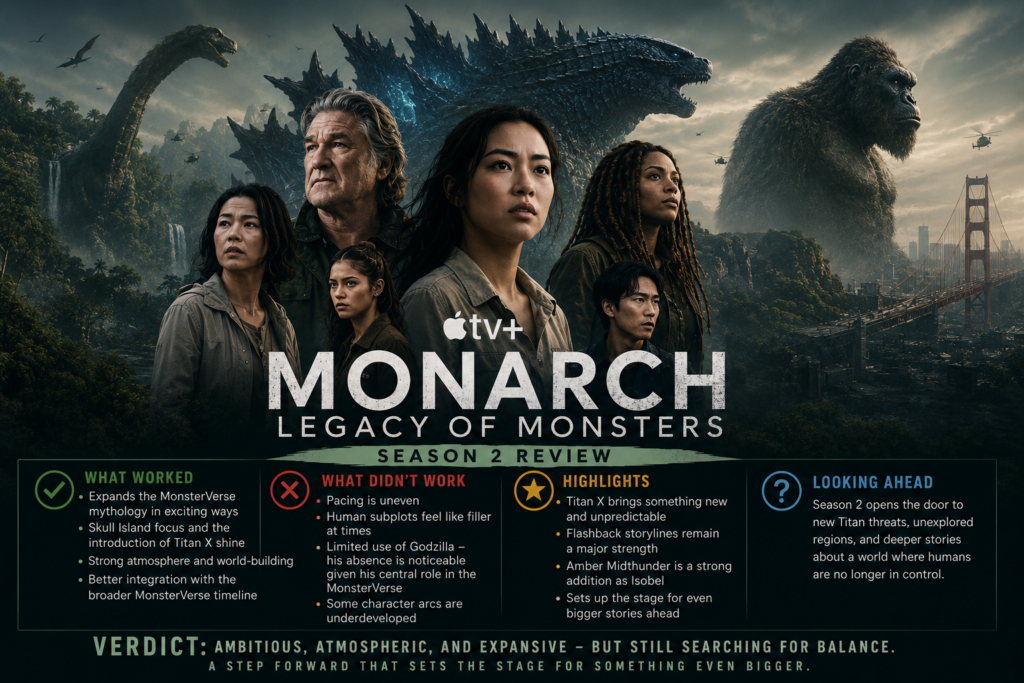
A Bigger and Darker Return (Warning Contains Spoilers)
In season two of Monarch: Legacy of Monsters, the production team ups their game significantly. Season two premiered on February 27, 2026, and concluded on May 1, 2026, after ten episodes. It picks up right where we left off in “Axis Mundi.” The season puts us back in a world of science versus survival. Cate Randa and Keiko Miura arrive back on Earth but they are different people than before. Lee Shaw’s ambiguous status adds an edge to the beginning episodes.
Much of the season takes place in 2017. The timeline carefully bridges the gap between Kong: Skull Island and Godzilla: King of the Monsters. This time, Skull Island becomes the true centerpiece. It evolves beyond a mysterious location into a dangerous, living environment. The island reflects the instability of a Titan-dominated world.
The season also embraces a more survival-driven tone. At the same time, it still delivers the epic spectacle expected from the MonsterVerse.
Returning Cast Keeps The Story Grounded
One of season two’s greatest strengths is the returning cast. Kurt Russell returns as Lee Shaw and brings real gravitas to the role. Shaw feels haunted by both the past and the present. Anna Sawai returns as Cate Randa, whose perspective continues to anchor the story. Mari Yamamoto also returns as Keiko Miura, alongside Ren Watabe and Kiersey Clemons.

Even as the world becomes larger and more dangerous, the emotional focus remains firmly human.
But Cate’s story may also be divisive amongst the audience. The season tends to focus more on her emotions than those of others. Sometimes, her character’s storyline can be repetitive instead of being an evolution. It is a good idea, but it does come off as being too restrained.

But Lee Shaw’s story is much more effective. Kurt Russell makes the character introspective and tortured. Scenes featuring him are emotionally charged, despite the writing sometimes failing to fully exploit his talent.
Keiko Miura gets one of the best arcs in the entire season. Mari Yamamoto makes her an emotionally strong character. Her adaptation to a new world is very convincing.
May Olowe-Hewitt remains engaging thanks to Kiersey Clemons’ charisma. Unfortunately, parts of her storyline feel disconnected from the central narrative.
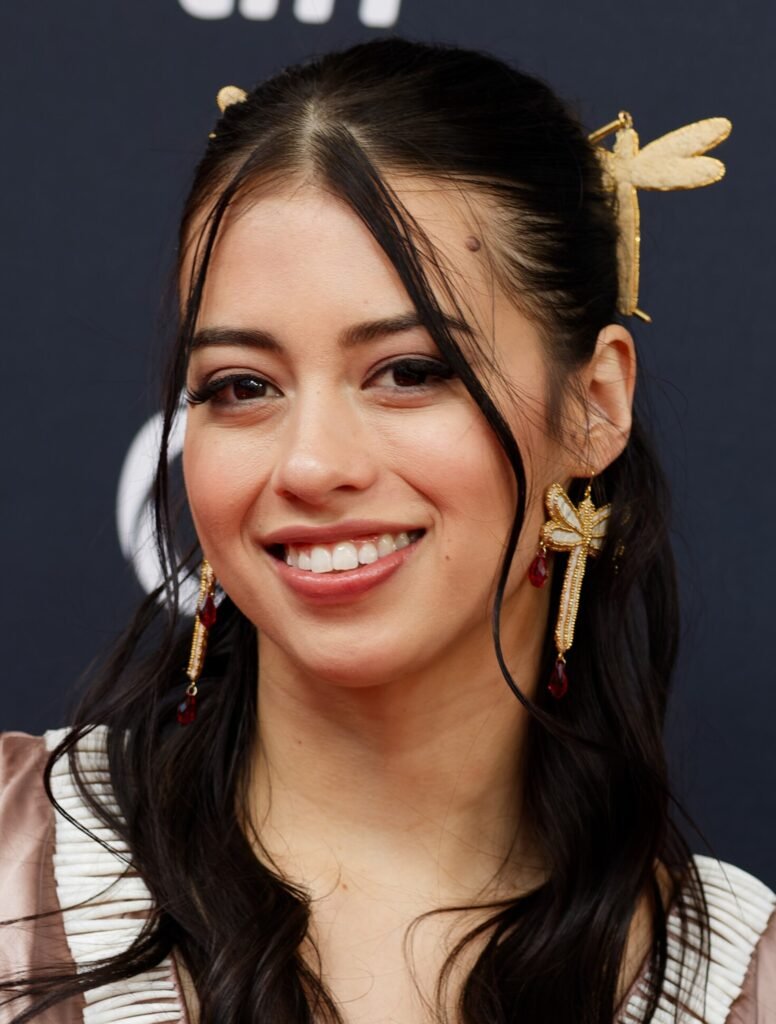
A major new addition is Amber Midthunder as Isobel. She immediately feels tied to the larger Titan conflict. Midthunder brings urgency and grounded energy to the role, making Isobel one of the season’s strongest additions.
New And Old Titans
Sure, the Titans cannot be forgotten, either. Well-known giants such as Godzilla and King Kong appear in the narrative once more. Nevertheless, Titan X is the most exciting element introduced in this season.
The large sea Titan is reminiscent of the classic Toho monsters like Destoroyah and Biollante. With the introduction of Titan X, an entirely new element of fear and mystery is introduced into the series.
A notable enhancement to the visuals is also seen in season two. The Titans seem to blend well with their surroundings. The lighting, texture, and composite are all better than before.
The water interaction effect is particularly impressive in this season. It seems that the waves and splashes have proper mass and scale now. Titan X definitely reaps the benefits of these enhancements.
The show also seems to get better at using their creatures. The Titans are more common and more detailed. Tracking shots and smooth camera work allow the creatures to look less like TV creatures and more like film creatures.
The destruction of the environment is also more realistic in this season. Trees bend, structures fall apart, and whole landscapes shift under the Titans.
Equally significant, however, is the fact that the series maintains self-restraint. The action does not become a constant string of monsters going at it. Rather, the series is wise in determining when to showcase the Titans.
Stronger Directing And Atmosphere
The second season takes on a much more confident directorial identity than the first. In comparison to the first season, the direction is much more cohesive and atmospheric.
The episodes taking place on Skull Island are particularly successful. With the dense jungle scenery and low visibility, there is a sense of tension that never leaves.
Monsters are also rarely shown on screen by the directors. The titans are usually obscured by either fog, water, or plants. This builds suspense and highlights how massive the creatures are.
The series undoubtedly takes its inspiration from movies such as Kong: Skull Island and Godzilla: King of the Monsters. The stormy skies, bioluminescence, and darkness make the titans seem almost godlike.
On the other hand, the camera remains on the ground level. Human reactions become more important than shots from above.
Even the quieter scenes get their due here. Close-ups and limited camera movement emphasize the dramatic acting.
Titan X also brings new visuals. The scenes underwater have an eerie dream-like quality to them. Unusual perspectives and slow reveals ensure that the creature remains a mystery, rather than a villain.
The overall directing is more consistent and polished. The season knows when to dial it back and when to go all out.
Themes Of Legacy And Survival
Another important theme is that of coexistence vs. domination. Using the monsters of Godzilla, Kong, and Titan X, the film challenges the question of whether humanity can coexist with the Titans.
The introduction of Titan X also changes the way the monsters are portrayed. The monster becomes more of an integral part of nature, something that mankind cannot comprehend.
This season, the storytelling seems even more cohesive. By focusing the story on Skull Island, the plot gains identity. Character arcs are better connected to the themes present.
Pacing is still hit-and-miss at times. There are times when the middle episodes feel slow, and there are subplots that lack proper development.
Multiple timelines do result in narrative fragmentation at times. Atmosphere can overwhelm pacing in some episodes. Titan X, while intriguing, feels like an underdeveloped concept given all the buildup leading up to it.
Human Drama Still Divides Viewers
One continuing difficulty with the series is striking a proper balance between character drama and monster action.
Clearly, the producers want to tell a character story before anything else. The Titans are more menacing than a steady stream of action scenes. But viewers who come looking for monster action will still get bored with the slower pace.
However, the flashbacks tend to be more effective due to their tighter connection to the origin of Monarch and its Titan mythology. On the other hand, some contemporary stories may seem unnecessary at times.
It is clear that there are certain production limitations. For example, characters such as Godzilla and Kong need massive amounts of visual effects. Consequently, the show uses them selectively.
Fortunately, the second season is able to manage this problem successfully. The best episodes of the show tie human stories to Titan mythology.
Final Verdict
Monarch: Legacy of Monsters season two thrives on its full potential to explore all the elements that set it apart from the rest. The overall ambiance is more immersive, Skull Island seems like a real place, and the Titan mythos becomes all the more intriguing.
Titan X is arguably the most intriguing Titan to be featured recently in the MonsterVerse series.
The season certainly gets much better on the grounds of production values, direction, and effects. The absence of the Titans notwithstanding, their influence is always felt in the environment of the protagonists.
Yet there are some issues with the pacing in the season, particularly regarding some of the less consistent human subplots, which may sometimes slow down the overall pace.
Overall, though, the second season proves to be bolder and more cinematic compared to the first one, not just more extensive but deeper too.
When the balance between character drama and Titan spectacle works, the series delivers some of the franchise’s most immersive and visually impressive storytelling yet.