
World War II with Tom Hanks: Review
Introduction
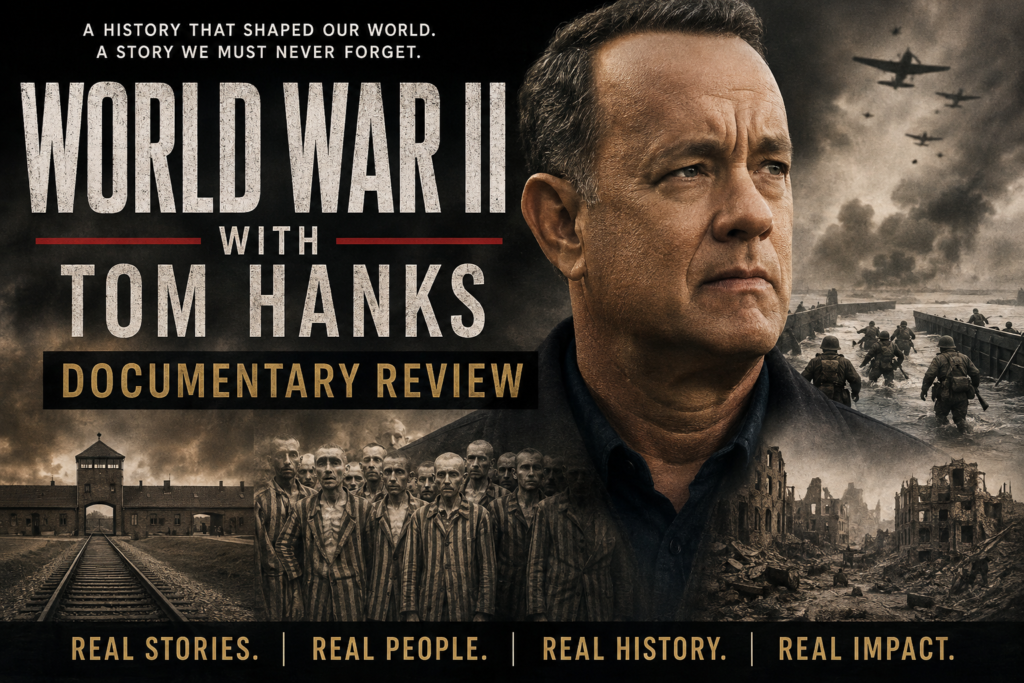
WWII With Tom Hanks is an ambitious documentary series that seeks to delve into what could be considered the most significant war in history.
The documentary consists of twenty episodes that seek to give an overview of the Second World War. It uses restored archive footage, renowned historians, and Tom Hanks’ voiceover.
The film addresses the development of fascism, warfare, and the consequences of the war. The series follows the story through Europe, Asia, Africa, and the Pacific.
Major battles and decisions made by political leaders that have influenced our world in one way or another are discussed. The experiences of people behind the historical events are also addressed.
The series is coming out in an especially intriguing period of time. Tensions in the modern world make the documentary even more topical.
How societies and people fall into conflict and how division within society develops is shown in the documentary. Whether it was the idea of the directors to convey this message remains unknown.
Instead of focusing on just the wins, the documentary looks at the effects of war. The documentary looks at the choices that were made and the suffering that resulted from those choices. It feels like both a historical account and a warning.
A Global Perspective Rather Than an American Story
The documentary’s biggest strength is the balanced view that it holds. Many people watching would expect the story to be from an American point of view. Tom Hanks is very well known for his movies about American war stories.
However, this series does not become an exclusively American interpretation of the war. It acknowledges the fact that the war had started well before the entry of America into the war. The first few episodes deal heavily with Europe and its involvement.
This kind of structure is extremely significant from an editorial perspective. It gives the audience an insight into the reasons behind the war and the problems which Europe was facing at that time. The viewers come to know that the war was already global before America entered into it.
The series does not go on to immediately jump into American involvement in the war. Instead, it builds up the entire context of the war. Pearl Harbor becomes one of the turning points in the war.
Another strength of this series is its portrayal of the difficulties faced by America. The series does not neglect the losses incurred in battles against Japan.
Pacific War is portrayed truthfully and objectively. The successes of Japanese forces are admitted along with those of the Allies.
In this way, the credibility of the series is enhanced. There is no glorification of any nation. Every military operation carries its own repercussions. This series understands the complexity of history.
Courage, sacrifices, errors, and tragic situations have been part of World War II. These aspects of the war have also been captured in the documentary series.
The production of the documentary series indicates a deep understanding of the process. The producers have used archival footages in presenting their narratives. These footages are not used as mere background materials.
They have been enhanced to become an important part of the storytelling process. Improved images have enhanced viewers’ connections with events of the past.
Editing is also worth mentioning. It is difficult to coordinate historians, archival footages, and narration by Tom Hanks.
While historians give explanations for the events, the visual content serves as supporting evidence. Tom Hanks is the guide for the bigger historical story. All elements complement each other very well.
Transitions from the commentary to the footage flow effortlessly. There are no instances where the documentary seems to be made up of separate parts. On the contrary, it is one continuous historical story.
Another element that is worth mentioning is the pacing. This documentary takes its time when it comes to major historical events.
The most important moments get proper attention. In addition, there is no information overload for the viewer.
There is a great use of maps, pictures, and documentation throughout the series. It makes the complicated military moves easier to understand.
Finally, the series does not overuse the dramatization of the events. It lets the authentic material speak for itself emotionally.
The editing style highlights the need for presentation. It is impossible to convey the whole story with just historical footages. Organization and explanation are needed.
The Historians and Their Role
The historians give the human and political repercussions of the decisions. They make it clear that there were always ramifications to every decision made.
The insights provided by the historians complement the themes of the documentary. The themes that they address include issues of leadership, ideology, propaganda, and conflict.
It is good that the series gives experts the chance to challenge assumptions. The series makes one think about what is said instead of just accepting it.
The Human Cost of War
One of the strongest points of the documentary is its openness. The creators do not shy away from portraying the cruelty of the war. The series depicts war as a destructive event for human beings.
The pain and suffering of soldiers are presented clearly. The casualties among the people engaged in the war are not ignored. The documentary depicts the reality of war.
At the same time, the attention is paid to civilians as well. The destruction of cities due to bombings is described in detail. The influence of the war on families is discussed.
Such an approach makes it impossible to turn the event into a mere military affair. The documentary depicts the impact of the war on the whole society.
The episodes dedicated to the Holocaust are especially strong. The episodes are among the most important ones of the series.
The use of genuine footage and pictures in the documentary is deliberate and appropriate. There is no exploitation of these images for their emotional value. Rather, they are presented respectfully.
The historians play an important role in putting all of this into context. They discuss how Nazi ideas came about. They illustrate how discrimination grew into systematic genocide.
This pairing of evidence and explanation is extremely powerful. The viewer is able to appreciate the magnitude and the human cost of what took place.
This contributes to the overall message of the documentary. History must be remembered as it happened. The dangers of intolerance should never be forgotten.
Themes and Modern Relevance
The themes of the documentary series remain relevant as they link the past with the present times.
The series depicts ways in which societies can evolve into conflict. The danger of propaganda and extremism is one of the topics addressed in the film.
There is no obvious reference to the contemporary situation in the show. At the same time, the information presented remains relevant.
The documentary series indicates that conflict usually arises slowly. Conflict is usually a result of political decision-making and division in society. Conflict may have extremely negative results.
As a consequence, the series goes beyond its historical aspects and provides insights into human behavior. This encourages the viewer to reflect about the importance of peace.
The role of memory is also discussed in the series. In order to prevent the same mistakes from happening again, people should remember their history. Knowledge of history becomes an important defense mechanism.
Therefore, the show’s makers create a series that is educational and reflective at the same time. The series treats viewers as thinking individuals.
What Worked and What Did Not
The documentary succeeds on multiple fronts. The most impressive achievement of the documentary is, in my opinion, its scale. Making a documentary on the Second World War is no easy task.
The combination of images, historians, and narration is extremely effective. The documentary remains interesting throughout its twenty episodes and creates a great base to understand the war.
Unfortunately, the size of the project limits the documentary in certain ways. The timeline can be somewhat confusing. Switching between theatres of war can be distracting.
Indeed, there are many different countries and campaigns covered by the documentary. This makes the documentary ambitious, but also complicated. Some transitions from story to story were not smooth enough.
Finally, another limitation of the documentary was that some of the topics could have been covered in greater detail.
There are countless stories related to the Second World War. Twenty episodes just cannot cover everything in depth.
The constraints in the documentary serve as proof of how ambitious it is. It tries to tell the story of a conflict that covers the whole world. Any form of the documentary would face challenges when making decisions.
An improved timeline format would make the documentary more accessible. Some viewers could have been assisted with more summaries. These small problems do not affect the documentary’s quality in any way.
Overall Verdict
On the whole, World War II with Tom Hanks is a remarkable and meaningful documentary. It succeeds in introducing audiences to the complexity of World War II. It is historically accurate while being emotionally appealing.
The most impressive aspect of the documentary is its balance. It does not turn into a celebration of one nation. It shows several angles and faces the reality of war.
The restored footage gives viewers a link with history. The historians bring in their knowledge. The narration of Tom Hanks provides coherence.
The way the documentary deals with human pain is impressive as well. It pays tribute to soldiers, civilians, and victims of genocide. It makes sure that the war is not glorified.
There were also some structural problems which needed to be elaborated upon in greater detail. But when comparing these flaws with all of the strengths of this series, they are insignificant.
Finally, the reason why World War II with Tom Hanks is a success is due to the fact that it is aware of the importance of learning from history.
It is not only showing what happened but also why it happened and what can be learned from that.
This series serves both as an educational tool and as a warning. It proves how dangerous hatred, separation, and aggressiveness are. More importantly, it explains why the knowledge of history is so crucial.