
Blue Heron Film Review
Introduction
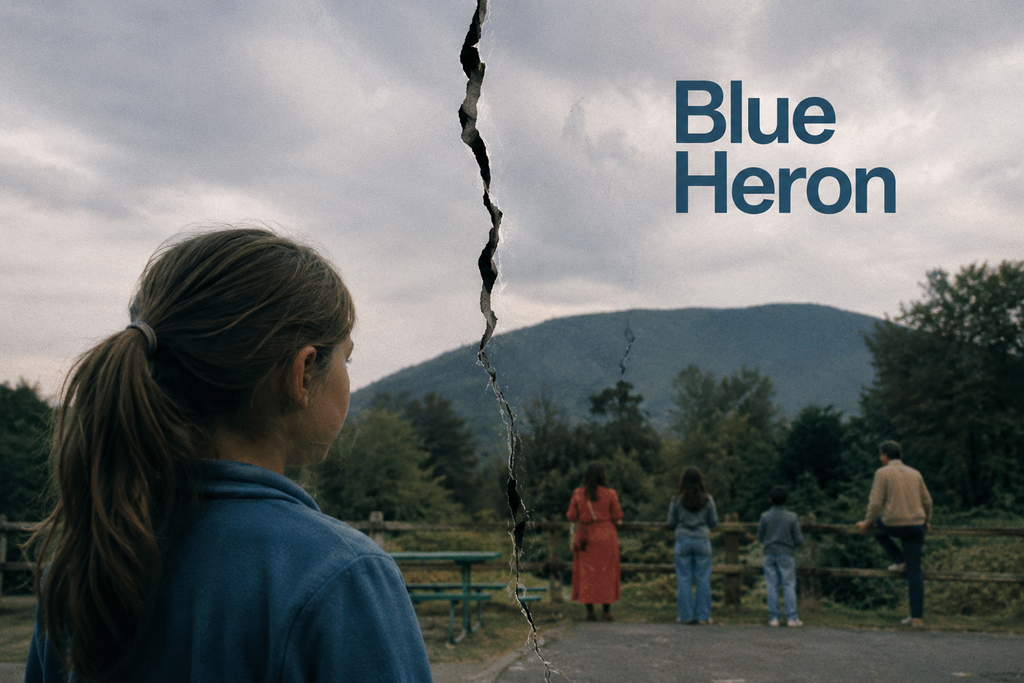
Blue Heron is an intimate movie about childhood, family traumas, memories and grief by Sophy Romvari.
The movie takes place on Vancouver Island in the late 1990s and focuses on eight-year-old Sasha and her family of Hungarian immigrants.
While the family’s new suburban home was meant to symbolize a new beginning, internal conflicts soon shatter this illusion.
Jeremy, Sasha’s elder brother, becomes more and more aggressive, thus creating the feeling of fear and uncertainty.
Romvari does not present the family’s circumstances in a direct way, rather she lets Sasha experience them while being unaware of what exactly happens around her.
This is how the movie, based on uncertainties, broken memories and lack of understanding of children’s experiences, is formed.
In spite of being a debutant work, Blue Heron shows a remarkable confidence of its visual and narrative language.
A distinctive directorial approach

The best decision made by Romvari is to limit the first part of the movie by using Sasha’s childhood point of view.
It affects how the audience perceives the information. The characters and actions of the film can be viewed only in the light of Sasha’s perceptions, her experience.
She doesn’t understand completely why Jeremy acts like that; consequently, the audience also does not understand his behaviour.
It creates tension through the feeling of uncertainty but does not involve the explanation and psychoanalysis of his character.
Romvari’s movies do not use trauma as a spectacle. Silence, pauses, gestures, minor details create a sense of reality.
It allows to perceive the situation in a more realistic way and does not make it melodramatic.
The viewer becomes the observer of the family instead of a judging person from the outside.
It is also important because Sasha tries to understand what is wrong with them too.
Moreover, Romvari does not stereotype Jeremy in the role of villain.
It is a very scary person but he is not a symbol of evil. It adds to the complexity of a family’s image when they try to cope with difficult behaviour.
The Parents are also shown as complex characters without simplification. They care about their son but also feel afraid for other children.
This technique is the film’s biggest strength. It gives Blue Heron the ability to look at traumatic experiences without having everything turn into a conflict.
The film recognizes that trauma does not have to be loud. The film recognizes that trauma can take place silently in a regular family home. This concept makes up most of the film’s emotional power.
Cinematography and visual storytelling
The work of Maya Bankovic as cinematographer is significant in the creation of the film’s intimacy.
The visual style can seem natural, observational, and detached.
It fits Sasha’s lack of comprehension of her surroundings. The camera itself can seem to observe, rather than to suggest what to look at.
Slow zooms can be used especially effectively in the childhood parts of the film. It can suggest Sasha’s attempt to understand the object that she sees.
The movement itself is soft, which helps not to distract the viewer visually. In addition, it encourages them to find out more information about the details in the scene.
Bankovic also uses distance and framing to make the film emotional. Characters can enter the shot through doorways, windows or other visual barriers.
An important dialogue can take place, while the camera shows something else. The technique reflects the children’s perception of adult life.
Sasha can hear something, but not fully understand it. She can see some gesture, but not feel its importance emotionally.
Thus, the cinematography is an integral part of the story itself. The visuals of the film can seem fragmentary and selective.
It is especially important considering that the film is semi-autobiographical and based on memories.
The naturalistic lighting helps to reinforce the sense of authenticity of the film. The settings of the family can be presented as warm, familiar and beautiful.
This beauty can contrast with the anxiety that is building up in the house. The contrast helps the settings to feel nostalgic, but not to represent childhood as perfect.
The visual style helps to establish the biographical aspect of the film. Blue Heron does not seem to be a reconstruction of history in a polished way.
Instead, it seems to be a reconstruction of memories, built from partial information.
Creating a biographical style
Romvari achieves the sense of autobiography through several interrelated techniques.
First, she does not reproduce her personal experience as an objective historical account.
She rather focuses on how personal experience turns into memory and story. Specific period of time, place, and family setting are depicted in the childhood scenes.
The time is the 1990s, which makes it easy to introduce some sense of personal history. Domestic spaces make the story appear more realistic and related to personal family experience.
Cameras, photographs, and recordings are also symbolic objects in this film.
They are associated with childhood experience and documenting the memory. The fact that the main character becomes a filmmaker is also very symbolic because Sasha grows up to be someone who records and investigates experience that was confusing for her before.
Adult story-line also works in the same direction. Adult Sasha tries to figure out her family through interviews and documentary techniques.
She recalls the events that were hard for her to understand when she was a child. However, more information does not lead to complete emotional certainty.
This is the moment when the film becomes especially thought-provoking. It questions the idea that remembering something means understanding it.
Memories preserve the details but still leave many questions unanswered. Moreover, they can evolve as people get to know something about their past better.
Thus, the reliability of memory is questioned in the film, but memories are not considered meaningless.
On the contrary, they become very emotionally significant even though they are not completed. This is one of the key ideas of the whole film.
The Two Timelines
The structure of the film makes it unique and special for the perception. The first half depicts Sasha’s early life period.
The second half goes ahead of time for about twenty years and shows Sasha in adult age.
The difference in the approach leads to re-evaluation of the previous perception.
Childhood part demonstrates experiences of Sasha in a situation which she cannot understand completely.
Adult part shows Sasha trying to interpret these experiences with the help of more knowledge.
Therefore, there appear two perspectives on the same emotional experiences.
Child is confused and uncertain. Adult tries to build some meaning of these experiences.
The structure also helps the film to avoid falling into the category of childhood trauma films.
The film turns out to be a reflection on the relation between the past and the present.
Sasha does not try to remember her past experiences. She is trying to interpret the meaning of these experiences.
Thus, the flash-forward is not only a part of the narrative structure. It becomes the depiction of the continuity of trauma into adulthood.
The past lives in memories, investigation and mourning of Sasha.
However, the structural transition is not perfect. The first part of the film establishes the rhythm of the childhood observations.
The second one uses more reflection and documentary techniques. Some people will be disturbed by this transition.
The transition can stop the momentum that was created by the previous part of the film.
It asks the viewer to make another adjustment after he/she gets used to the initial rhythm of the film.
Nevertheless, the disruption has its artistic purpose. It shows that the adult perception cannot reproduce childhood experience.
Themes Of Memory, Grief, And Family
Memory has been highlighted very skillfully in the movie. Nearly every important filmmaking aspect is used to support the theme of remembering.
Structure, photography, performances and documentary are some of the factors that help in reinforcing the theme.
Grief is portrayed in a unique manner in the movie. There are no indications in the movie that grief is supposed to go through certain stages.
Grief, on the other hand, remains intertwined with the themes of memory and family.
It may affect how people interpret events long after they have occurred.
Family is also an important theme in Blue Heron. The movie demonstrates how problems faced by an individual can affect an entire family.
Behavior of Jeremy creates a certain emotional atmosphere around him.
Sasha suffers from such emotional turbulence without being able to interpret it properly.
Responsibility is also among the themes highlighted in the movie. Parents have to balance their love for Jeremy with their responsibility towards other children.
There is no straightforward solution in this case. Lack of such an easy resolution makes the family appear more complex.
Theme of identity has been presented through adult Sasha. Experiences suffered during her childhood are linked to her decision to become a filmmaker.
Now she has learnt how to observe, document and investigate things.
Such interconnection of her childhood and adulthood allows for more sophisticated character development.
Occupation of Sasha is no longer just a characteristic of her adult self. It is rather a reflection of her ability to deal with traumatic experiences.
Character Development And Performances
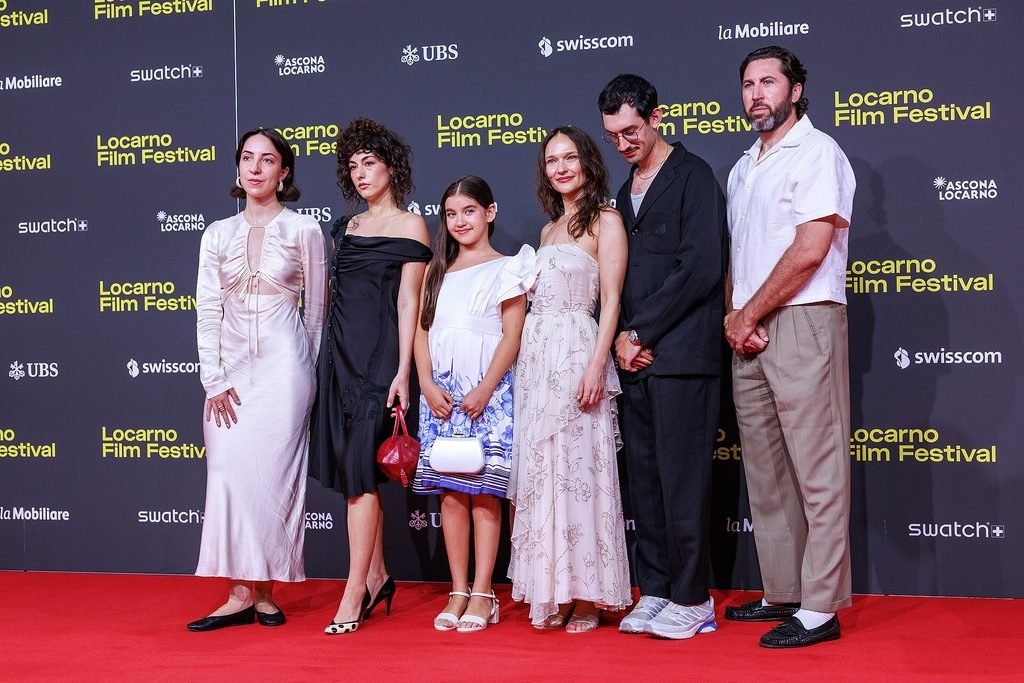
Sasha is certainly the best-developed character in the movie. We get access to the childhood story mainly through her eyes.
We see her reaction to things that she does not quite understand.
Eylül Guven performs well without making her look like a child version of adult. Her reactions are more observational than analytical.
Often she conveys uncertainty through facial expression and behavior changes. Such an approach works perfectly fine for the film.
Amy Zimmer has another kind of challenge in playing adult Sasha. She needs to convey a person who lived with unresolved memories for many years.
Thus, her performance is quieter and more contemplative.
The difference between the two performances is very helpful in distinguishing childhood and adult Sasha.
Young Sasha is observing without understanding while adult Sasha is investigating in order to understand something.
Hence, performances contribute to the film’s main themes regarding memories.
Edik Beddoes‘ task is much harder when he plays Jeremy. He must make the character scary without simplifying it to the level of villain.
In this way, his performance is helped by the fact that the film decided to make Jeremy partially enigmatic.
Nevertheless, partial development of Jeremy can be seen as one of his weaknesses. His impact on the family is much clearer than his inner experience.
Audience does not see the whole picture of his personality. It is clear since the plot is concentrated on Sasha.
However, some people would prefer to know more about Jeremy.
Supporting characters have even less development compared to Sasha. It happens partly due to the shortness of the film but also due to its main theme.
More development could help to improve some relations in the family.
Storytelling, Runtime, And Pacing
Despite its relatively short length, the running time of the film can be justified by the storyline.
Romvari does not try to explain everything connected with family’s past. She picks out the moments which help her to reveal the atmosphere of Sasha’s childhood.
Thus, there is a fragmentation of storytelling.
The viewer gets some impressions but not the whole biography of the family.
Such approach corresponds to the philosophy of the movie concerning memory. Also, it helps not to overcharge the story with the exposition.
Still, the slow pace is not suitable for all viewers.
Some parts of the movie stay on everyday moments for a long time.
Lack of a usual dramatic escalation may make the plot seem deliberate.
It can be both an advantage and a disadvantage.
The slow pace gives time for perception of Sasha’s surrounding.
Also, it helps to create the atmosphere of gradually growing family’s tension. However, it may weaken the narrative momentum of the movie.
The adult storyline raises another problem.
The film becomes more reflective after the time leap.
It starts to concentrate not on the family’s tension but on the investigation and interpretation of what happened.
Some viewers may find it less emotional.
Other people may like the chance to think about the consequences of their childhood.
Thus, the success of this part of the film can depend on expectations of the viewer.
At the same time, the pacing of the movie reflects the philosophy of the film. Romvari is interested in the everyday moments connected with trauma.
She is not interested in creating the usual chain of dramatic events. Slow rhythm allows her to do it.
What Works And What Does Not
The strongest element of Blue Heron is its consistency. The film’s form and themes continually reinforce one another.
The cinematography supports the childhood perspective.
The performances support the naturalistic tone. The structure supports the exploration of memory.
Romvari also deserves credit for resisting melodrama. The subject matter could easily have produced a much more conventional family drama.
Instead, she trusts silence, observation, and ambiguity. That restraint gives the film a distinctive identity.
The autobiographical approach is another major success. Romvari does not simply tell a personal story.
She questions how personal stories are reconstructed through filmmaking. This gives the film an additional layer of meaning.
The main weaknesses come from the same choices that make the film distinctive. Its ambiguity can create emotional distance.
Its slow pace can test the audience’s patience.
Its supporting characters can feel underdeveloped.
The transition between timelines is also a calculated risk. It is intellectually justified but can weaken the momentum of the first half.
The film asks viewers to accept a significant change in tone and storytelling.
Jeremy’s characterisation presents a similar issue.
His mystery strengthens the child’s perspective.
However, it limits our understanding of him as an individual.
This leaves an interesting question about whether thematic consistency outweighs character depth.
Despite these weaknesses, the film rarely feels confused about its intentions.
Its decisions are purposeful even when they are not universally successful.
That distinction is important when evaluating a first feature.
Overall Verdict
This debut film by Romvari is ambitious and thought-provoking. The biggest success of this movie is in the fact that memory became a part of its form.
The audience does not just hear about remembering, it becomes part of a story being remembered.
The cinematography of Maya Bankovic helps with this effect. Also, the performances remain natural, while the two timelines help Sasha’s story to be emotionally deep.
The movie does have some flaws. It can be slow-paced, and its structure might be not appreciated by everyone.
Some characters could get better development.
Also, the deliberate ambiguity sometimes results in detachment from the characters.
Still, these flaws do not outweigh its strong sides.
These are the risks of the chosen unusual method.
Romvari refuses to transform complicated experiences into simplified explanations, and this decision is what makes Blue Heron emotionally true.
Being a debut feature film, it displays a lot of confidence. Romvari demonstrates her ability to combine directing, cinematography, performances, and structure into something interesting.
Her decisions were not always easy, but they were never without meaning.
In conclusion, it can be said that Blue Heron is successful because of its understanding of the limitations of memory.
The film understands that some childhood experiences cannot be easily explained.
It understands also that the process of aging does not give the complete answers to all the questions.
Sometimes, being adults creates more questions about experiences that seemed easy to interpret before.
This transforms the movie into something bigger than just a story of a dysfunctional family. It becomes an exploration of the ways people bring the past into the present.
For those who are willing to accept its unusual pace, this movie becomes rewarding.
Its imperfections are apparent, but its ambitions make it impossible to underestimate.
Being a debut film, it becomes clear that Romvari is a promising filmmaker.