
The Gentlemen Season 2 Review
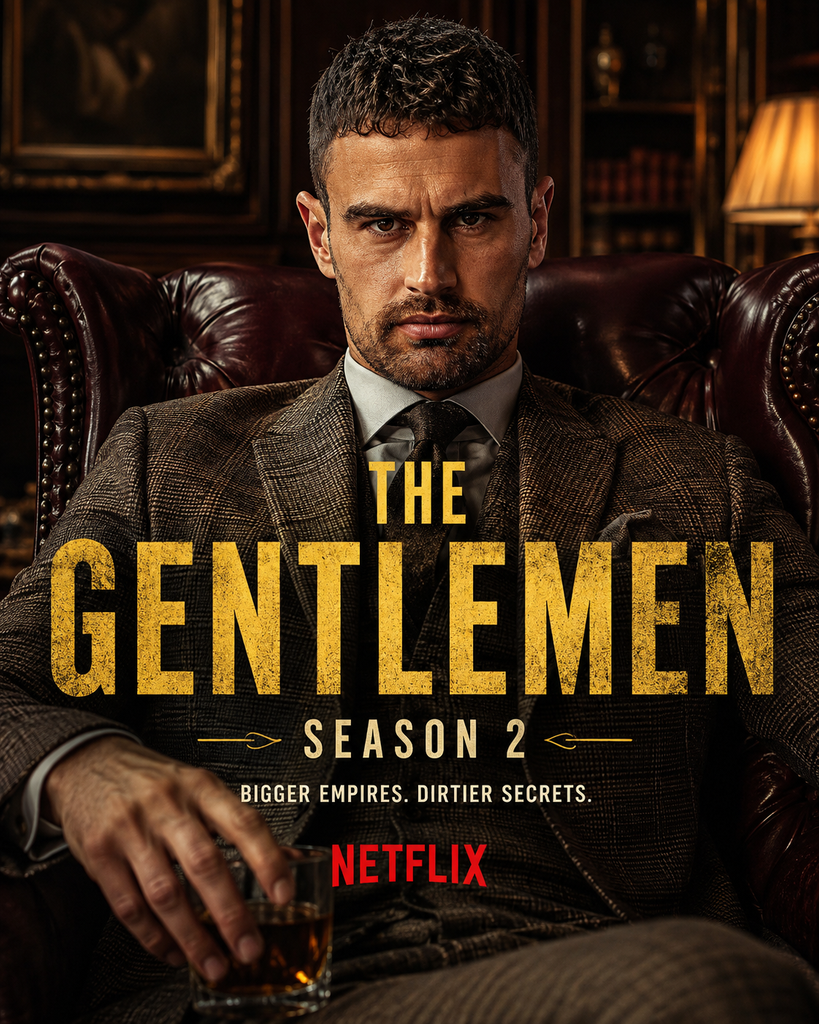
Introduction: The Gentlemen Season 2 Review
Note: The Gentlemen Season 2 Review discusses the season’s themes, character development, and ending direction without giving away its biggest twists. Although some spoilers may be there.
A Bigger Empire and a Different Eddie
There is a noticeable difference between Eddie Horniman (Theo James) in the first season and the man we meet now.
Eddie Horniman in the first season unwillingly got involved in the world of crime. He received an estate and realized there was a huge amount of marijuana planted under his land.
At first, it seemed like a problem he had to solve. Crime became a thing that Eddie had to control.
But everything changed in Season 2. Eddie is no longer surviving in the world of crime. He has begun to appreciate what it can do.
This development forms the basis of the second season. Eddie and Susie Glass seek to extend their criminal enterprise beyond Britain.
The two aim to venture into Italy and further into politics and the aristocracy. This brings about a storyline that extends the reach of the television series both geographically and socially.
All eight episodes were released on Netflix on September 3, 2026. Season 3 was confirmed by Netflix before the release of the second season.
That renewal makes sense from a storytelling perspective. Season 2 leaves plenty of room for the criminal empire to become even larger.
Several characters leave with unfinished stories as well.
But expansion poses an intriguing query. Is it better to be a more extensive version of The Gentlemen?
The answer is not simple.
The expanded version of the film does have more spectacle, crime, and international intrigues. It also has more of Guy Ritchie‘s (The show’s creator) humor and unique visuals.
That tension defines much of Season 2. It is recognisably The Gentlemen, but it is also attempting to become something larger.
Direction and the Guy Ritchie Style

The directorial approach by Guy Ritchie still continues to be a defining characteristic of the show.
Fast transitions between different characters, places, plans, and twists characterize the show.
One can never be sure when a normal conversation will not develop into violence.
It will soon change into humor again. This pace makes the show have a unique personality. The direction rarely allows scenes to remain straightforward for long.
Ritchie co-directs with Eran Creevy and Nick Rowland during the second season. The list of the writers include Ritchie, Matthew Read, Danielle Ward, John Jackson, and Iain Weatherby.
This way, the visual style is maintained. Nevertheless, the second season makes it possible for other directors to add something new into that style.
The direction becomes more sure-footed when the story moves to Italy. New locations add new visual and cultural atmosphere to the series.
Italian villas and country scenery take the place of some British country estates. This way, the criminal world becomes bigger while keeping its aristocratic base.
Direction uses contrasts well.
In the picturesque locations, the characters are discussing murders, drugs, money, or betrayals. Expensive environment is combined with extremely ugly actions.
That distinction lies at the very core of the series’ identity.
The series also knows the humor of crime in high society. Eddie is able to have serious conversations about criminal business while still being surrounded by the classic signs of opulence.
This forms one of the key gags of the show. The characters live in a world of privilege, but they begin acting like gangsters.
It gets even more exaggerated in season 2. The ambition of Eddie’s criminal pursuits begins affecting his interactions with British politics.
This allows the theme room for more material. Yet, this hectic approach can at times become too much.
There are scenes that seem geared more toward creating some crazy action sequence than anything else.
That is one of the season’s central weaknesses. Ritchie’s style remains entertaining, but it sometimes feels like the style is driving the story rather than supporting it.
Cinematography and Visual Style
Visually, Season 2 is one of the show’s most impressive elements. The program retains its attraction towards the luxurious side of life, as well as its interest in luxury buildings, tailoring, cars and landscapes.
Season 2 further develops this visual universe by venturing into Northern Italy.
This way, cinematography gets new visual material to work with. British nature and Italian locations produce a completely different atmosphere.
Cinematographer Stephen Murphy collaborated with director Eran Creevy in crafting the darker visual style of the season. Interviews with the crew talk about how the visual style of the season was partly inspired by Tony Scott.
This is reflected in the use of movement and vibrant color. The shows also make even mundane conversations seem expensive. Movement is something that the camera loves.
People enter rooms confidently. Cars move across landscapes. Massive mansions and estates act almost as if they were characters.
This lavishness in visuals matches Eddie’s evolution. In Season 1, the estate was a burden. In Season 2, wealth becomes more about power.
Thus the camera is able to capture Eddie’s evolving relationship with his environment. Costumes matter here just as much.
Eddie’s custom-tailored attire conveys his metamorphosis better than dialogue at times. Now, he appears to be at ease in the world he once rejected.
Susie’s look also serves as an expression of her power. Her attire and setting speak to her increasing stature.
It is in this way that The Gentlemen grasps the importance of television as a visual medium.
The show does not merely state to its viewers that these characters have money. Rather, it continually demonstrates it.
There is, however, a risk involved here as well.
The visual elements might sometimes overshadow subpar storylines. A beautiful picture cannot cover up lackluster dialogue.
If the dialogue is good, then the visuals make it better. If the dialogue is not, then the style might just be decorative.
Season 2 therefore succeeds visually more consistently than it succeeds narratively.
Storylines, Pacing, and Character Development
The biggest development of all is Eddie himself. He has progressed from an unwilling aristocrat to an ambitious criminal.
This development provides a character-driven element to the season that was lacking from its predecessor.
Now Eddie actually has goals and wants things instead of just acting in response to situations. He wants more power and an expanded empire.
This creates a number of issues.
Growing internationally means that Eddie now has to interact with people who play by different rules. Enter the Italian Mafia.
Sergio Castellitto plays Marco Moretti, a powerful Italian crime boss. Michele Morrone plays Cico Maldini, who becomes Eddie and Susie’s local fixer
This helps give the plot more thematic substance.
The season is thus not only about making more money from cannabis but what happens when criminal money starts having an impact on respected institutions.
That concept could have been developed further.
Sometimes, the political content seems to be just another layer of comedy and complications for the show without delving into it.
Another aspect that is both good and bad is the pacing of the season. Certain scenes are very energetic. Some others require more time before they develop into something significant.
The fact that it is an eight-episode season avoids the lengthiness of the season.
Season 2 clearly develops Eddie, but not every character receives the same attention. Susie is vital to the story, although her development is not independent of Eddie’s development.
This is somewhat surprising since Kaya Scodelario is still one of the best performers in the show.
The partnership between Eddie and Susie is engaging because neither of them fully trusts each other.
There is a mixture of emotions in their professional interaction. Furthermore, their ambitions do not align at times.
This provides a solid basis for the future seasons. The Eddie and Susie team is also interesting since neither of the characters can be trusted by another one.
There is emotional conflict in their working connection. Their goals are not always the same either. This makes a good base for future seasons.
Performances and Characterisation

Theo James is at the heart of the show.
The way he acts is effective since Eddie has grown more confident but hasn’t been entirely transformed.
Some of the shy aristocrat seen in Season 1 is there but is being drowned out by ambition. James portrays this change subtly.
It’s not as though Eddie has suddenly become someone else; rather, the choices he makes show how the underworld has influenced his priorities.
That makes his character development more convincing.
Kaya Scodelario continues to provide a strong counterbalance.
Susie is more experienced than Eddie in the criminal world. She understands its dangers in ways that he does not.
Scodelario gives Susie authority without making her emotionless. There is always a sense that Susie is calculating several possibilities simultaneously.
Her relationship with Eddie therefore remains unpredictable.
Daniel Ings continues to bring comic energy as Freddy Horniman.
Freddy remains one of the show’s most ridiculous characters. Yet his unpredictability can also make him useful.
His relationship with Eddie provides a different perspective on Eddie’s transformation.
Ray Winstone also remains important as Bobby Glass. His presence connects the new season to the criminal structure established earlier.
The new cast members provide some of the season’s most interesting additions.
Hugh Bonneville portrays Lord Richard Hawthorne, a character who brings something unexpected to the aristocratic criminal world.
It is precisely the contrast between his role and public persona that works best for Bonneville.
Michele Morrone’s Cico brings a different kind of energy. He is portrayed as useful but somewhat untrustworthy.
This element of uncertainty makes him a good fit in the international storyline.
Sergio Castellitto gives Marco Moretti a more convincing air of power and experience.
Marco, unlike Eddie, does not need to establish his status as the boss.
This contrast goes to show how much further Eddie needs to go.
Benedetta Porcaroli’s Bella is another example that is worth comparing with Eddie since she is aware of the aristocratic circles and has ties to crime.
This expanded cast means that there are more possibilities in terms of storytelling. The issue with the introduction of new characters is that it means less time for the old ones.
That problem is seen in Season 2. Some characters appear mainly to move Eddie’s story forward.
That is efficient storytelling, but it limits their development.
Themes of Power, Class, and Ambition
Ambition is the most fascinating theme from Season 2. Eddie learns that power addiction exists.
At the beginning of Season 1, Eddie was protecting his family and estate. Now he wants to spread himself. It means the moral stance of the character has changed.
Eddie cannot say that crime is committed to him anymore; now he is responsible for his choices. This is why the series focuses on personal responsibility.
This is a significant aspect for the first season. The noble context also enables the show to further examine class issues.
The title of Eddie gives him access to places that the common criminal does not have. Hence his criminal acts take place next to genuine wealth.
The second season takes this connection between privilege and crime further. The entry into politics makes it clear.
It implies that power does not always run through visible criminal networks. At other times, it uses institutions that appear to be respectable.
The show deals with this notion with its customary wit. But there are instances where the basic principle takes on a more serious note.
There is also an exploration of masculinity in the show. Eddie begins to feel the pressure to make himself a powerful man in the underworld.
His confidence may thus be seen as confidence and insecurity at the same time. There is another take on power by Susie.
Susie doesn’t need the aristocratic title of Eddie to make herself heard.
Her authority comes from experience and reputation. That makes their partnership more interesting.
Neither character completely possesses the kind of power the other has. Their relationship is therefore based partly on mutual usefulness.
It also contains the possibility of conflict.
What Worked Best
The biggest strength in Season 2 is the expansion of the world. Italy introduces new places and new criminal contacts.
The political plot line also offers possibilities which go beyond the original cannabis scheme. Thus, the series does not simply replicate the concept from Season 1.
The development of Eddie’s character is another example of real progress. This might be the most important change.
A second season needs to justify its existence through character development. The Gentlemen achieves that with Eddie.
There is yet another factor which contributes significantly to the overall look of the show – the visual style.
The show definitely has an expensive, self-assured and unique look to it. And there are no bad performances from the cast.
Theo James and Kaya Scodelario continue to be the backbone of the criminal couple. There are more interesting faces among the newcomers to the show.
Even when the story becomes violent, there is usually some absurdity nearby. That tonal combination remains difficult to reproduce.
What Could Have Been Better
The major weakness is that of repetition. This second season seems like a rehash of the first season.
While the goals of the characters are bigger, most of the story telling techniques seem similar.
There is also repetition in terms of dialogue.
The unique slang of this show is fun to hear but only in small doses. This is because some scenes seem more style than substance.
Another problem is pacing. The issue is not in the absence of events in the story.
They are numerous enough.
What fails to happen in such instances is the fact that not all events lead to significant changes in the characters.
This gives the impression that the season is even longer than its eight episodes.
Moreover, the political elements in the story could have been used more.
The relation between aristocracy, criminal money and politics is one of the most interesting ideas of the show.
However, it is often treated as yet another source of humor. A deeper exploration of the plot would bring another layer to it.
The character of Susie could also get some focus. She has one of the best relationship dynamics in the show.
A more independent motive would improve the bond even further. All of these criticisms do not discredit the season.
They just highlight areas for improvement in the future.
Does Season 2 Create a Future for the Series?
The answer is certainly yes structurally.
Netflix has already announced an eight-episode third season. Guy Ritchie has revealed that the world of the series has become bigger and the repercussions more serious.
In addition, there are many ways that the story can be developed in the future seasons.
Eddie’s criminal business can grow further. Susie’s situation can get complicated. The link with Italy can come back into play.
Finally, the connection between criminal organizations and the British government can also come into play.
Perhaps most importantly, Eddie himself can grow and develop. He has changed from an unwilling successor to a budding crime boss.
That gives the writers ample room for developing an interesting character arc throughout the show.
The TV show may take advantage of whether Eddie eventually turns out to be just like the person he used to despise.
Susie is another character with plenty of promise. The connection between Susie and Eddie can turn into something good or bad.
There are also options in the supporting cast of characters. Freddy, Bobby, Geoff, and the new Italian characters present different avenues of storylines.
So there is enough content that the show can progress beyond the original idea of the TV show.
Final Verdict
The Gentlemen Season 2 is an entertaining follow-up that succeeds in transforming Eddie while not giving up on the identity of the show.
What makes it most successful is Eddie’s transformation. Now he is not just responding to the criminal situations; now he is seeking power.
This creates a more dramatic background for the season. Expansion into Italy means that the story does not stay only at the usual British setting.
New characters create new conflicts and new criminal authorities. The visual style remains consistently impressive.
The combination of British estates, Italian landscapes, luxury clothing, expensive vehicles, and sudden violence gives the series its distinctive appearance.
The performances remain another major strength.
Theo James and Kaya Scodelario continue to anchor the show. Hugh Bonneville, Michele Morrone, and the wider new cast add further personality.
However, Season 2 is not a complete reinvention. There are pacing issues.
For example instances where the show takes too long setting up scenarios that are basically only there to deliver another spectacular moment.
The political and class issues could have been developed more thoroughly.
This is a problem since the show’s premise already has enough substance for something more challenging.
The best possible rendition of The Gentlemen would still be filled with Ritchie’s humor, but with more emotional depth for its characters.
Season 2 does this quite well, especially Eddie’s character development The question for Season 3 is whether the series can continue that development.
The opportunity is certainly there. This leaves a lot of room for conflicts in the series.
The gossip about Meghan Markle maybe appearing in season 3 has also shown how much attention the series can gain outside its usual viewership.
However, the main reason why the series must be kept going must still be the world it creates.
Neither Eddie nor Susie have run out of storylines. Though their criminal enterprise has grown, their personal relationships are still shaky.
This provides plenty of room for developing the series further.
So the second season therefore feels less like an ending than another stage in Eddie’s transformation.
It broadens the scope of the show without limiting further character development. Its main weakness is its tendency for the writing to be unable to keep up with its ambitions.
Its main strength is its ability to entertain with its characters and style despite the weak moments.
On the whole, The Gentlemen Season 2 offers even more crime, even more glamour, even more international espionage, and the distinct Guy Ritchie touch.
Improvement is not made in all aspects compared to the first season.
But it surely helps develop Eddie’s character in a way and provides the series with more storytelling opportunities.
Therefore, the second season becomes a significant leap forward instead of just rehashing the same.
And considering the show has been renewed for another season, that is crucial.
The criminal organization has become bigger. Eddie himself has become a different person. Susie’s place has become much more complicated.
And the universe of The Gentlemen has enough material for further stories.