Nasza rewolucja (Our Revolution) – Movie Review
Introduction
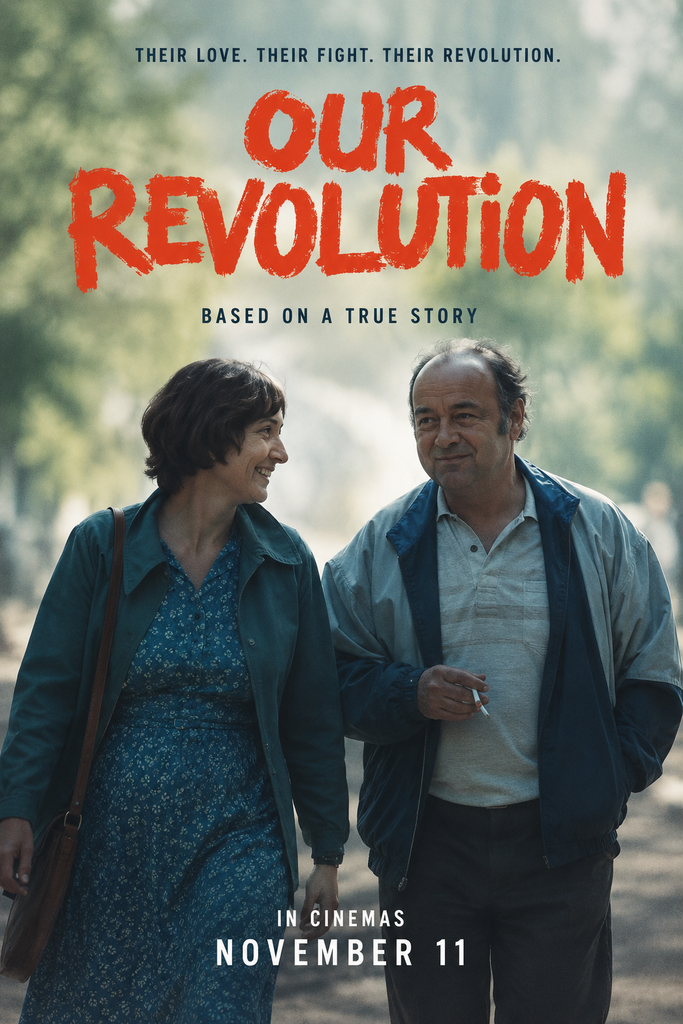
Piotr Domalewski’s Nasza rewolucja (Our Revolution) tells a deeply personal story against one of Poland’s most turbulent periods.
Rather than presenting a conventional historical drama, it explores the relationship between dissidents Jacek and Grażyna “Gajka” Kuroń.
Their marriage becomes inseparable from the struggle for democracy, as their Warsaw apartment develops into a vital meeting place for the opposition..
Set over the period between 1978 and 1982, Jacek and Gajka experience constant surveillance, political change and the rise of ‘Solidarity’.
Their home is used by many active members of opposition movement, and acts as an unofficial centre of resistance.
However, within this time they face great personal sacrifice. Due to the constant surveillance by the government, domestic life is made very difficult.
Following the imposition of martial law in December 1981, Jacek and Gajka are separated and imprisoned.
Here, they face illness, loneliness and emotional stress. Despite their strong political beliefs, we are left with the question of whether love can withstand so much sacrifice.
A Revolution Told Through Love
Domalewski approaches this history through the couple’s private experiences rather than grand political set pieces.
He deliberately avoids presenting Jacek and Gajka as untouchable national monuments. Instead, they emerge as complicated people whose ideals sometimes clash with their responsibilities towards family.
This approach gives the film its strongest emotional foundation. Jacek’s dedication to the opposition is admirable, but his commitment can also leave Gajka carrying the burden of their domestic life. Their son Maciej is another reminder of what their political struggle demands from the family.
Importantly, the film gives Gajka considerable space within this history. She is not simply portrayed as the wife supporting a celebrated dissident.
Her resilience, independence and quiet determination make her an equally important figure in the resistance.
This perspective adds welcome depth to a story that could easily have concentrated exclusively on Jacek’s public achievements.
The film also emphasises the importance of non-violent resistance. Jacek repeatedly argues against street violence, believing collective unity and moral courage offer the strongest opposition to authoritarianism.
These moments give the political material a clear moral perspective without completely overwhelming the relationship.
Powerful Performances From the Leading Pair
Arkadiusz Jakubik gives a great performance as Jacek. Even though he does not adopt specific physical traits, he captures the character well.
He portrays a charming, passionate character who often does not understand the impact of his political involvement on people in his life.
Magdalena Poplawska gives a very good performance as Grażyna. Without any unnecessary over-dramatization, she expertly conveys exhaustion, weakness and determination.
Throughout the film, subtle expressions and movements are used very effectively.
Jakubik and Poplawska have a great dynamic together. The best moments come in scenes which do not involve political meetings and allow them to convey years of love and frustration for each other. As a result, the relationship feels very realistic.
Jacek Koman’s performance as Marek Edelman is notable. Despite his subtlety, he produces one of the best supporting performances in the film.
By trying to support Gajka during her illness, Koman displays a large amount of tenderness. It is therefore very reasonable that he was awarded at the Gdynia Film Festival.
Jakub Jakubik plays Maciej very naturally. Krzysztof Zarzecki and Dorota Segda excellently portray the oppressive nature of the Security Service and state prosecution.
Capturing Communist-Era Poland
One of the film’s greatest achievements is its atmospheric visual presentation. Cinematographer Michał Sobociński creates a convincing portrait of communist-era Poland through muted colours, carefully composed frames and an appropriately oppressive atmosphere.
The camera frequently adopts voyeuristic angles resembling Security Service surveillance. These compositions reinforce the constant threat surrounding the Kuron family.
More intimate close-ups, meanwhile, bring emotional attention back to the couple and their increasingly fragile private lives.
The Warsaw apartment is especially effective as a central location. Crowded with activists, visitors and political discussions, it feels simultaneously welcoming and claustrophobic.
Its transformation into an opposition headquarters makes the couple’s loss of privacy immediately tangible.
The production design and costumes also deserve praise. Rather than presenting the 1980s through glossy nostalgia, the film embraces lived-in details and subdued colours.
The contrast becomes particularly striking when the story moves towards internment and separation.
Domalewski’s collaboration with Sobociński and editor Agnieszka Glińska gives the film considerable technical confidence.
Its visual language helps communicate historical tension, even when the storytelling becomes less cohesive.
An Uneven Historical Drama
Unfortunately, Nasza rewolucja never entirely fulfils its ambitions. Its biggest weakness is an episodic structure that sometimes resembles a collection of historical vignettes.
Individual scenes can be powerful, but they do not always develop into a satisfying dramatic progression.
The film also assumes considerable familiarity with Poland’s opposition movement. Figures such as Adam Michnik and Bogdan Borusewicz remain largely in the background.
This keeps the focus on Jacek and Gajka, but occasionally leaves important political developments insufficiently explained.
The result is a historical backdrop that can feel frustratingly compressed. The rise of Solidarity, worker strikes and negotiations receive less context than some viewers might expect.
Those unfamiliar with this period of Polish history may struggle to understand the significance of certain events.
The pacing also becomes uneven between its two halves. Initially, the film has the energy of a surveillance thriller, with activists constantly anticipating the authorities’ next move.
After martial law, the narrative becomes slower and more emotionally devastating. Both approaches work individually, but the transition feels abrupt.
The reported disagreements surrounding the screenplay may offer some context for these structural problems.
Maciej Pisuk reportedly removed his name from the credits following disputes over changes to his original script.
Whatever the precise creative circumstances, the finished film occasionally feels like competing approaches that never fully come together.
Nevertheless, its second half contains some of its most affecting material. The separation, illness and emotional strain experienced by Jacek and Gajka give the political struggle an intensely personal dimension.
Final Verdict
Nasza rewolucja is a moving portrait of love and resistance, elevated by two outstanding central performances.
Domalewski’s intimate direction and Sobociński’s atmospheric cinematography recreate a difficult period without relying on glossy historical spectacle.
Its fragmented storytelling and rushed political context prevent it from becoming a fully satisfying historical drama.
However, the decision to place Gajka alongside Jacek at the heart of the narrative gives the film genuine emotional significance.
Ultimately, this is less a comprehensive account of Poland’s democratic opposition than a compelling story about the people who sacrificed their private lives for it.