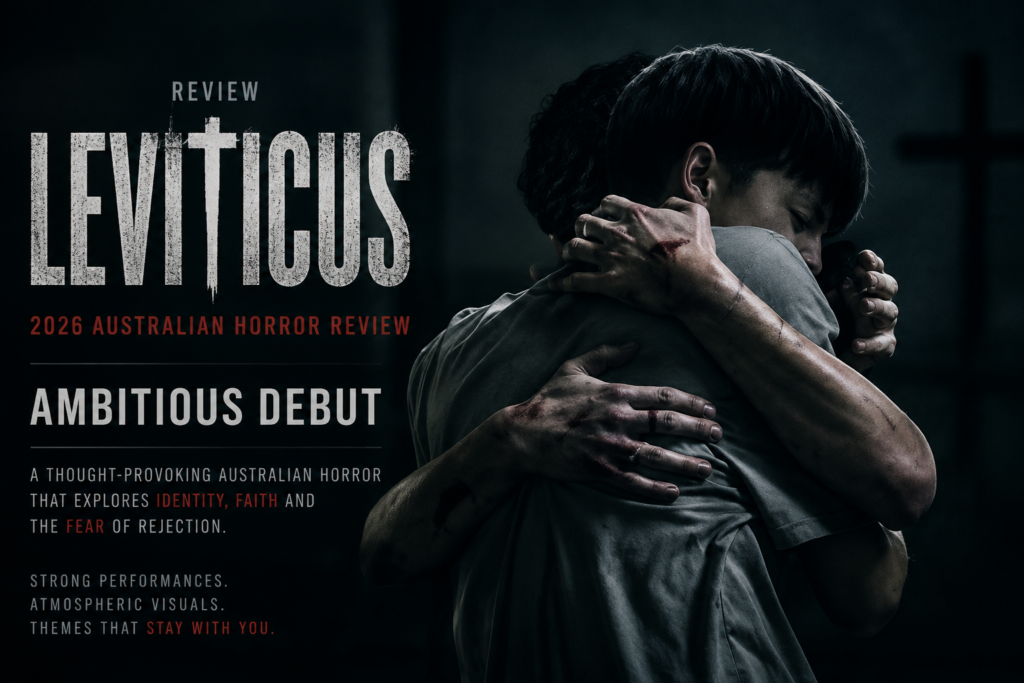
Leviticus 2026 Australian Horror Review: A Promising Australian Horror Debut
Introduction
Australian horror has had an interesting evolution in the last few years. It has moved away from the simple jump scares and gore that many had come to expect from the genre. Many writers and directors have found a way to use the horror genre to explore deeper human struggles.
Films like Talk to Me, and Bring Her Back all have found a way to use the supernatural to highlight the internal conflicts and struggles of real people.
This is why Leviticus is such an intriguing film to watch. Coming from the producers of Talk to Me, Causeway Films. Plus, it’s director Adrian Chiarella’s first time directing a full length feature film.
Leviticus looks set to deliver a unique brand of Australian coming-of-age supernatural horror.
The film was written and directed by Chiarella and stars Joe Bird, Stacy Clausen, Jeremy Blewitt, and Mia Wasikowska.
The film tells the story of teenage friends Naim and Ryan whose relationship is discovered by their conservative religious community which leads to their families trying to exorcise them.
The boys are forced into a religious deliverance ritual intended to purge them of their “evil ways” which ends up unleashing a murderous supernatural entity on them, taking the form of the person each of them most desires.
Leviticus is a conflicted movie which seeks to explore themes of identity, acceptance, faith, and repression through the lens of body horror and supernatural terror while delivering a message of tolerance and inclusion.
The result is an ambitious debut. It does not always achieve perfection. However, it shows a filmmaker with a clear purpose.
Adrian Chiarella’s Directorial Debut

A first feature film is always a challenging endeavor. Plots have to be carefully crafted, and directors have to find their voice while balancing all aspects of the production.
Adrian Chiarella tackles Leviticus with an assured hand. He knows where to look for the movie’s heart, and he understands that the real source of the film’s horror lies in human nature.
The most surprising and refreshing aspect of Chiarella’s direction is his emphasis on the human aspect of the story.
The supernatural elements are well-integrated and serve to highlight the horror themes without overpowering the main message.
This decision alone makes the film stand out from the rest, as the true horror comes from the metaphysical entity, and not merely from the gruesome acts done to the protagonist.
The entity embodies judgment and shaming and seeks to impose conformance and a sense of shame on the protagonist.
It is a manifestation of a person’s internal struggle with their innermost desires and the suppression of these desires by society’s expectations.
Moreover, the film’s strength lies in its restraint, as shown in Chiarella’s lingering focus on the events that occur. The film prioritizes a build-up of tension over rapid reveals.
This approach makes it unsuitable for some viewers who may find the film’s tempo to be inconsistent or unfocused.
However, it allows most viewers to experience the horror of the situation better through its slow unveiling of events. Its emotional impact thus relies on its slowness and tension.
Above all, the film’s power comes from its very idea and its ability to depict such a horrific act as the conversion therapy.
Chiarella does not shun away from the horror of this particular act, as the entity’s presence is used as a means of showcasing the terror the protagonist is made to endure.
Yet, as noted, the film’s strength is its restraint, and the horror is not in the direct depictions of conversion therapy but in the entity’s very nature.
The metaphysical entity embodies the terror that the protagonist must face because of their desires and the judgment of society.
Unfortunately, the film’s strength is also its weakness, as the presence of the entity renders the narrative incoherent at points.
The film tries to depict the horror too explicitly at times, which makes it loses some of the impact it would have had if it were left implicit.
This approach also makes the film’s themes too clear and straightforward when they could have been more nuanced and meaningful had they been depicted the way they are in real life.
Nevertheless, Chiarella has displayed a remarkable level of creative confidence in his debut film. He has managed to depict the terror the protagonist is made to endure.
He also showcases the entity as a part of the problem that the protagonist must overcome on their path to self-acceptance.
Australian Identity And The Horror Genre
One of the most interesting aspects of Leviticus is its Australian setting. I think that this is a particularly fitting choice, as the landscape plays a major role in many Australian horror movies.
Australian horror has often explored isolation. The country’s landscapes can create feelings of distance and vulnerability.
In another Australian Horror movie called Wolf Creek, the outback becomes a place of danger. In Talk to Me, ordinary Australian suburbs become unsettling.
Leviticus presents an even more insular environment than Wolf Creek, as it focuses on a small religious community.
The film depicts this group as united in its belief in a higher power, creating an oppressive atmosphere for anyone who does not share their faith.
It is not that all religious groups are inherently oppressive, but for me the film’s horror comes from the way in which isolation from the outside world leads to such a group thinking that they are the only right ones.
The horror is the result of the fear of exclusion, as the teenagers are made to realize that they are challenging established thought.
This makes for an Australian perspective on the idea that isolated communities can generate a powerful form of social control.
The film’s setting plays an important role as well, as it provides the sensation of vastness that offsets the confinement the characters feel in relation to the others.
The two feelings are in direct opposition, which makes for a powerful realization on the part of the viewer.
The characters live in an environment that offers them an impressive opportunity for expansion – and yet, the only direction they seem to have is inwards, among the other members of their community.
Tyson Perkins’ Cinematography
The cinematography of Tyson Perkins is one of the film’s strongest features. His framing creates a pervasive atmosphere of isolation and desolation that surrounds the characters and suffuses the narrative with a sense of existential dread.
The Australian setting is depicted in such a way as to amplify the feeling of the characters being minuscule and helpless in the face of vast, indifferent forces of nature.
The shots of the Australian outback create a pervasive sense of isolation and even hopelessness. The characters are overwhelmed by the emptiness around them, yet they cannot escape it.
The characters are trapped in the community, which is, in turn, surrounded by nothingness.
Perkins’s use of this contrast is masterful, as the landscape is beautiful yet intimidating at the same time.
The cinematography of the film also makes ample use of the lighting of the environment, which is also used to convey specific emotions depending on the location.
The more positive interactions between Naim and Ryan occur in warm areas, which subconsciously affect the viewer.
Meanwhile, the use of shadows in the religious places creates an opposite psychological effect, making the institutions appear intimidating and judgmental.
Similarly, the film uses framing to reinforce these ideas, with the characters often framed within spaces that limit their view or movement.
This technique makes the setting even more intimidating while also suggesting the inability of the protagonists to escape it.
The camera rarely looks directly at the characters, creating an unsteady effect that adds to the anxiety seen in the film’s aesthetics.
As such, Perkins’s approach to the presentation of the setting is fitting, as it supports the psychological aspects of the film’s narrative without undermining its strengths.
The cinematography does not seek to scare the audience directly but instead wants to invoke a sense of unease through the use of shadows and framing that evoke repressive connotations.
Overall, Perkins’s contributions to the production make the film’s themes and messages more accessible by engaging viewers with the setting in a unique way.
Themes And Storytelling
The themes are where Leviticus shines brightest. This is not a typical supernatural horror film, so it approaches the genre in a unique way.
Horror elements in this film explore its central moral question: what happens when people refuse to accept others’ differences.
The movie’s underlying metaphor suggests that the worst source of intolerance is the prejudice itself.
The movie deals with the themes of religious trauma, focusing on the way dogma can be used for malicious purposes.
However, it does not vilify religion itself, but rather the toxic extremist views on the matter.
This is precisely the distinction that makes the story so compelling, as it is not a fight against belief but against prejudice.
It’s not the belief that is problematic here, but rather the pressure of society.
The role of the small community in which the protagonist finds himself is significant, as it personifies a type of social pressure and creates an atmosphere of prejudice against those who oppose it.
The story’s simplicity allows the audience to become emotionally involved.
There are moments, however, when ambiguity may arise, such as the line between illusion and reality.
In this regard, the work is ambiguous, as it sometimes obscures what is real and what is imagined, which makes one feel as if they are guessing at the truth.
On the one hand, the clouds of confusion are useful because the very fact of them existing makes one think. But on the other hand, it distracts one from the actual narrative, confusing the audience.
The film’s themes are most effective when they are focused on its characters; the emotional impact of the story is stronger than its symbolic representation.
The characters of Naim and Ryan allow the film to focus on their personal experiences, which invoke deeper emotional responses for the audience.
Performances
The performances give Leviticus its emotional core. The youth actors are the heart of this film.
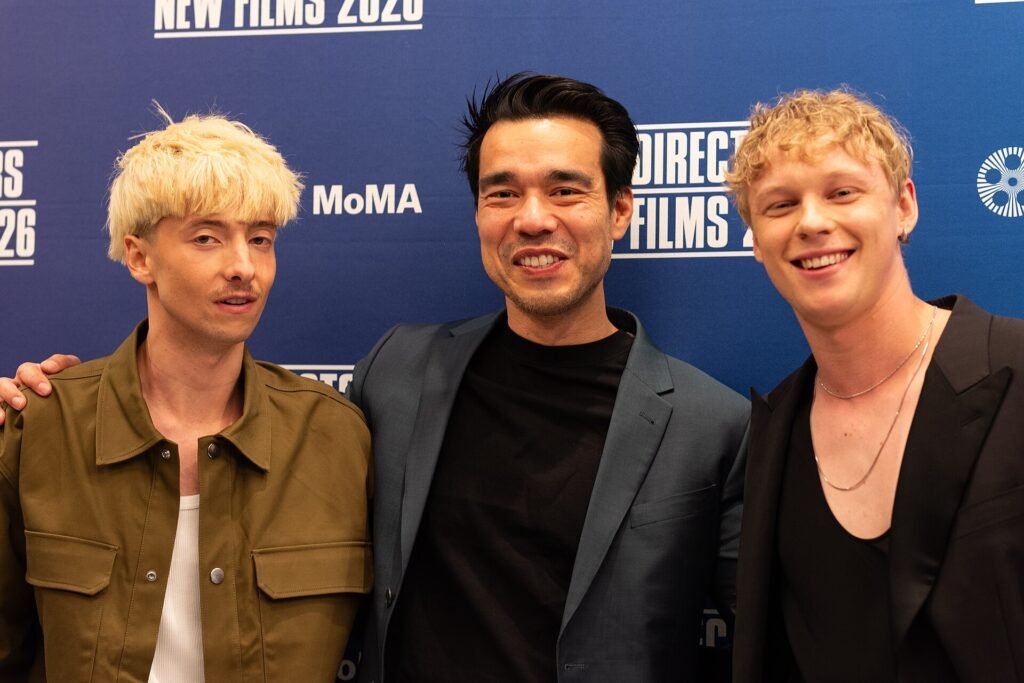
Joe Bird and Stacy Clausen are especially notable for their chemistry, which makes the relationship between the characters believable.
Their connection is so important to the movie’s success that without it, the film would not have worked nearly as well.

Stacy Clausen is especially deserving of recognition for his subtle, powerful performance as Ryan.
Clausen captures Ryan’s vulnerability and confusion. He also manages to convey his strength under pressure.
He manages to avoid melodrama by focusing on emotion and restraint. This allows Clausen to make Ryan relatable and his fears and frustrations understandable.

Joe Bird also delivers a strong performance. He portrays Naim’s emotional complexity well: the uncertainty of self-discovery and the anguish of rejection.
Bird and Clausen deliver the film’s best moments, as their roles allow them to affect the deepest levels of horror in the viewer.
Jeremy Blewitt is also good in a supporting role, as he helps to create an atmosphere of social tension around the town.
Mia Wasikowska is similarly effective, as she grounds the production in an appropriately serious tone.
The film’s supporting characters are all strong, but the leads are its beating heart.
What Worked And What Did Not
The greatest strength of Leviticus is its ambition. The film wants to explore meaningful ideas through horror.
It successfully creates emotional connections. It also benefits from strong performances and impressive visuals.
The cinematography gives the film a distinct identity. The Australian setting feels important rather than decorative.
In addition, Chiarella’s direction feels confident and assured, as one would expect from a first-time filmmaker.
Despite this, the film’s ambition leads it to occasionally overreach, particularly in regards to the themes it seeks to impart.
For example, symbolism can feel overly explicit at times and the presentation of certain concepts can feel unnecessarily.
Additionally, the ambiguity of the entity haunting the film’s protagonists can feel at times like two differing ideas vying for dominance, rather than a unified vision.
The pacing may also be an issue as some viewers may find it slow going. However, others may want scares to be a bit more frequent.
Again, these are not deal-breakers, but just observations of what can happen when trying to balance ambition and execution.
Leviticus is a film made by someone who is still finding his voice, but at the same time, it is a film made by someone who had a vision and wanted to share it with the world.
Final Verdict
Leviticus steps into Australian horror with a lot on its mind. It’s not just about scaring you—it wants to dig a little deeper, nodding to the country’s habit of mixing real emotion with supernatural chills.
It doesn’t quite hit the highs of Talk to Me or Bring Her Back. However, you get the same feeling that the filmmaker cares about the characters as much as the scares.
The debut of Adrian Chiarella is flawed. It does, however, show a strong sense of creative voice.
The film works due to its understanding of what horror really is. Terror may symbolize something beyond being physically threatened.
Fear can symbolize exclusion, humiliation, and social pressure. Fear can expose the problems that exist inside communities.
Joe Bird and Stacy Clausen give impressive performances. Clausen deserves a special mention for her outstanding acting skills.
Cinematography by Tyson Perkins adds to the unique look of the film. The Australian environment gains significance in the film.
Some concepts could be developed more delicately but Leviticus stands out nevertheless. It is a film that has a strong intention behind it.
The 2026 Australian horror film review of Leviticus sees a flawed debut but a promising one by Adrian Chiarella.
Australian horror genre keeps developing. The film Leviticus shows that there is plenty left to say.
More importantly, it hints at Chiarella becoming an interesting figure in the world of Australian horror films. The future of this genre is in good hands.