
Bad Apples 2026 Review
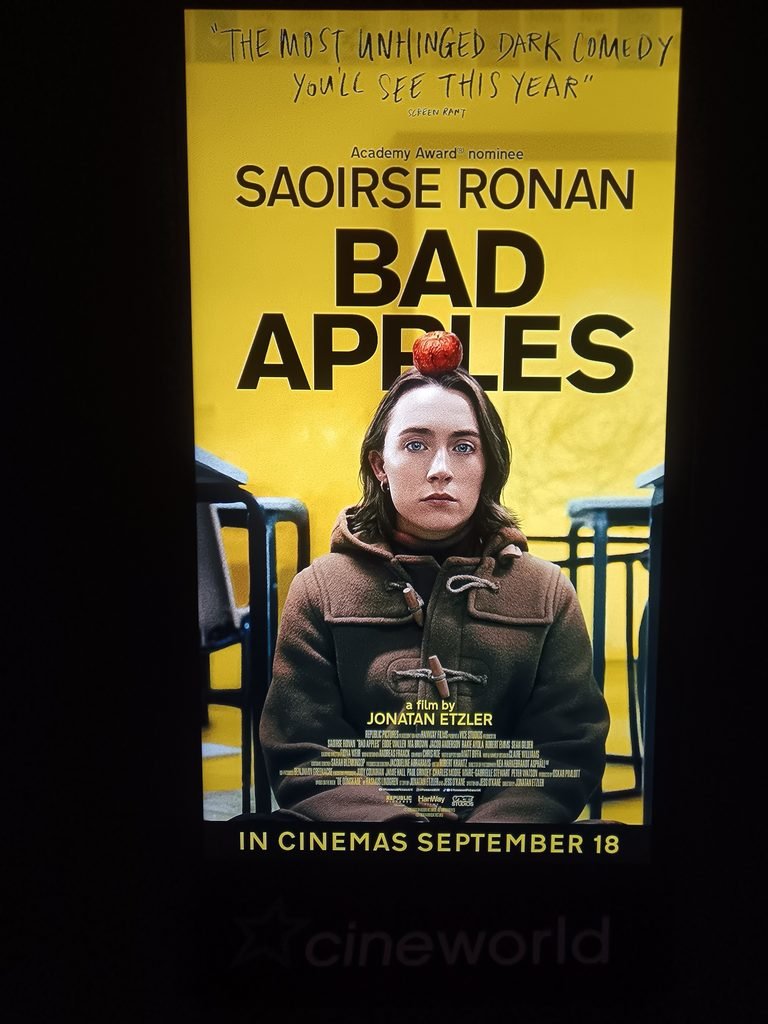
Introduction
There is something immediately unsettling about Bad Apples. Jonatan Etzler’s dark comedy begins with a familiar school environment.
Teachers try to teach their students. Students are supposed to learn, behave, and grow up.
Instead, one disruptive child threatens to destroy everything around him. For Maria Spencer, that boy is Danny.
Maria is an idealistic elementary school teacher who is desperately trying to keep control. Her classroom is always disrupted by the increasing violence of Danny.
She does not get much help from her principal. Also, an Ofsted inspection is coming up soon. Maria knows that just one more failure could ruin her career.
But then an event turns things around. Maria ends up leaving Danny unconscious after a physical altercation with him.
She does not go for help but panics. She takes Danny home with her and locks him in her basement.
This makes Bad Apples a very different kind of movie. This is a film that becomes increasingly obsessed with how a problem is solved.
In absence of Danny, Maria’s pupils start flourishing. Their performance improves.
The classroom setting becomes less chaotic. School administrators are pleased. Maria seems suddenly to be a successful teacher.
The irony is clear. The school can only function if a child is taken out of the equation. This thought forms the crux of Bad Apples.
It also offers Saoirse Ronan a great role. Maria is not simply a good teacher making one terrible decision. She is a complicated person under extraordinary pressure.
Desperation starts to get hard to distinguish from morality. This makes for a more intriguing film than the outrageous concept behind it.
A Very Unusual School Story
Bad Apples was directed by Jonatan Etzler. The screenplay was adapted by Jess O’Kane from Rasmus Lindgren’s Swedish novel De Oönskade.
Its English title is “The Unwanted.” Bad Apples was screened at the Toronto International Film Festival in September 2025.
The movie hit the silver screens in September 2026. The director’s style is intentionally unsettling. This film makes us find humour in situations which ought to make us very uncomfortable.
Such a combination will definitely not please everyone. Some parts of the film’s humour are exaggerated.
Sometimes, we need to suspend our disbelief for quite some time. However, such ridiculousness is what makes up the uniqueness of the film.
Etzler did not intend to make a conventional film about school life. He takes a common dilemma of education and takes it to the most extreme and outrageous levels.
The outcome is a film about institutional failures presented in the guise of a crazy kidnap story. The film also understands how frustrating classroom disruption can become.
Danny is not simply an annoying child. His behaviour affects every pupil around him. He interrupts lessons.
He intimidates classmates. He creates an atmosphere where nobody can properly concentrate.
Maria is expected to solve the problem without being given adequate support.
That frustration gradually becomes the foundation for the film’s darker ideas.
Saoirse Ronan Is Excellent

The biggest strength of this film is Saoirse Ronan. This should not come as a shock, considering her career.
She has shown that she can play with dramatic depth before. However, in this film she has the opportunity to try something else.
Maria is scared, shy, frustrated, lonely and going crazy. Ronan shows all these aspects of her character, but does not make her ridiculous.
Ronan keeps the character grounded. Even when Maria makes an insane choice, there is a human element in her.
It is very important. If Maria would be a monster, it would be easy to disregard this movie.
Instead, Ronan manages to show her desperation without making her decisions justified.
It is quite challenging.
Ronan also shows that Maria can find some comedy in her misery. Sometimes Maria looks completely helpless.
Sometimes it looks like she feels relieved with her situation.
That contradiction certainly gives Ronan plenty to work with.
Sometimes her expressions speak louder than the lines themselves. Her look can give away the fear that’s gripping Maria.
Her pause can tell you she feels guilty about something. Her small smile can indicate how quickly she adapts to her situation.
The performance succeeds because Ronan takes the whole thing seriously. She takes the premise seriously enough to make it work as comedy.
Even The Guardian picked out Ronan as the best part of the movie. That’s because she’s taking on so much of the burden. Without her performance, the premise would have been unbearable.
But with her, it becomes oddly fascinating.
Eddie Waller Makes Danny Difficult To Ignore
Eddie Waller also deserves considerable credit. Danny could have become a simplistic movie villain.
Instead, Waller gives him an unsettling unpredictability.
Danny is aggressive. He is also disruptive. He knows exactly how powerful this behavior can be. But there is more to him, too.
As he turns away from the classroom, Danny becomes somewhat vulnerable. This creates a complicated situation for him and Maria.
She is keeping him hostage. But she is also teaching him things. This makes for one of the best ideas of the movie.
Maria learns that Danny has the ability to learn. And Danny learns that there is someone who will talk to him.
Thus, the dynamic of their relations is changing gradually. It is not becoming easy or comfortable. In fact, it should not.
But there is something of beauty in their relationship which turns the movie into something more than just satirical.
Because it starts questioning why are certain kids like that. And what happens when no one listens to them.
This is where the film starts exploring the possibility that neglect created some of Danny’s problems.
That makes Maria’s situation even more complicated. She is trying to protect her classroom.
She is also becoming the first adult to genuinely spend time with Danny. The irony is brutal.
Danny may actually improve because Maria kidnapped him.
That is one of the film’s darkest jokes. It is also one of its most interesting observations.
The Classroom Becomes The Real Battleground
The school context provides Bad Apples with an abundance of content.
Maria is constantly being assessed. Pupils are assessed by test scores. Teachers are assessed by inspections.
Schools are assessed on their results. Parents demand progress. Principals demand order. Everyone demands quantifiable success.
Unfortunately, children do not always fit the measurement criteria. Danny is exactly what the institution finds challenging.
He is disruptive. He is problematic. He does not conform. Therefore, the obvious solution is to get rid of him.
And there lies the main question raised by the satire. What happens when success depends upon getting rid of the problem?
The solution is quite disturbing. Maria’s class automatically gets better. The other pupils are able to focus.
Test scores are increasing. The administration of the school is pleased. Maria is praised.
No one seems worried about the fate of Danny.
This is a very intentional joke. It is also a very insightful one. This is where the social commentary of the film works best.
It does not simply criticise disruptive children. It examines the adults responsible for managing them.
It questions the support available to teachers. It questions the pressures placed upon schools.
Most importantly, it questions what society considers success.
The Dark Comedy Works Because It Is So Uncomfortable
The comedy in Bad Apples is rarely conventional. There are funny situations. There are awkward interactions.
There are moments of genuine absurdity. However, the film rarely allows the audience to relax completely.
Each joke is rooted in some nastiness lying underneath it. This creates an unusual atmosphere.
You might chuckle without knowing what you are laughing at. The whole scenario is gruesome.
Sometimes the characters take the scene for granted. The juxtaposition produces the humor.
Time Out pointed out the balance between the depressing content and absurd humor in the movie.
It also mentioned the relations between Maria and Danny. These relations become more and more bizarre with each passing scene.
Maria starts feeding Danny. She starts structuring his life. She teaches him. She plays with him.
The whole scenario takes on the qualities of a dysfunctional family relationship.
It is grotesque and funny. The filmmakers are aware of it. They do not try to make their viewers feel comfortable.
Instead, they keep pressing this paradox. Maria has done something horrible. She helps Danny. Both can be true. The moral paradox adds to Ronan’s performance.
The Film’s Strange Moral Perspective
One of the most interesting things about Bad Apples is its refusal to offer easy answers.
Maria is wrong. Danny’s behaviour is also wrong. The school system is failing. His family is struggling.
Other students have their own problems. Nobody is all that innocent. Therefore, the apple has taken on another role within the movie.
Jonatan Etzler’s Direction
Despite how outrageous the plot becomes, Etzler’s direction remains understated. He doesn’t make the movie into a typical thriller.
On the contrary, he lets the absurdity grow step-by-step. This contributes to the effectiveness of the process of transformation of Maria.
The movie starts rather traditionally. One terrible decision then changes everything. Afterwards, the plot becomes more and more surreal.
Etzler realizes that the audience must get used to the idea. The movie cannot hurry with Maria’s transformation. Her decision must seem impulsive.
At the same time, her decision to keep doing the same thing should become more and more purposeful.
It is important. Maria’s first mistake may be explained by panic. Everything else is harder to justify.
The movie gets darker because of how much Maria chooses an incorrect way to solve the problem.
Still, each of her decisions seems logically to her. That is why the movie becomes disturbing. Maria does not turn into a completely different person all of a sudden.
She just keeps making steps. One after another. And then she reaches a place which she had not even supposed to reach.
The Supporting Cast Adds Another Layer
The supporting cast members are very solid. In particular, Nia Brown is excellent as Pauline. At first glance, Pauline represents the perfect student.
She pays attention. She desires attention. She desires success. However, later on, the viewer sees another side of her personality.
This also contributes to the theme of children and their expectations by adults.
Similarly, Rakie Ayola also adds to the atmosphere of the school. It helps emphasize the pressure which Maria has to deal with.
Furthermore, Jacob Anderson adds a new perspective in the personal life of Maria.
These characters make sure that the movie is not centered on Maria and Danny only. Nevertheless, the expansion is not always smooth.
There are multiple different ideas which are trying to fight for the viewer’s attention in the movie.
Firstly, there is the educational system. Secondly, Maria’s personal life. Thirdly, Danny’s domestic life. Finally, Pauline also has her own idea.
Sometimes it feels like several movies are running at once. Nevertheless, the core relationship is strong enough to keep the narrative together.
When The Thriller Takes Over
The movie becomes increasingly tense as it becomes increasingly difficult for Maria to hide her secret.
The main issue is self-explanatory. She can’t hide Danny forever. Each visitor means an additional risk.
Each talk poses a new threat. Any unforeseen event brings about the risk of exposing Maria. This is how the movie gets its thriller mechanics.
But the movie “Bad Apples” does not become a classical suspense movie. Because the fear and tension is not just the one of being scared, but embarrassment as well.
Maria constantly tries to act normally. This makes some of the most funny moments of the movie. She needs to maintain her professional image.
As well as maintain the illusion that Danny is missing. While, in reality, he is locked in her basement.
This becomes quite cartoonish at times. And the movie knows it. The best moments of the movie happen when the movie doesn’t try to justify its absurdity.
The Film Does Not Always Push Its Ideas Far Enough
This is where Bad Apples becomes more complicated. The premise is stronger than some of the film’s individual ideas.
There is huge room for exploring the main idea. The film could have expanded on the topic of education.
It could have examined the decisions of Maria more deeply. It could have made the response of the school even more uncomfortable.
Instead, it occasionally settles for the cliché joke. That does not mean that the film fails. It only means that the satire can be inconsistent.
Some of the moments are very clever. But there are times when it feels like reiterating a point which we already know.
Here is a movie which often interprets its metaphor too literally. The analogy of the apple can become very cliché at times.
The social criticism is also pretty transparent from the start. There is no need to spell out the message to the audience.
Fortunately, Ronan saves the film. Her performance adds depth to the plot. Without her, some of the cliché satire would lose all meaning.
Does Bad Apples Work?
For the most part, yes. The movie has an odd premise. It has an odd tone. It asks the viewers to believe a lot of incredible things.
But there is enough wit beneath all the insanity. Certainly, the best part of the whole movie is Ronan.
She makes the character of Maria very believable. She also makes the film’s oddest turns emotional.
Another important actor is Eddie Waller. His performance makes sure that the character of Danny doesn’t become a one-dimensional villain.
It also helps that the movie is not afraid to be offensive. It doesn’t strive to make its characters likable.
This is something very refreshing. Sometimes, the satire becomes too clear. Sometimes, the plot seems to be stretched.
There are ideas that could be elaborated on more. At times, the movie tries to make a bigger point than the story allows.
All this notwithstanding, the movie is still impressive. It’s hard to imagine any mainstream comedy using such a premise.
This is what makes Bad Apples worth seeing.
Final Verdict
Bad Apples is a unique dark comedy that doesn’t want to follow all traditions of school movies.
It starts with an absurd premise. It uses humour that sometimes is not comfortable. It offers commentary on society that is sometimes direct.
But the movie has enough emotional maturity to make it work. The main reason for that is Saoirse Ronan.
She manages to give Maria vulnerability without denying her responsibility. She makes her character funny without turning her into a joke.
She makes her character disturbing but still understandable. Also, Eddie Waller adds an unexpected layer to the movie.
Their relation becomes even stranger and more interesting during the development of the plot.
Jonatan Etzler deserves credit for taking the material seriously. He allows the film to remain uncomfortable rather than turning everything into easy comedy.
Sometimes, the satire of education is not quite sharp. There are also some ideas fighting with each other in the background.
This movie sometimes seems to have too many messages to offer. However, the main idea stays strong.
What happens when the elimination of one problem makes the others seem better? That question gives Bad Apples its darkest edge.
The answer is not particularly reassuring.
A classroom can improve while a child suffers.
A teacher can succeed while crossing an unforgivable line.
A school can celebrate results without asking how they were achieved.
That contradiction gives the film more substance than its outrageous premise suggests.
Bad Apples is not a perfect satire.
It does not always push its ideas far enough.
However, it is distinctive, uncomfortable, and often very funny.
Most importantly, it gives Saoirse Ronan something different to play.
Maria is one of her more unusual recent characters.
She is sympathetic, frustrating, funny, and increasingly alarming.
That combination keeps the film alive even when its satire becomes uneven.
Bad Apples ultimately works because it understands one uncomfortable truth.
Sometimes the people trying to fix a broken system can become part of the problem.
And sometimes the biggest problems are not the people we first identify.
They are the systems that allowed everything to reach this point.