
Digger Movie Review
Introduction (Warning This Review Contains Spoilers)
There are films that surprise you because they take an unexpected turn. Then there are films that make you question what you were watching.
Digger belongs firmly in the second category.
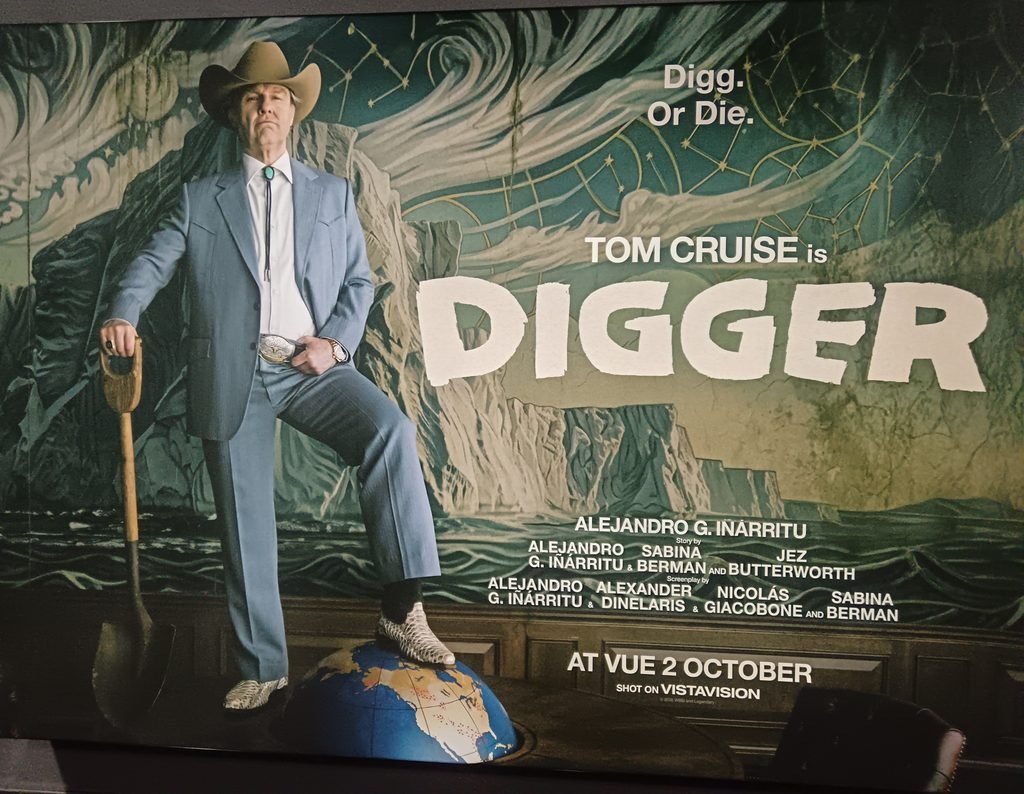
Directed by none other than Alejandro G. Iñárritu, an Academy Award winner, Digger features Tom Cruise as Digger Rockwell, who is a billionaire oil tycoon.
At the beginning, you are led to believe that this is going to be a dark satire on wealth and power in the face of global climatic catastrophes.
Digger ventures to Greenland for a drilling project that ends up disastrously.
However, this disaster not only threatens the business prospects of the tycoon but turns into a global environmental disaster.
All of a sudden, Digger finds himself in a unique position. Here, the man who has caused the disaster is supposed to save the world from the same.
That setup gives Iñárritu plenty of material for satire. It allows the director to attack corporate power, political messaging and celebrity culture.
It also provides Tom Cruise with an unusual character to play. This is certainly not the refined action hero that most people would expect him to portray.
Cruise appears under heavy prosthetics, with a pronounced Southern accent and a noticeable beer belly.
Digger is brash, cocky, ridiculous and thoroughly self-important. It is an uncomfortable transformation that Cruise has undergone.
Cruise does not just step outside his type; he strips away the screen image that has haunted him for years.
All of that makes Digger a very interesting character indeed.
But there is much more in the movie than meets the eye.
Alejandro G. Iñárritu Takes a Huge Risk

Alejandro G. Iñárritu has never been a filmmaker particularly interested in playing things safe. With Digger, he goes somewhere considerably stranger.
The acting is broad. The dialogue feels unnatural. The characters act like cartoonish versions of themselves.
The political mockery is blunt. The environmental message comes through loud and clear.
At certain points, you may actually ask yourself what Inárritu is up to. This is an integral part of the movie.
Digger aims to make you feel uncomfortable. It seeks to challenge you on your perception of the tone of the film.
It challenges you by making you think that you are watching an environmental movie. But then it throws a curveball.
That’s something I will explore in the spoiler section below. Before reaching that point, however, the film deserves credit for establishing such a distinctive atmosphere.
There is something deliberately artificial about the world. Everything feels heightened. Digger himself looks almost absurd.
His Southern accent feels exaggerated. His speeches seem designed for a much larger audience than the people standing around him.
That becomes part of the film’s design. The strange performances are not necessarily mistakes. They are clues.
Tom Cruise Gives One of His Strangest Performances
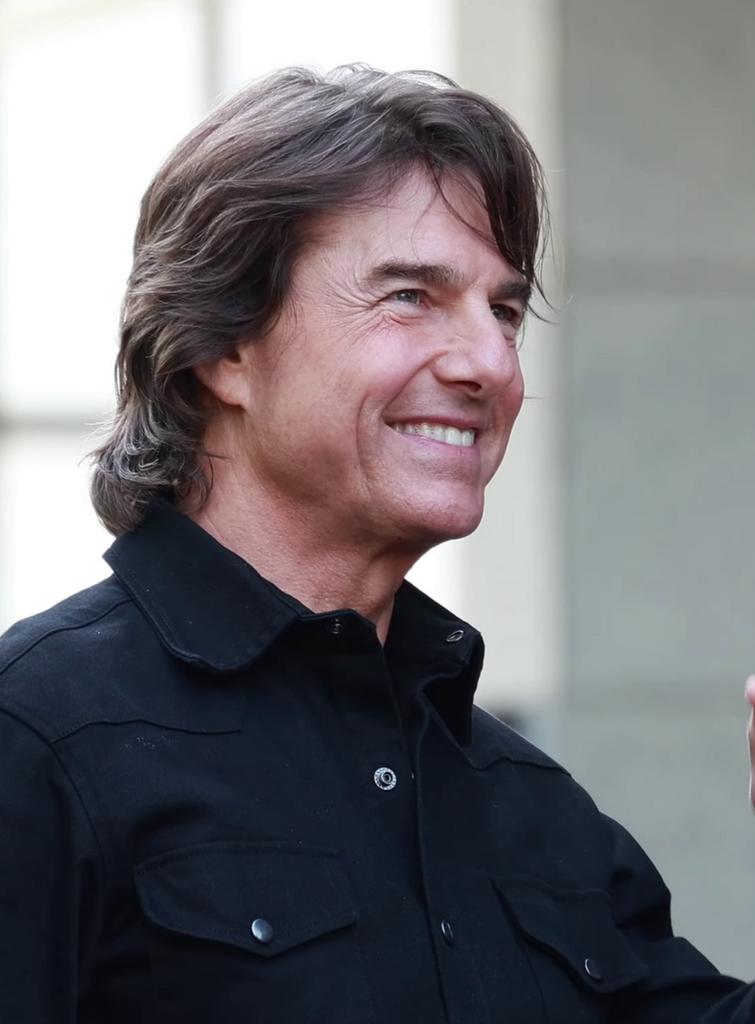
Tom Cruise has an awful lot of responsibility here.
A large part of the movie is contingent upon the viewer’s willingness to accept Tom Cruise in a totally unfamiliar character.
Digger Rockwell is not Ethan Hunt. Digger Rockwell is not Maverick. Digger Rockwell is not that determined hero striving against the odds.
Digger is the problem.
He is an incredibly rich man who thinks that wealth and self-assurance will get him out of all problems. His arrogance is part of the humor.
His ignorance of the responsibility he bears is part of the satire. And Tom Cruise delivers the whole thing with full commitment.
The physical transformation goes a long way to making it possible. The makeup alters his face and physique.
The accent alters his voice. The attitude of the character alters his posture. There is almost something grotesque about the performance.
And that is precisely what makes it possible. Tom Cruise has no problem looking ridiculous.
That is rather a courageous move for a star whose whole persona was built on physical perfection and control.
Riz Ahmed Provides an Important Counterbalance

Ganesh, played by Riz Ahmed, is an advisor to the government and one of the only individuals capable of challenging Digger.
Ganesh can be described as one of the moral cores of the movie. He knows the gravity of the situation.
He also knows how ludicrous is Digger’s attempt at a solution to the problem. This provides a humorous conflict.
To Digger, he sees himself as humanity’s messiah. For Ganesh, he sees a rich individual trying to handle a situation he created.
Ahmed makes the character intelligent but does not turn him into a mere lecture.
His body language is as important as what he says. He becomes the audience’s key to madness.
His relationship with Digger sets up an interesting conflict between responsibility and loyalty.
He needs to help resolve the crisis. He also needs to face the one responsible for it.
Sandra Hüller, John Goodman and the Supporting Cast

Sandra Hüller brings another unpredictable presence to the film as Emma Rockwell. Her performance fits the film’s deliberately unstable tone.
Her acting style matches the film’s intentionally volatile atmosphere. Emma is not only there to respond to Digger’s actions.
She also creates another layer of complications for the family’s already complicated attitude to power.
John Goodman portrays the President Compson with equally broad style.
Goodman loves the ridiculousness of the political theme in question. He is another character, who adds to the criticism in the film.
Political figures understand the value of the narrative control. Digger knows about it just as much.
It becomes harder and harder to distinguish between politics and PR.
Jesse Plemons, Michael Stuhlbarg and Sophie Wilde also add to the bizarre acting ensemble of the film.
The acting style often seems overdone. It will most likely annoy some spectators. Nevertheless, the acting makes a lot more sense when one discovers the structure of the movie.
Cinematography: Iñárritu and Emmanuel Lubezki
Visually, Digger is one of the film’s most impressive achievements. Iñárritu reunites with Oscar-winning cinematographer Emmanuel Lubezki.
The feature was shot entirely in VistaVision. That choice gives the film an enormous visual canvas.
The format is particularly effective when the film moves into large environmental and disaster imagery.
The landscapes feel imposing. The scale of the ecological crisis becomes almost overwhelming.
Yet the film does not rely exclusively on spectacle. Lubezki’s camera also works inside tighter spaces.
That contrast matters. The film can make Digger appear enormous. It can then make him look completely insignificant.
That visual contradiction supports the story’s central ideas. Digger believes he controls everything.
The camera repeatedly reminds us that he does not. The environmental imagery also has a deliberately manufactured quality.
That becomes increasingly important as the film’s true structure emerges.
What initially looks like an enormous cinematic spectacle begins to feel more like a performance.
The visual language is constantly playing with that distinction.
The Soundtrack and Editing Add to the Madness
The soundtrack by Cosmo Sheldrake doesn’t just let us know how we should be feeling. Quite the contrary – the soundtrack sometimes adds an extra layer of ridiculousness.
There are some scenes where the soundtrack adds to the grandiose feeling. Other scenes become quite uncomfortable because of the slight disconnect with what’s going on.
That fits right in with a movie that questions performance.
The editing by Stephen Mirrione and Conor O’Neill deserves attention. The film moves between tones with little warning. A ridiculous moment can become disturbing.
A serious scene can suddenly become funny. A political speech can turn into theatrical absurdity.
That unpredictability keeps the audience unsettled. It also contributes to the film’s biggest weakness.
Sometimes the editing makes the movie feel intentionally chaotic.
Other times it simply feels confusing.
There is a fine line between disorientation and frustration. Digger walks that line throughout its runtime.
Bread and Circuses: The Roman Empire Comparison
One of the unexpected thoughts Digger left me with was a comparison to ancient Rome.
The film’s ideas about entertainment and distraction brought the Roman concept of “bread and circuses” to mind.
Roman rulers understood the political value of spectacle. The population could be given food, entertainment and enormous public events.
The games offered excitement. They offered violence. They offered something to watch.
Meanwhile, Rome continued to face enormous social and political problems. The comparison is not exact.
Digger is obviously dealing with a completely different society. However, the underlying idea feels remarkably similar.
Give people something spectacular to watch. Give them someone to cheer for. Give them a villain to hate.
Give them a hero who promises to solve everything. Perhaps they will spend less time asking why the problems exist.
That idea becomes particularly striking during the sequence where Digger addresses the European governments.
There is something almost Roman Senate-like about the scene. Powerful figures gather in an imposing political setting.
Digger enters as a larger-than-life personality. He does not just give an answer.
He makes himself the answer. The politicians become a part of the show. The crisis is the stage.
The audience is yet another element of the show. This is one of the most striking instances of the film’s preoccupation with political theater.
The scene illustrates Digger’s conviction that control can only be achieved by means of performing.
He knows that people want certainties. They want a person who looks confident. A person who can stand in front of the horror and say that everything will be okay.
Digger knows all that very well. He turns the catastrophe into an entertainment. And here is when the comparison with Rome becomes particularly relevant.
The games did not solve any of the Roman Empire’s problems. They offered a spectacle. They offered people something tangible to occupy themselves with.
Digger implies that modern society has its own versions of such spectacles.
SPOILERS: The Film Within the Film
A stagehand enters the scene.Spoilers for the movie Digger below. The most significant plot twist occurs about half an hour into the movie.
Up until this point, we have been led to believe that we have been watching the story of Digger Rockwell.
We’ve seen his drilling cause devastation. We’ve seen the political response.
We’ve seen him try to sell himself as humanity’s savior. But then something odd takes place.
While Digger is interacting with President Compson, one of the model trees falls over. A stagehand enters the scene.
All illusions crumble away immediately. Cruise stops mimicking Digger’s southern accent. Cruise moves to the backstage area.
The audience realizes that all of the first part of the film was nothing but a stage play. The fictitious play is titled Fossil Fools.
Cruise is not Digger Rockwell. He is an actor named Curtis Markson. Everything suddenly changes. Exaggerated acting becomes understandable.
Cartoonish accent becomes understandable. The strange dialogue makes sense.
The ridiculous costumes make sense. We have not been watching bad acting. We have been watching actors deliberately perform a bad play.
Why the Twist Works
This is where the shock effect starts kicking in. You get the impression that your first thirty minutes have been stolen from you.
You paid for the disaster. You paid for Digger. But now the film makes it clear that none of it was how you expected it.
That can make you frustrated. Sometimes even annoyed at the point of asking why all that happened.
But this is exactly the reaction that Iñárritu wants to evoke in you. The movie is not just concerned about what happens in the plot.
The movie is not only about asking what is going on in the story. It is about asking why are we seeing the story.
This is an increasingly significant question. The play takes place in a dystopian society ravaged by environmental disaster.
The audience in the play laughs. They clap. They enjoy the spectacle. However, in the outside world, reality is starting to look like a nightmare.
That is when Digger becomes so much more fascinating. The play is not simply fiction.
It becomes a reflection of reality. The audience is watching a fictional version of a catastrophe that is happening around them.
That creates the film’s central metaphor. We know about environmental destruction. We know about climate change.
We know about political failures. We know about corporate responsibility. Yet we continue consuming entertainment about those subjects.
We watch. We discuss. We become outraged. Then we move on. The film asks whether entertainment has become another way of avoiding responsibility.
The Audience Becomes Part of the Film
This is perhaps the most intriguing concept of the movie. Digger will eventually make its way back to our lives.
Digger is not just a movie anymore. We are watching the audience watching Digger.
We create a number of levels of spectators. We have the audience watching the play in Fossil Fools.
We have the audience watching the theatre audience. And then we have ourselves. We are in the cinema watching everyone.
It creates an uneasy feeling in the viewer. Are we really that different from those people inside the movie?
We can watch the fall of a made-up world. We can joke about its ridiculousness. We can analyze the movie politically.
But then we leave the movie theater to go back to our lives. The movie does not provide a solution.
One of the reasons why the ending is so memorable after the credits roll. It refuses to let the audience remain comfortably outside the story.
The Privilege Problem
This is possibly one of the most fascinating criticisms of Digger. The film ridicules billionaires and political elites.
On the other hand, it is made in the same rich entertainment industry that it condemns. This does not necessarily mean that the criticism is hypocritical per se.
Nevertheless, it makes the contradiction inevitable. We are asked by the film to scrutinize the theatre and wonder why we are watching there.
But maybe we can do the same thing to the film.
Why are you making this movie?
Why spend enormous amounts of money creating another piece of entertainment about humanity’s failure to act?
Why not use that money differently? There is an obvious response. Filmmakers make films because filmmaking is their profession and their form of expression.
A movie can communicate ideas in ways that other forms cannot. That is perfectly legitimate.
But Digger makes its audience’s consumption of entertainment part of its argument. Once it does that, it opens itself to this criticism.
The contradiction becomes even more noticeable through Tom Cruise. Cruise has spent decades encouraging audiences to experience movies on the biggest possible screen.
He has repeatedly presented cinema as something worth leaving home to experience. There is nothing wrong with that.
Indeed, it is a part of why his career has such close ties with the theatrical experience.
But Digger challenges viewers to consider whether it is worthwhile to be in the movie theater watching entertainment when the world is plagued by such problems.
This raises the odd situation.
Cruise is both a part of the reasons for going to the movies and a part of a movie challenging why people go there.
But that does not necessarily make the message invalid. It simply makes it seem less relevant to the audience.
In effect, the movie could find itself doing precisely the kind of thing it asks us to think about.
This is when the movie becomes out-of-touch.
Yet there is a disturbing dimension to this criticism.
Those individuals who need to consider their privilege, are viewing a film made by some of the most privileged people in the world.
Iñárritu is a renowned director.
Tom Cruise is one of the most successful actors in the world. It takes tremendous resources, talent and money to put together such a production.
Hence the movie is privileged in its own way. This does not mean that rich individuals cannot critique the rich.
It does not mean that filmmakers cannot address issues of inequality or climate change.
However, what the film sometimes does is to make it appear as if it is judging ordinary members of society without considering the context from which the criticism emanates.
To somebody having a difficult time paying for accommodation and other bills, hearing that they are part of the problem because they have seen this movie can be irritating.
Most ordinary people do not control oil companies. They do not control government policy. They do not control international corporations.
They do not have billions of dollars that could be redirected towards solving environmental problems.
The film occasionally blurs those distinctions. That matters. It is one thing to say that society has become numb to catastrophe.
It is another to suggest that everyone carries the same responsibility for that catastrophe.
These are very different arguments.
Digger is most powerful when directed against those who have concentrated power.
But its case becomes harder to make when everyone in the audience shares the blame.
Humans need entertainment.
Humans need escapism.
Humans need stories.
They need times when they can shut out the pressures of their increasingly difficult world.
Going to the movies is not, in itself, an immoral act.
And Digger runs the risk of forgetting this point. Its better question is not why people watch movies.
It is who controls the spectacle, who profits from it and what powerful people want audiences to see.
That is a much more complicated argument.
And it is one Digger occasionally understands better than its own broader criticism suggests.
The Illusion of Control
Control is another major theme. Digger believes he can control everything. He controls companies. He controls money.
He controls political relationships. He believes he can control the public narrative.
Even environmental catastrophe becomes another public relations problem. That is the joke.
The man who believes he can control nature cannot actually control anything.
The stage provides another version of the same idea.
Actors control what happens onstage.
They know where to stand.
They know their lines.
They know when the lights change. They believe they are creating an artificial reality. But the real world refuses to follow the script.
Curtis experiences that difference personally. His character onstage is loud and powerful. Curtis himself is much more vulnerable. His character onstage is loud and powerful.
His personal anxiety becomes increasingly important. The contrast between the two identities gives Cruise some of his strongest material.
Climate Change Without a Conventional Climate Movie
It would be easy to describe Digger simply as a climate change satire.
That description is accurate. It is also incomplete. The environmental crisis provides the foundation. The film is ultimately more interested in how humans respond to crisis.
It looks at denial.It looks at distraction. It looks at public relations. It looks at celebrity. It looks at political theatre.
It looks at the human desire for simple heroes. Digger offers himself as that hero. The disaster is complicated.
His solution is simple. He caused the problem. Therefore, he presents himself as the person capable of solving it.
That is an incredibly cynical idea. It also feels relevant to the way public narratives can work.
A catastrophe becomes a branding opportunity. Failure becomes a story about courage. Responsibility becomes personal heroism.
The person responsible for the mess becomes the face of the solution.
The Movie’s Biggest Strength Is Also Its Biggest Weakness
The boldness of Digger cannot be questioned. It is an ambitious film.
It is also an extremely strange one. The problem is that ambition does not automatically create coherence.
The movie combines environmental satire, political comedy, family drama, theatrical experimentation and psychological storytelling.
It also changes genre during its runtime. Some viewers will find that exciting. Others will find it exhausting.
The first half is particularly difficult because the audience has not yet been given the information needed to understand its tone.
The performances can seem bizarre. The dialogue can seem unnatural.
The humour can feel forced. The political satire can become heavy-handed.
Then the twist arrives. Suddenly, many of those choices become understandable.
That does not mean every scene becomes brilliant.
Some material remains overextended. Some jokes do not land. Some of the messaging is repeated too often.
The film occasionally explains ideas that would have been stronger if left alone. That is probably going to divide audiences.
Is the Twist Too Confusing?
This is where Digger will probably lose some viewers. The marketing presents a very different film.
You can reasonably expect a dark comedy about Tom Cruise playing a billionaire oil tycoon. That is certainly part of the movie.
It is not the whole movie. The theatrical reveal changes the genre. The film becomes a backstage drama.
Then it becomes a psychological story. Then the distinction between fiction and reality becomes increasingly unstable.
That structure demands patience. It asks the audience to reconsider what they have already seen.
Some viewers will enjoy that challenge. Others may feel manipulated. Both reactions are understandable.
The twist works best when you accept that confusion is part of the experience. The film wants you to experience the same
The film wants you to experience the same uncertainty as its characters. You are supposed to wonder what is real.
You are supposed to question what the movie is trying to tell you. The problem is that not every audience member will want to work that hard.
A Brave Choice for Tom Cruise
There is something genuinely admirable about Cruise making this film. He could continue making conventional blockbuster roles.
But he has chosen something very different here.
Digger has enabled him to satirize himself through his own larger than life character. It also offers him a chance to portray a very vulnerable character.
This contrast is what makes the whole movie. The Cruise we have grown up watching is virtually indestructible.
Not Curtis. That difference makes the performance more revealing than it initially appears.
It is also refreshing to see one of Hollywood’s biggest stars take such a strange creative gamble. Whether you enjoy the film or not, it is difficult to call the choice predictable.
Final Verdict
Digger is not your typical movie. This can be said to be both its greatest strength and its greatest weakness.
It starts off as a dark comedy of a wealthy oil businessman making an environmental catastrophe.
But then you realize that it’s something else entirely. The structure of the movie-within-a-movie turns everything in the opening around.
The acting becomes comprehensible. The over-the-top dialogue makes sense.
The odd tone is woven into the fabric of the argument.
Firstly, the movie makes a turn towards its audience.
We see people watching a fictional disaster unfolding.
And the actual disaster happens somewhere outside the theater.
This premise gives true meaning to Digger.
Iñárritu wants to know if entertainment could substitute actions.
He wonders if we consume narratives of catastrophes because they give us some feelings without bringing any changes.
Also, Iñárritu raises the question of whether the people in power have become good at managing their stories of failure.
All those questions make the movie more intriguing than its peculiar plot seems at first glance.
But still, the movie does not escape from its own critique.
If cinema becomes a source of distraction, then the movie becomes a part of that entertainment industry.
And if audiences are criticized for being in theaters while the world is burning, then it is quite understandable to ask why filmmakers make another movie for them.
Cruise’s own personal involvement in theatrical movies only adds fuel to this contradiction.
He has been spending years convincing people to watch movies in movie theaters, but here, this film is asking us to question the very idea.
This doesn’t undermine the message of the movie.
But it certainly complicates it. The same can be said about the idea of responsibility portrayed in the film.
Ordinary people don’t have the power of the billionaires, the government or multinational companies.
They cannot simply buy their way out of the problems of the world. They cannot resolve issues of global warming on their own.
Choices can be made. But these choices happen within systems dominated by much larger institutions.
This is something that needed to be considered further. The comparison to Rome makes this all the more fascinating.
This movie knows how to use spectacle. The European government sequence functions like a political senate.
Digger assumes the role of the emperor in its midst. He turns disaster into show. He provides those in power with something to watch.
He provides the masses with a story to consume. He makes himself the hero. It is a perfect metaphor of how spectacle serves as a diversion from underlying issues.
However, the Roman analogy also reminds us that the masses are not automatically guilty of creating the spectacle because they witness it.
The people watching gladiators did not create Rome’s political problems. They were part of the audience.
The people watching Digger are also an audience. That distinction matters. The film is at its best when it makes us think about who controls the spectacle.
It is less effective when it simply tells us that we are wrong for enjoying it. Ultimately, Digger will divide audiences.
It is not a conventional comedy. It is not a conventional environmental film. It is not a conventional Tom Cruise vehicle.
It is not even a conventional narrative. The cross between genres can be fascinating.
It can also be confusing. The plot twists can frustrate viewers who expected something simpler.
The marketing may create expectations that the film deliberately refuses to satisfy.
Some people will find the movie daring. Others will find it pretentious or preachy. The important thing is that there is plenty here to discuss.
The performances are strong. Cruise takes a remarkable risk. The cinematography gives the film scale.
The editing keeps the audience unsettled. The soundtrack adds to its strange atmosphere.
The meta-narrative forces you to reconsider what you have already seen. And the film leaves behind questions that are difficult to shake.
That is probably its greatest achievement. Digger is not a perfect film.
However Digger is a film that will probably stay with people. Not necessarily because everyone will love it.
Not necessarily because everyone will agree with it. But because it gives audiences something increasingly rare.
Something to argue about after the credits.
Digger is bizarre, ambitious, frustrating and frequently fascinating. It does not always work, but it certainly gives you something to think about.
The Start of October’s Big Movie Season. A final afterthought
Digger also reaches an interesting point in the cinema schedule for 2026.
October is coming around, and with it come several of the most exciting films of the year. Including Verity, Street fighter, Clayface and Whalefall.
This makes Digger an interesting choice for the opening film of the month.
September was a good month for films, giving the audience many reasons to go to the movies.
Now October must follow up on this trend.
It is hoped that October continues this improvement throughout the month.
Certainly there is much room for variety.
Following a September filled with some excellent cinema, it will be difficult for October to merely rely on good marketing.
Digger certainly provides something new.
However, it remains to be seen whether it was what the audience wanted at the start of the month’s big films.
Digger is certainly an unusual film, which can be good for the month as a whole.
After all, a good month for the cinema does not mean that everything must follow the same formula.
What is important is whether the month as a whole can maintain the excitement about seeing something interesting on the big screen.
Digger is certainly ambitious enough to spark this discussion.