
Holy Days Movie Review
Introduction
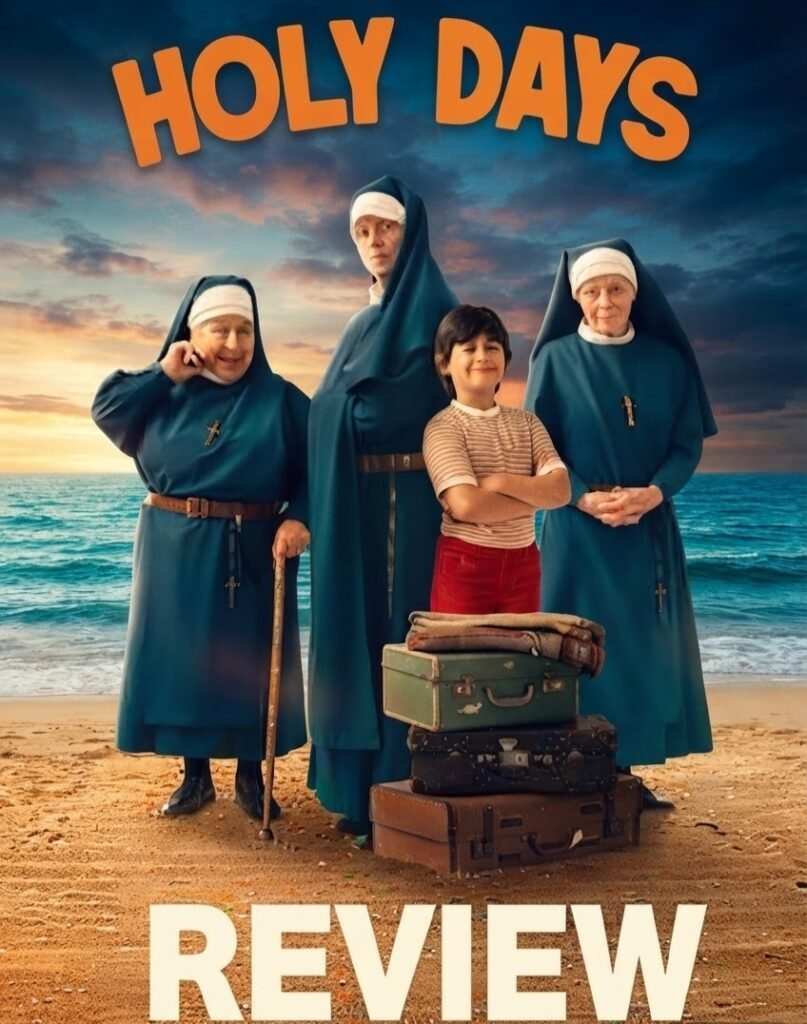
There is something immediately appealing about Holy Days. This film combines tragedy, friendship, religious aspects, comedy and adventures.
Moreover, it features three eccentric elderly nuns and a mourning boy. Giving the movie a distinctive personality.
Holy Days is a comedy-drama road movie released in 2026 and directed by Nat Boltt. It is also her first directorial feature film debut.
The movie is a Canada-New Zealand co-production inspired by Dame Joy Cowley‘s award-winning novel.
Its events take place in New Zealand in 1974. The main character of the film is Brian, a boy who lost his mother.
He finds solace in the run-down local convent. Then he realizes that the convent itself is being sold out.
In addition, the elderly nuns who inhabit the building will have to move away. Brian decides to help them save their house.
They steal a car and start a bizarre journey. They have to go to some place outside the convent to search for the deeds to save their house.
Moreover, Brian wants to climb up the symbolic mountain. The viewer sees an unorthodox road movie with an unexpected emotional depth.
This film consists of a combination of slapstick comedy and tragic moments. It also has a peculiar mixture of traditional live-action elements and innovative visual effects.
As a result, Holy Days is hard to classify in terms of its genre. On the one hand, it becomes its strength. On the other hand, it causes issues with tone and pace of the film.
As a result, it is a rather good movie which, however, it does not fully utilize its potential.
A Promising Directorial Debut
Nat Boltt can be appreciated for choosing such an ambitious first feature. Holy Days is not an easy movie to direct.
The movie needs a few tones to fit together. It covers aspects of comedy, grief, adventure and sentimental story line.
It also needs a credible generation gap between the characters. Boltt demonstrates her understanding of all these demands of the movie visually.
She provides a warm and imaginative visual environment for the story. The movie has many similarities with the book of childhood stories turned into reality.
Such a choice is perfect for the character of Brian. Brian is a child who tries to understand the adults’ world.
His mother’s death has ruined all he knew before. The convent becomes an unexpected safe place for him.
Boltt makes use of the fact that nuns possess quite unusual personalities..In addition, they compensate Brian in what he has lost.
They give him company, protect him and make him feel a part of the family. Such approach is one of the boldest decisions of Boltt as a director.
The road trip is not the only thing which makes the movie interesting. The emotions of the characters have the same role as the adventure itself.
The road becomes a way for Brian to grieve for his mother. For the nuns, it becomes a fight for their existence.
It provides the emotional depth of the adventure story line. Boltt, thus, works effectively with both character and the story.
She proves herself confident in creating atmosphere and visual contrast. She also understands the significance of New Zealand environment.
The country turns from a mere background to a part of the identity of the movie. It contrasts perfectly with the dying convent.
The open lands of New Zealand are the symbol of freedom and possibilities. The enclosed space of the convent looks worn and threatened by something.
A Distinctive Visual Style
One of the best parts of the film is the cinematography of Thomas Burstyn.
Through his cinematography, the film takes on an unmistakable visual character.
The film isn’t always attempting to look entirely realistic. Instead, it chooses a more dreamy and nostalgic aesthetic.
Pastel visuals contribute to this aesthetic. Sequences with grain add another element of texture.
At times, the cinematographer uses unusual angles as well. These visual techniques can make the world seem unstable.
It is an effect that fits the story well.
After all, Brian’s life has been destabilized by his mother’s death. As a result, the visual world can feel destabilized alongside him.
The effect adds significance to the visual aspect of the film. It is not just about making individual shots interesting.
The camera can capture how the characters feel. It can be especially meaningful in the context of Brian’s imagination.
Stop-motion visuals add yet another dimension. They allow separation between the imagination and reality.
They add a homemade quality to the film.
The miniature worlds resemble children’s stories. That is an approach consistent with the film’s thematic concerns.
It allows to keep the road movie from looking conventional visually. The landscapes of Burstyn are essential for the film too.
New Zealand provides a sense of scale to the journey. Characters look small against their background.
The visual scale helps reinforce the significance of the journey. Brian is a child exploring a large new world.
It is possible to convey that message visually, without dialogue.
The contrast between the road and the convent is emphasized too. Convent is safe, historical, home-like but also crumbling around its inhabitants.
Road is full of uncertainty, movement, opportunity.
It is a visual distinction that gives the film its structure. It shows the power of good cinematography.
The ideas can be conveyed visually instead of through dialogue.
The Performances
Another big asset for Holy Days is the quality of the acting. The movie has some wonderful known actors in its cast.
Judy Davis as Sister Agnes, Miriam Margolyes as Sister Luke. Jacki Weaver as Sister Mary Clare. Elijah Tamati as Brian.
Craig Hall as Joe Collins. Jonny Brugh as Father Findlay.
The main three characters present quite different attitudes to the situation.
Judy Davis gives Sister Agnes a strong sense of authority. There is also vulnerability behind her stubbornness.
Agnes could easily have become a familiar comic stereotype. But Davis gives the character more dignity than that.
She makes Agnes seem like a person with a past. Davis’ acting becomes especially valuable in the drama scenes.
Because such scenes demand more than just comedic timing. They demand a knowledge of loss and fear. And Davis has it.
Miriam Margolyes has a more relaxed approach to Sister Luke. Her natural talent for comedy fits the character very well.
She brings enthusiasm and eccentricity into the role. Her acting contributes greatly to the comic atmosphere of the film.
But there is one drawback to such a recognisable actor. Sometimes people may notice Margolyes, rather than seeing Sister Luke.
And it has partly to do with the script. Some scenes are heavily dependent on the actor’s personality.
But Margolyes is always entertaining in most of the movie.
Jacki Weaver serves as an important balance within the group. Sister Mary Clare is a warmer and more gentle character.
Weaver helps to create an emotional balance between the other two nuns. All three actresses make a convincing group of characters.
It is evident that they know each other for a long time. It is very important for the movie’s success.
For the plot relies on the nuns getting close to Brian.
Without convincing relations between the nuns, the movie will lose its soul.
Luckily, the whole ensemble succeeds in creating a convincing relationship.
Elijah Tamati’s Performance
Elijah Tamati should be highlighted because of his portrayal of Brian.
Collaborating with three veteran actors is not an easy feat. A young actor could easily be overshadowed by such experienced actors.
But not Tamati.
He portrays Brian’s vulnerability without resorting to overt sentimentality. His portrayal of loneliness involves the restrained use of sorrow instead of always being sorrowful.
This ensures that Brian comes across as believable. The audience can identify with Brian’s sorrow without being constantly reminded about it.
His relationship with the nuns seems significant as well. Brian becomes less and less isolated during the course of the journey.
Therefore, the performance evolves alongside the emotional journey of the character. This is a significant accomplishment for a young actor.
Moreover, this shows the directing skills of Boltt in working with the ensemble cast. The veteran actors never overpower the young actor completely.
Brian is still the emotional center of the story.
Themes Of Grief And Belonging
Grief is probably the most prominent topic in Holy Days. Before the plot of the movie starts, Brian has lost his mother.
Therefore, he already has to experience a whole range of emotions. The road trip gives that process a physical form.
He travels through new places, while at the same time coping with the huge emotional burden. The nuns become his substitute family step by step.
That topic provides the film with a lot of its emotional aspect.
It also helps to build up the strong relationship between the characters. The nuns are trying to save their home.
Brian is trying to find a place to belong to. In that way, both conflicts naturally supplement each other.
The convent stops being just the building.
It stands for a safe place, family and belonging.
Saving the convent becomes the way to save something precious emotionally.
The topic of ageing is another point that the movie touches upon. The nuns are seen as people whose life became useless.
That gives a strong contrast to the youth of Brian.
Both the young boy and the elderly nuns are uncertain about the future.
Every generation experiences its own vulnerabilities.
That could give a chance for a much deeper study of the issues related to ageing and society. Unfortunately, the film sometimes leaves that subject prematurely.
It means that the topic is present but it does not get developed enough.
The same thing happens with the topic of faith. The convent offers plenty of possibilities for the discussion of that topic.
Nevertheless, the film prefers to focus on the relationships of the characters.
Comedy And Drama
Maintaining balance between comedy and drama is a huge challenge for this film.
Boltt clearly aims to show both aspects of the story. That is a sensible decision.
Life doesn’t fit into a single emotional box most of the time. One can experience grief and find humour in it.
Humour also helps people cope with difficulties. The film understands this point.
Some of the best moments in this movie make it possible for tragedy and comedy to be present simultaneously.
The trouble starts with obvious jokes. Some of the best jokes are made due to unexpected behaviour of the elderly nuns.
That is a funny idea. However, it starts becoming old very quickly.
The comedy is better when it comes from characters. When it relies just on surprise or contrast, it appears forced.
That has consequences for the dramatic aspect of the movie. Any serious scene can lose some of its weight after a too wide joke.
As a result, the emotional atmosphere of the film can become inconsistent. This inconsistency can be caused by the lack of breathing space for dramatic moments.
That is especially true for Brian’s tragic story. The story has a lot of emotional potential.
Some scenes demonstrate it very well. However, there are other scenes that move away from it before the emotions can fully emerge.
Thus, the film could have used restraint. There would be fewer jokes but they would be funnier.
There would be more quiet moments that would strengthen the dramatic side.
Does The Story Hold Together?
The plot itself is simple enough. Brian seeks safety among the nuns. The convent is directly threatened.
There is a need to find the deeds. Thus, they embark on their shared journey. Brian has his symbolic destination too.
The physical journey parallels the emotional journey.
That sets a great basis for the road movie. The story also ensures that there is a motivation for participation from everyone involved.
No one is left outside of the conflict that unfolds. That helps keep the plot going. Yet the structure of the road movie is well-known.
Many audiences can predict some typical occurrences. The journey often turns into a somewhat predictable process due to that structure.
Some events appear just to create another hindrance to overcome. Some others allow creating yet another comic scene.
These episodes are funny but not always necessary. As a result, the film works best when the journey serves the characters’ development.
Otherwise, the journey is just a tool to create another occurrence. This issue is very clear in the middle part of the movie.
The viewers already know what destination awaits the characters.
What remains unclear is whether the stops along the way bring anything meaningful. Sometimes they do. Sometimes they don’t.
The tighter screenplay would help get rid of some unnecessary stops. That would give more room to the relationships.
Pacing And Structure
The movie has an adequately short running time. It ensures that the plot doesn’t get too long.
But it is important to note that length and pacing are not one and the same. A movie can be short but still not well-paced.
It happens in Holy Days on occasions. At the start, the characters and issues are well-established.
The road trip adds action to the plot.
In the middle, however, the film is not as exciting all the time. Some scenes are inevitable in the narrative.
Other scenes appear as comic relief. Such moments cause loss of rhythm now and then.
The rhythm gets improved once the character development is back on track. It makes the story more coherent and compelling.
The end benefits from emotional investment made at the start. The whole movie would have been stronger if the middle part had been more disciplined.
Thus, there would have been more emotional involvement in the outcome. The pacing is therefore acceptable but not remarkable.
It is seldom disastrous.
It is just not consistently good all the time.
What Works Best
The biggest success of the film comes from its heart. There is affection for these characters on screen.
These key relationships provide the story with emotion and purpose. The performances provide emotional warmth where the script fails to do so.
The style of filmmaking itself adds a personality to the film. The cinematography is responsible for capturing the New Zealand landscape.
The stop-motion animation provides a unique creative element in the film. The juxtaposition between the convent and the road creates some very effective visuals.
The film is also successful because of its unusual premise. Three old nuns and a bereaved child create an entertaining group of individuals.
The idea creates an identity of sorts for the film.
Boltt should be praised for making her debut a unique visual experience. It could easily have been a conventional road movie.
Instead, she makes it visually unique. The uniqueness of the film adds some interest to the debut.
Though the film sometimes falls short of its mark. It is never anonymous.
What Does Not Work
The major flaw is lack of consistency. The movie has some great concepts but does not pursue each concept to its full potential.
Grief and belonging come out as the strongest themes. Themes of aging and faith are not as powerful.
Comedy may also be repetitive at times. Jokes seem to be broader than the emotional issues demand.
The screenplay uses road movie clichés from time to time. This makes things somewhat predictable.
The middle part could have also been tighter. Some scenes only add one more element of a comic complication.
At times the movie explains emotions which are already evident from the characters’ performances. Some confidence in those quiet scenes would be useful.
The movie does not need to spell everything out to us. It works best when it lets actors do their work.
The screenplay could also benefit from such an approach. This would give the drama some breathing space.
And make the comedy sound more natural.
A Successful First Feature?
A judgment on Boltt’s film as a debut calls for a little context.
She is trying a complex combination of tones. She is working with a seasoned cast. She has to work with seasoned stars along with a young star.
She also needs to develop an appropriate feeling of period and place. By all means, she succeeds on all accounts.
Boltt has good visual instincts. She knows the value of creating the right atmosphere.
She also knows how to make good relationships between characters. Boltt’s teaming up with Burstyn has produced a strong visual presence.
There is no question about the film being firmly rooted in the world chosen by the director.
In any case, it is not an easy feat for a first-time feature.
Her biggest problem seems to be self-restraint. At times, Boltt goes overboard in terms of comedy.
She also indulges some narrative diversions for too long. These may be issues that time may help her solve.
What is important is that she does not allow the film to be aimless. There is a definite idea of what she wants to achieve with the movie.
All of this makes Holy Days an interesting debut indeed.
Final Verdict
Holy Days is a flawed but intriguing comedy-drama.
The highlights of the film are its performances, visuals and emotional depth.
The problems with the film are its inconsistent tone, formulaic plot and undeveloped themes.
The film works the most when focused on Brian and the nuns. Their interactions give the movie true emotional grounding.
This allows the style to give additional imagination to their adventure. The New Zealand locales give scale and unique quality to the trip.
The stop-motion animation gives yet another layer of childlike wonder. The established actors allow the film a lot of charm.
In Elijah Tamati the film has a good emotional center. All of that makes Holy Days a watchable film.
It is not always as funny as it wants to be. It is also not as dramatic as it should be.
Some of the most interesting themes need more development. The plot sometimes resorts to conventional elements for comfort.
The structure would benefit from a better middle section.
However, these flaws do not overshadow the positive sides of the movie.
The affection the filmmakers put into it is evident. Their intention to make something original is also clear.
This becomes important for evaluating a first feature film.
Boltt has not made a perfect debut. However, she has made a much more valuable film than just a technically good one.
She has made a film with personality. Her film features unique characters and style.
Boltt shows confidence in her narrative decisions.
With a little more restraint all of that could prove more effective.
Right now, Holy Days is an interesting first film by the director. It sometimes misfires, but never comes off as soulless.
It takes some unexpected turns along the way. But the destination of the movie is warm and satisfying.
Verdict: A charming, visually distinctive debut with heart, great performances and potential.