Opus: A Stylish Satire That Can’t Quite Sustain the Beat
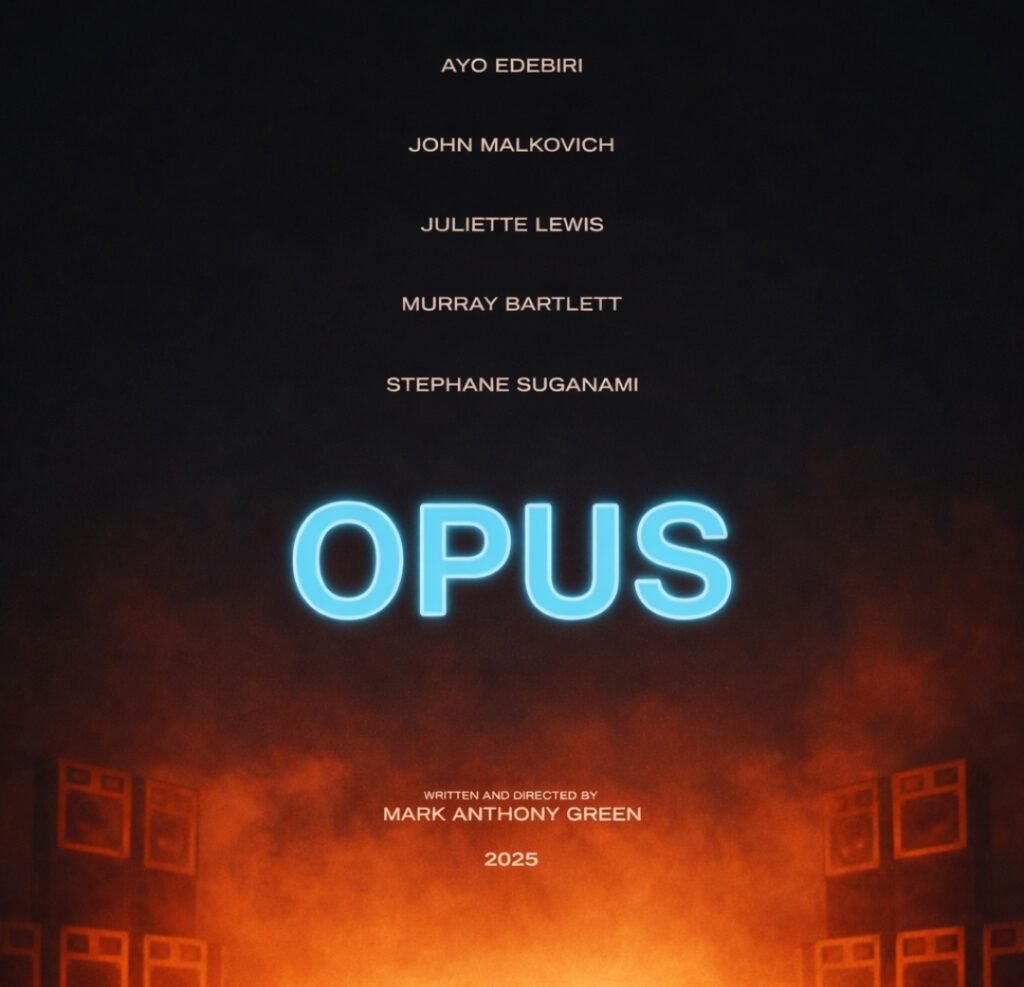
Mark Anthony Green wrote and directed Opus, a 2025 American thriller. Making his feature-length directorial debut after a career as an entertainment journalist. The film arrives with an impressive ensemble cast: Ayo Edebiri (The Bear), John Malkovich (Being John Malkovich), Juliette Lewis (From Dusk Till Dawn), Murray Bartlett (The White Lotus). Amber Midthunder (Prey), Tatanka Means (Killers of the Flower Moon), Young Mazino (Beef), Stephanie Suganami (Doctor Odyssey). Tamera Tomakili (Happy Face), and Tony Hale (Arrested Development). On paper, it has all the ingredients for a sharp, timely satire—but in practice, it doesn’t always know how to fully use them.
A Premise Rooted in Fame, Power, and Obsession
At its core, Opus blends psychological thriller and dark comedy. It draws inspiration from recent genre hybrids like The Menu, Blink Twice, and Midsommar. The story follows Ariel (Ayo Edebiri), an aspiring writer stuck in assistant purgatory at an elite music publication. Some of the film’s most effective early scenes come from this environment. Ariel’s editor, played with smug indifference by Murray Bartlett. Dismisses her ideas outright, while her coworkers quietly underestimate her ambition and intelligence.
Everything changes when Ariel unexpectedly joins a small group of journalists invited to hear Alfred Moretti’s first new album in decades. A legendary and deeply reclusive pop star. John Malkovich steps into the role of Moretti with eerie confidence, portraying him as both magnetic and faintly off-kilter from the moment he appears onscreen.
The journalists fly to Moretti’s remote compound, framed initially as an exclusive creative retreat. Juliette Lewis appears as one of the invitees, grounding the ensemble with her natural screen presence. What starts as a surreal industry perk quickly becomes something far more disturbing. Moretti’s estate isn’t just a private haven—it’s a functioning cult. Complete with ritualistic practices, devoted followers, and a belief system built entirely around his artistic “genius.”
A Promising First Half Fueled by Satire and Nostalgia
The first half of Opus is easily its strongest. The film captures the spirit of late-’90s and early-2000s dark comedies. These stories are full of eccentric personalities, sharp dialogue, and absurd situations that double as cultural critique. Green’s satire of celebrity worship feels pointed and timely, especially in how it equates modern fandom with religious devotion.
The film is particularly effective when skewering the world of music journalism. The hunger for access, relevance, and proximity to greatness is shown as both ridiculous and unsettling. Green’s background clearly informs these moments, and the insider details give the satire an authenticity that makes it sting more than it might otherwise.
Music as World-Building, Not Just Atmosphere
One of the film’s most convincing elements, is its music. The soundtrack—produced by Nile Rodgers and The-Dream—adds a layer of credibility that many films about fictional musicians lack. The songs genuinely sound like the work of a long-silent pop icon returning with something ambitious and self-mythologizing.
This musical realism is crucial to selling the premise. It helps explain why characters are so easily drawn into Moretti’s orbit and why his influence feels almost supernatural. Without it, the cult aspect might feel exaggerated or implausible, but the music grounds the fantasy in something tangible.
Performances That Elevate the Material
Ayo Edebiri anchors the film with a performance that balances vulnerability, dry humor, and growing unease. In my opinion, she handles the tonal shifts better than the script does, transitioning smoothly from workplace satire to psychological horror. Her comedic instincts keep Ariel relatable, even when the story starts to spiral.
John Malkovich is an inspired casting choice. While he doesn’t seem an obvious fit for a pop legend, he fully leans into the role, making Moretti feel like a man trapped inside his own myth for far too long. His performance is unsettling without being cartoonish. He convincingly portrays both the charm and the menace of someone who believes he has transcended normal human limits.
When the Story Starts to Unravel
Unfortunately, Opus begins to lose momentum in its second half. The darkly comic tension that initially made the film feel unpredictable gives way to more familiar thriller territory. Plot developments become easier to anticipate, and the sense of danger never escalates in a satisfying or surprising way.
The tonal balance also starts to falter. The film seems unsure whether it wants to lean fully into horror, satire, or social commentary. As a result, the filmmakers never push any of these elements as far as they could.. What initially felt daring becomes oddly restrained.
Big Ideas, Lightly Explored
The most disappointing aspect of Opus, is how many compelling ideas it introduces without fully committing to them. The parallels between pop fandom and organized religion are clear and provocative, yet the film only scratches the surface. The filmmakers make the cult visually striking, but they never explore its beliefs and inner workings deeply enough to make it truly unsettling.
The story also hints at deeper questions about artistic genius, ego, and whether great art justifies destructive behavior. These themes linger in the background but are never meaningfully interrogated. Instead of weaving them into the narrative from the start, the film gestures toward them and then moves on. Leaving the experience feeling thinner than its premise suggests.
Final Thoughts: Ambition Over Execution
Despite its flaws, Opus still feels like a promising debut. Mark Anthony Green shows a strong visual sensibility, a sharp eye for satire, and a clear understanding of the culture he’s critiquing. The problem isn’t a lack of ideas—it’s a lack of follow-through.
With a tighter script and more confidence in its thematic focus, Green’s future projects could be genuinely compelling. Opus doesn’t fully deliver on its potential, but it’s ambitious, stylish, and occasionally very sharp. Even when it stumbles, it hints at a filmmaker capable of something more daring down the line.
Opus may not hit every note, but there’s enough originality and intent here to make it worth watching. Especially for anyone drawn to dark comedies that blur the line between satire and psychological thriller.