
Whalefall Movie Review
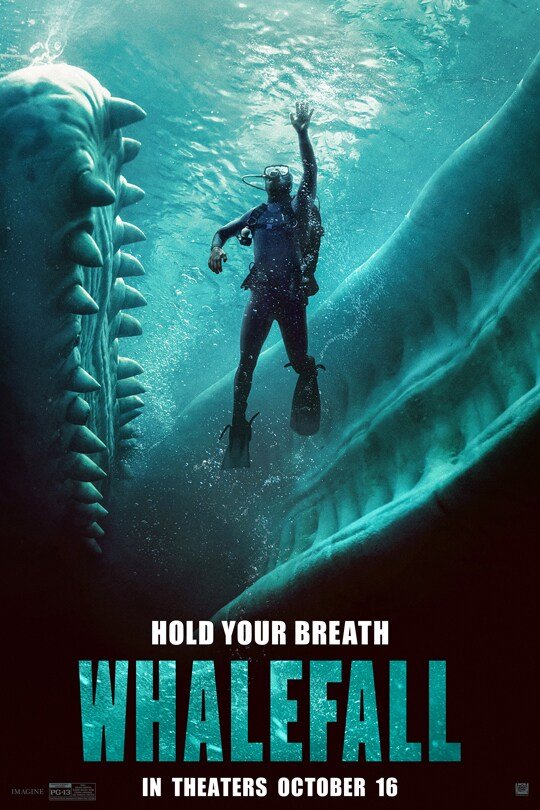
Swallowed Alive in the Deep Blue
While some survival thrillers thrive on constant action, others employ extreme situations to expose the hidden depths of the human psyche.
Whalefall tries to accomplish both in trying to trap the protagonist within one of nature’s strangest creatures and compelling him to face his long-suppressed past.
The 2026 survival thriller, which is written by Brian Duffield based on Daniel Kraus’s 2023 best-selling novel, has a unique idea that it drives to terrifying levels.
This film features Jay Gardiner (Austin Abrams), a scuba diver mourning the death of his father whose body is being sought off the coast of Monterey, California.
This search turns into an unexpected horror after a colossal sperm whale eats him alive.
However, Jay’s predicament is like no other because he is trapped in a living creature and has no idea how to get out before his oxygen depletes.
Every action he makes might be dangerous and the unfriendly environment provides no chance for relaxation or clear thought process.
However, Whalefall does not tell a story of a man who tries to escape from a whale; there is much more than that in this unusual movie.
Yet Whalefall is not simply a film about a man trying to escape a whale. Beneath its extraordinary survival scenario lies a painful story about grief, guilt, masculinity, and the complicated legacy of an emotionally demanding parent.
Even though Jay’s father, Mitt Gardiner (Josh Brolin), is already dead, he still dominates his son’s life.
Mitt Gardiner was a great marine biologist but also a tough guy who had a very special way of raising his son.
As Jay fights to stay alive, the memory of his relationship cannot be separated from the struggle to survive.
The concept is obviously very different, but Duffield takes it extremely seriously. In the film, rather than making the whale a typical Hollywood monster, Jay’s predicament is used to analyze the emotional burden that he brings down with him into the depths.
This is a bold mixture of survival horror, psychological thriller, and family tragedy. The most interesting thing about the film is that it asks not if Jay manages to escape the whale, but if he changes because of it.
Austin Abrams Faces His Most Unforgiving Role
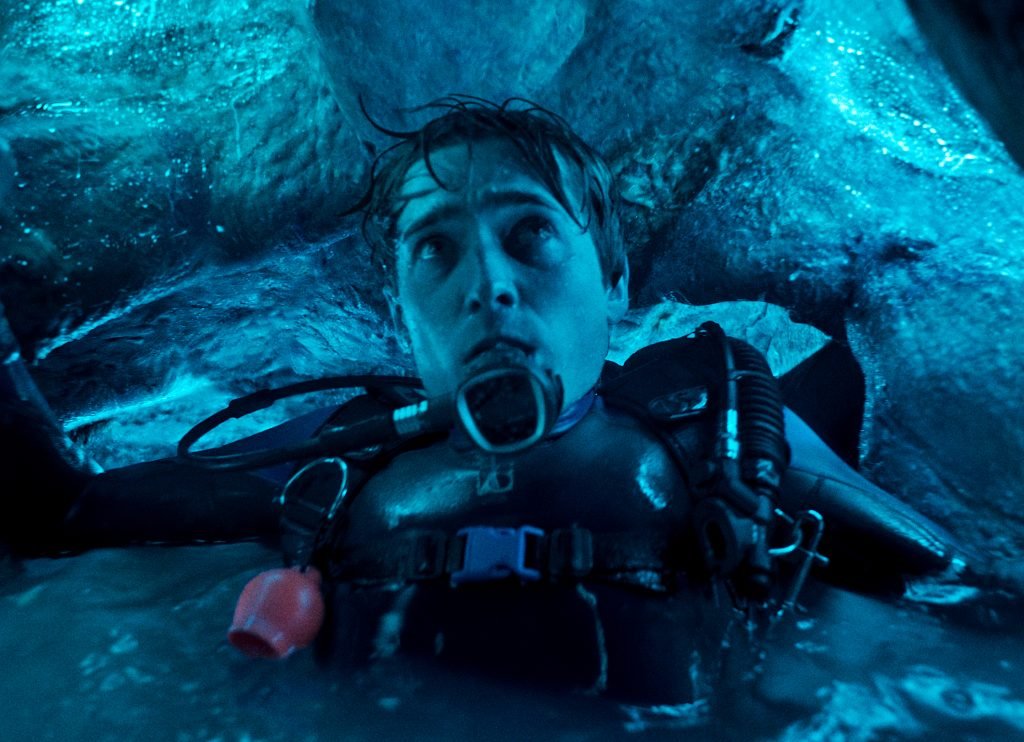
Austin Abrams shoulders the majority of the burden of Whalefall, as he provides a highly physical performance that entails the communication of fear, desperation, and vulnerability under extremely stringent conditions.
Jay is not your average action hero. Instead, he is a young man who makes the choice to make a perilous dive due to his unresolvable issues concerning his father.
His task to retrieve the body of Mitt turns out to be one last attempt to resolve a relationship that left no room for closure.
Vulnerability forms a key component of Abrams’ portrayal of Jay. Though he has all the requisite skills for making a safe dive in perilous surroundings, he is not mentally prepared to face what awaits him there.
It allows the movie to not present Jay as some sort of survival expert and to depict him as a regular man who makes mistakes, struggles to keep calm and has to constantly deal with the fear that all his efforts are in vain.
Moreover, the equipment for underwater diving presents Abrams with another issue. Being almost completely covered with it, the actor cannot rely upon traditional acting techniques such as facial expressions and speaking.
Therefore, Abrams has to use his eyes, his movements, his breaths and his reactions in order to tell the story.
Even a small pause or change of breathing may be enough to show Abrams’ feelings, while long speeches would not be efficient in this situation.
The role requires Abrams to act physically very well. Due to the fact that the movie focuses on the realistic environment, Abrams has to react to the water, narrow space, moving platform and all the discomfort that surrounds him.
Most importantly, Abrams’ performance becomes really powerful when there is a collision of physical danger and emotional pain.
Terror for Jay is not only the natural reaction of a person who faces death, but also something much deeper.
Abrams gives the character a grounded, recognisable quality. Jay feels like an ordinary person pushed into circumstances beyond his comprehension, rather than a superhero conveniently equipped to survive them.
That human scale is vital to the film’s success. The more believable Jay’s fear becomes, the more disturbing his predicament feels.
Josh Brolin and the Shadow of a Difficult Father
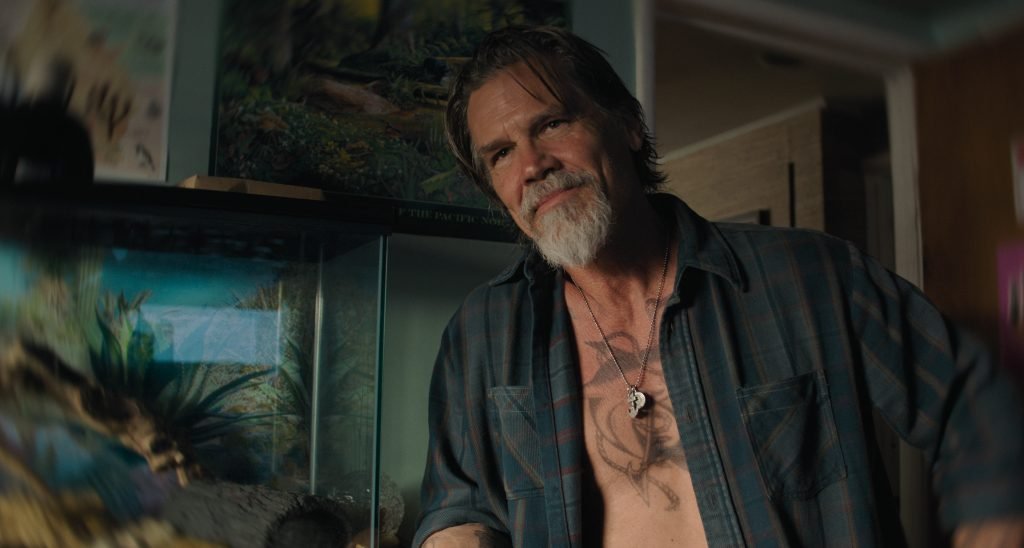
Josh Brolin provides the film’s emotional counterweight as Mitt Gardiner, Jay’s deceased father.
Although Mitt is absent from the present-day action, he remains a powerful presence through flashbacks that gradually reveal the history behind their damaged relationship.
As such, Brolin gives Mitt an air of seasoned toughness which makes him appealing yet hard to warm up to.
On one hand, Mitt’s tough love could be motivated by the need to prepare his son for all the risks he will have to deal with in real life.
On the other hand, his approach produces cuts that are beyond the realm of mere practicality.
The scenes of the past show us why Jay’s emotions are so mixed. He has learned from his father all the necessary survival skills, but he also has to deal with the emotional trauma connected with their source.
Brolin bases his acting upon this paradox. Mitt may appear intimidating and disrespectful, but at times one can see some paternal care toward his son.
Mitt’s fear of the future of his son is not an excuse for him, but it sheds light on the paradoxes of their relationship.
This is also how the movie acquires its emotional structure. As Jay strives for survival, the memories of his father come not just as additional details, but require Jay to reflect upon what he has been taught by his father and what he should renounce.
The relation between the characters, I think, is the most intriguing part of the movie. A whale represents a direct threat, but it is the influence of Mitt that brings psychological meaning into it.
Inside the Whale: A New Kind of Survival Horror
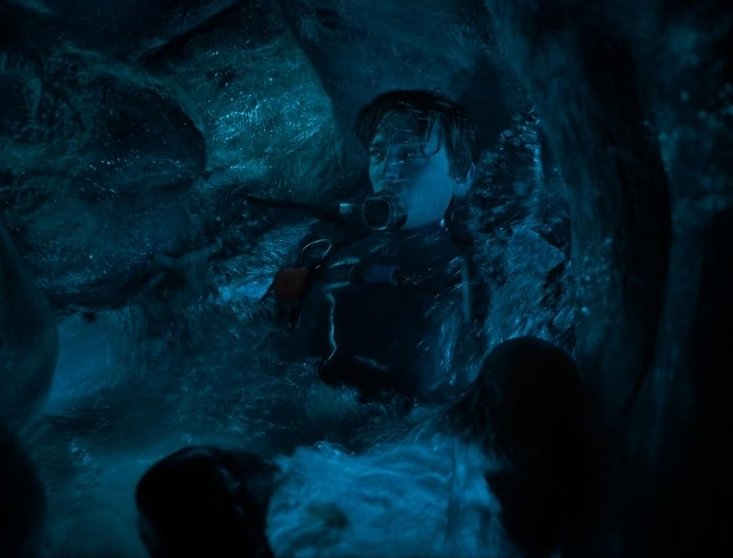
The survival sequence plays a key role in making Whalefall unique. There are not many movies where the protagonist finds himself inside an enormous animal in order to create the entire movie plot.
First of all, it brings up a feeling of enclosure. Jay finds himself in an environment which moves on its own and does not allow him to feel safe.
In contrast to regular stories about surviving in water, the threat is not just the depths of the ocean or danger of being drowned. In fact, Jay is enclosed inside a living organism which was never made for such usage.
His position may be unstable because of the whale’s movements. In addition, there is darkness, which limits his perception of reality, limited space and lack of oxygen, which creates a time pressure.
These circumstances provide great opportunities for creating the atmosphere of suspense because every step forward may bring problems and staying at the same place means death.
At the same time, it becomes clear that Jay cannot understand the environment he is in because everything is unfamiliar for him.
The movie also recognizes that fear does not always involve someone attacking the main character. Sometimes, knowing that there isn’t a way out of the situation can make for terrifying situations on its own.
Jay’s story becomes progressively darker as the physical torture shifts to the psychological. The inside of the whale is not only physically confining but also a space where Jay has to come face to face with his inner turmoil.
This blend of physical and emotional terror is one of the things that separates Whalefall from your average creature movie.
While the creature itself may be the monster in the movie, Jay himself embodies all of the fear and guilt.
However, there is an underlying risk in crafting a story with such an outrageous premise. If the scenario becomes too unrealistic or too repetitive, the movie will fail due to the concept itself.
Duffield’s challenge is to keep the physical struggle compelling while ensuring that Jay’s emotional journey continues to develop.
The film is at its strongest when these two elements reinforce each other, making every attempt to survive part of a larger confrontation with his past.
Practical Effects Make the Ocean Feel Terrifyingly Real
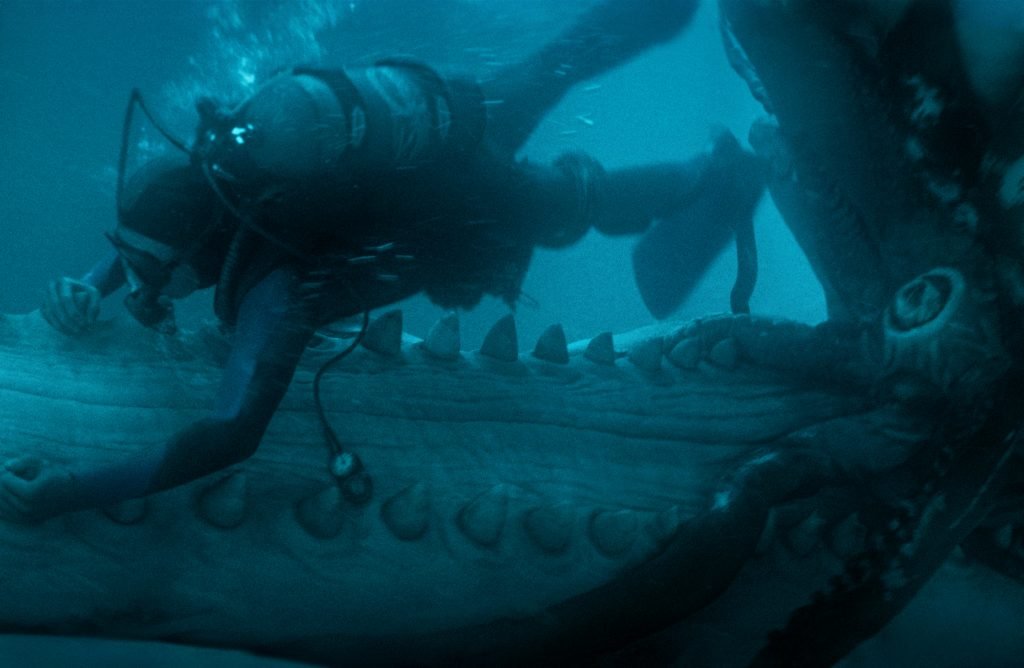
Some of the most noteworthy aspects of Whalefall include the fact that it creates an extremely realistic physical environment.
Instead of simply filming Abrams against a green screen and digitally adding water to the setting, this production utilizes many practical sets and underwater filming locations to envelop the protagonist.
The construction of an underwater arena at Radford Studios is what gives physical context to the ordeal of Jay Abrams.
This method enables the surroundings to react with Abrams, instead of Abrams having to imagine his experience in the absence of physical surroundings.
Water is especially hard to shoot effectively. It makes a difference in the manner of movement and visibility.
Water also causes many technical issues for both actors and film crews due to the space limitations involved.
With the help of creating practical environments through which these problems arise, the filmmakers create a believable physical aspect of the action.
Jay’s fight looks not very staged but rather a desperate effort to survive in the unfriendly environment.
Moreover, the use of visual effects and the film technology by the production team are also crucial.
Special technologies will allow the crew to visualize changes in the environment, and cinematography will show how it feels to be inside a moving creature.
The cinematographer Aaron Morton uses specialized Petzval lenses that distort the borders of the screen in order to make the viewers feel Jay’s growing fear and physical effort.
The fact of using such distortion techniques also contributes to the feeling of unreliability of the image. In this way, the viewer shares Jay’s confusion and does not watch his struggle from a distance.
The use of innovative camera mapping techniques used during production can further assist in blending the actor with his surroundings.
The intention here is to provide the feeling of the whale’s inner part as a real space rather than the one composed of various visual effects.
The purpose of the technology used is quite evident. The use of such technology is significant since it contributes to the sense of realism in terms of danger rather than to the impressiveness of the production.
This leads to the creation of the visual experience which would be especially appreciated in the cinema.
Aaron Morton’s Cinematography Turns Claustrophobia Into an Art Form
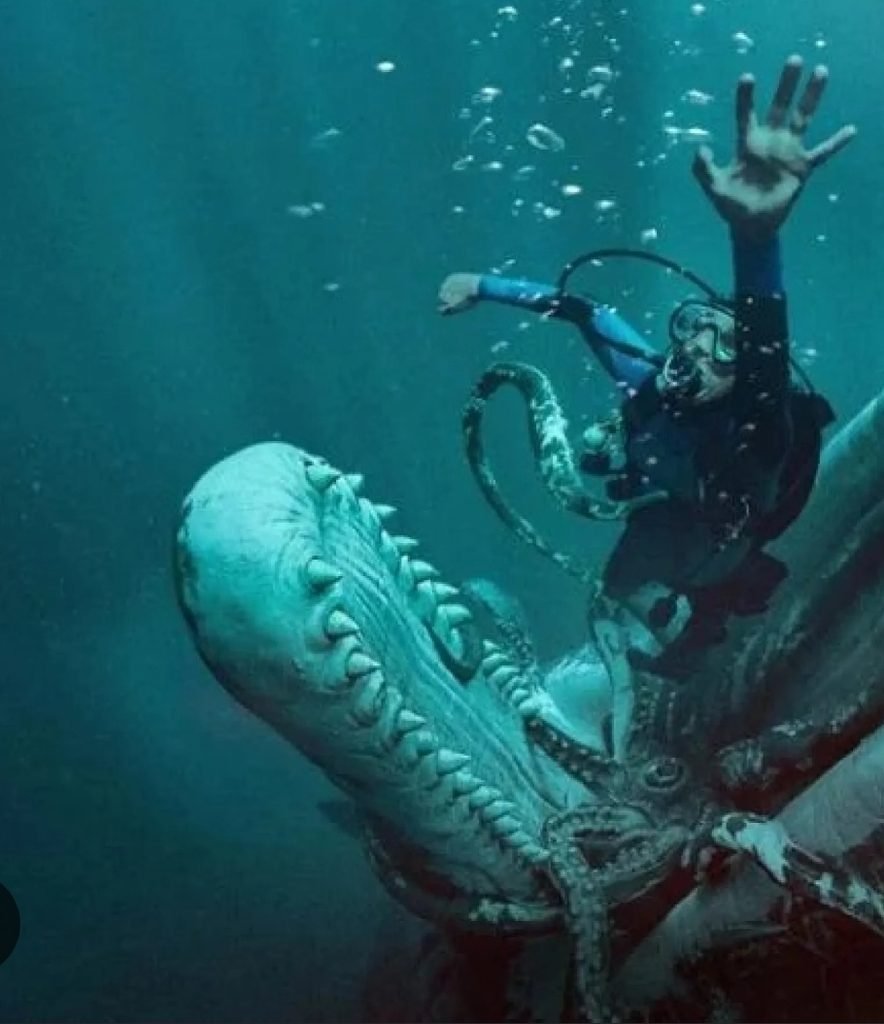
The cinematography is especially important in this regard since it defines the way in which the viewer sees the captivity of Jay.
Indeed, a movie shot within the whale can easily look too repetitive since the space is rather limited here, and there is not much room for movement.
However, Morton manages to create an atmosphere of disorientation that is based on precise compositions that put the viewer in close proximity to Jay and thus make his movements and breathing seem more and more restricted.
The use of distorted lenses creates instability in the visuals, while the darkness of the whale does not give us enough knowledge about the space itself, adding up to the suspense.
At the same time, it is important to mention that the film language creates contrast between the claustrophobia of the protagonist and the vastness of the Pacific Ocean, whose waters are unfriendly to human body in unprotected conditions.
Inside the whale, that contradiction becomes even more pronounced. Jay is surrounded by an enormous natural world yet has almost no freedom to move within it.
Here comes into play the visual style of the film which is tied to the themes. The viewer can see the difference between the physical size and individual freedom.
The whale is huge while Jay’s world has shrunk down to mere survival. The same can be said about his emotional state; years of unresolved conflict have narrowed his self-perception and perception of his father.
These production methods make this connection tangible. The setting provides the cinematographer with something real to work with, making the scenes look believable despite being extraordinary.
Not all viewers will appreciate the purposely distorted visuals used in the film. Some parts may seem overwhelming visually as the camera reproduces Jay’s panic.
But this seems to be one of the key points made by the film’s directors. Whalefall wants the audience to feel trapped.
Grief, Guilt, and the Search for Closure
However, there lies beneath the plot of survival another story – the story of sorrow which is unwilling to stay in the past.
The act of looking for the body of his father on the part of Jay is an attempt to reclaim some tangible thing from his past which did not end the way it should have.
The fact that Jay’s grief is mixed with anger is clear since Mitt was not an ideal father and Jay cannot simply think about him with no complex feelings.
The memories that he has include disappointment, anger, and a bitter realization that love is not enough to keep people safe from each other.
It makes Jay’s story more interesting than a typical narrative about overcoming one’s fears because it is not just about returning to his previous life but about defining its meaning.
The inside of the whale becomes a symbolic place where Jay has to face the past he cannot avoid anymore. Jay is physically trapped, but so is he by his memories and by all the things he had to carry with him ever since his father left.
The most important metaphor used in the movie is very strong and meaningful because it links the idea of survival with the emotional state of the main character.
Jay will not be able to get out only with the help of his bravery, but he has to face the emotions that have led him there.
The movie does not present grief in the form of one special event in which everything gets solved and clarified. The main hero is put in such a position that he cannot use the option of avoidance any more.
Jay tries to make a distinction between the pain associated with his father’s death and the important lesson he could learn. He needs to admit the influence of his father on his life and become free from it.
That is what makes the movie dramatic and meaningful for the viewer.
Toxic Masculinity and the Burden of a Father’s Expectations
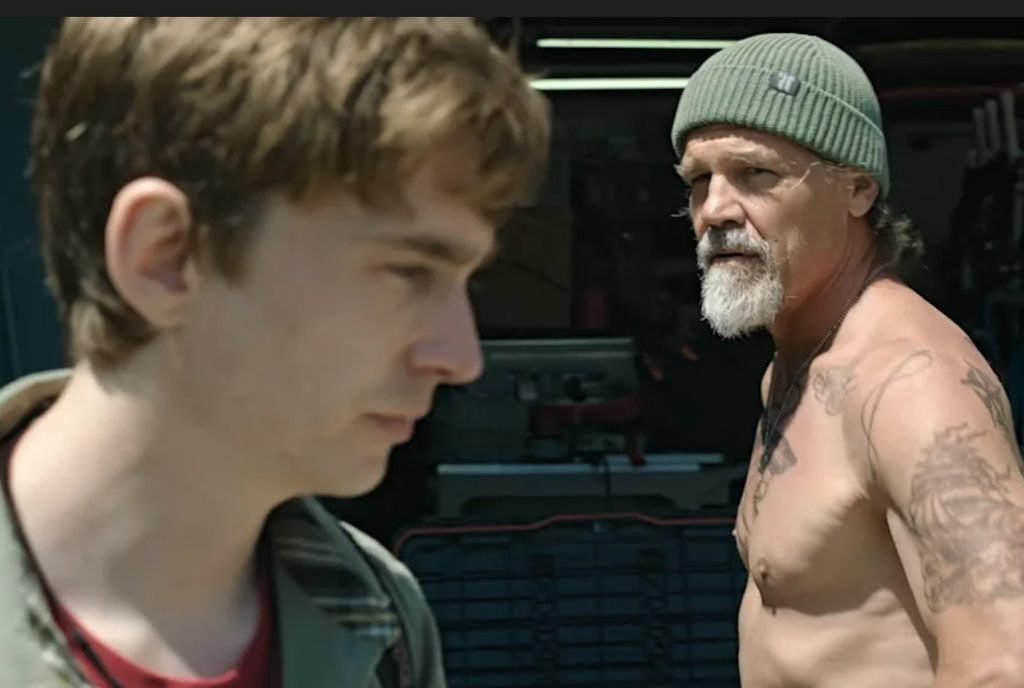
This influence brings another crucial theme to light – the harmful effects of viewing masculinity only as strength.
Indeed, the way he understands the role of a father implies that strength and preparation are key to survival. For Mitt, being emotionally vulnerable is to be ill-prepared to the roughness of reality.
However, as the movie demonstrates, there are some disadvantages of such an approach. While Mitt can teach his son various life skills, he makes him feel ashamed, angry, and inadequate.
Tragically, Jay will have to use the knowledge gained from his father to survive. The information which used to be the sign of the tense father-son relationship turns out to be essential in order to survive.
This situation leads to a strange paradox. It turns out impossible for Jay to deny all the information obtained from his father, as well as accept his attitude to life and the world around without doubts.
That confrontation serves to draw attention to the gap between resilience and emotional suppression. The ability to handle physical threats is very different from the ability to connect with one’s emotions and develop meaningful relationships.
Although Mitt’s motives might partially lie in his love and care for his son, it cannot be assumed that any concerns will inevitably result in beneficial behavior. Not being able to communicate with Jay on an emotional level has its ramifications.
It is Brolin’s acting that allows for making the aforementioned theme complex rather than simple.
Mitt is not just a one-sided character that is purely evil; some of his more humane traits make the viewer reconsider his attitude towards the character.
Nonetheless, there is no need for the movie to justify him to recognize his flaws and his humanness.
There is a difference between comprehending why a person acts destructively and believing that his actions have no ramifications.
What the boy needs to do is to find his identity, figure out what lessons he should keep and what he should forget about.
This makes the escape theme more personal. The process of escaping a dangerous animal becomes inextricably linked with escaping one’s past.
The Supporting Cast and the Family Left Behind

Despite the fact that Jay’s struggle forms the core of the plot, the larger picture of family relations adds an interesting background to his internal development.
Elisabeth Shue is featured as Jay’s concerned and alienated mother, whereas Emily Rudd acts as his sister. The way they view their family relations sheds light on the fact that Mitt affected more than just Jay.
They have all been influenced by the same troubled man, although this does not mean that their experiences were equal.
Their reaction to Jay’s dangerous choice shows how complex feelings can be in a family that has lost a member.
Moreover, Jane Levy appears to be another member of Jay’s family that attempts to convince him not to go on the dive.
John Ortiz plays a local maritime expert who assists him before the expedition.
These characters assist in establishing the danger associated with Jay’s mission prior to the start of the survival narrative.
The fears of these characters highlight the fact that his actions will have an effect on the people that may remain after his departure.
Nevertheless, the unusual concept of the film makes it impossible to focus on anyone else apart from Jay and Mitt.
Supporting characters appear to be used mainly in the context of developing the main emotional conflict and do not have any separate story.
It is possible to understand why this was done in the context of the story; however, the family connections could provide a better insight into the way his actions affect other people as well.
The best supporting scenes are the ones that help to know Jay better and do not divert our attention from his present situation.
Adapting Daniel Kraus’s Novel for the Big Screen
The task of adapting a novel with a unique survival situation is a hard one. A novel can delve deep into the mind and memories of the characters; however, a movie adaptation has to turn those mental processes into visuals, performances, and a well-organized sequence of scenes.
In this case, Brian Duffield decides to work with Daniel Kraus who authored the novel to adapt the script.
This allows him to establish a direct connection between the original and the movie version of the story.
In this case, the main idea of the movie is that Jay gets swallowed by a sperm whale while trying to find the remains of his father. Another important element of the movie is the bond between Jay and Mitt.
Yet, the screen adaptation has to maintain the perfect balance between the present danger and the background that is crucial to understand the importance of the experience that Jay goes through.
It is the flashback structure that allows for the gradual emergence of the father-son relationship against the backdrop of the protagonist’s struggle for survival; in other words, the past informs the present, but does not neglect the main problem of the narrative.
In this context, this method also serves as the means of bridging the gap between the two key sources of tension.
As the past unfolds through Jay’s recollections, the physical danger acquires an even greater significance, because now the reason for his perilous adventure is revealed.
In this respect, the adaptation cannot be limited to the faithfulness to the source material only; on the contrary, it should transform the written text into the visual one in terms of the experience of reading that includes sound, performance, and visual confinement.
From this point of view, the experience of Duffield as the author of the horror film No One Will Save You becomes very helpful in making Whalefall.
Indeed, his genre background can be viewed as his asset in the process of transforming the complex story into the film.
Does Whalefall Sustain Its Unusual Premise?
Indeed, the main idea of the movie is its primary merit, but it simultaneously creates enormous pressure on the storytelling.
The idea of a person being stuck in the body of a whale sounds fascinating from the start. At the same time, the moviemakers have to maintain the suspense without resorting to constant recurrences of fear, pain, and desperate escape attempts.
Emotional background allows for some diversity in the presentation of the story. The fight for survival of Jay is associated with memories of Mitt, which allows the moviemakers to go from one state to another.
At the same time, such transitions have to be made in the right way. Too many flashbacks will reduce the tension of Jay’s situation, while the lack of them will make the father-son bond insufficiently strong.
It is true for visual intensity of the film as well. Distorted cameras, darkness, and close-ups can generate great suspense, but only through variations in rhythm and point of view.
It is obvious that the intention of the film is two-fold. It is supposed to be not only a survival thriller of some kind but also an exploration of grieving. These intentions are related to each other, yet none of them must overshadow the other one.
The film proves to be successful exactly where it is able to unite emotions of the character with his struggle for survival. Not only does the setting become clever but also the flashbacks gain importance.
This combination is the key for success of the plot. The idea is appealing enough; however, there is something deeper that justifies existence of the film.
Final Verdict
Whalefall is a movie that explores grief, guilt, toxic masculinity, and the painful separation of oneself from the impact of one’s parent by taking a remarkable survival setting and using it to make a statement on these subjects.
The film is directed by Brian Duffield in such a way that he creates claustrophobic tension through an interesting psychological story plot, which gives meaning to the experience that happens to the protagonist.
The strange concept will require the pacing to deliver quite a lot. It is important to note the right balance between the two factors; that of physical suspense and the flashes back of emotions. However, the film becomes more interesting when both of these factors work together.
It is clear that Whalefall is not only about the interesting survival concept. What is even more important about this film is the fact that sometimes it is easier to escape a physical trap than an emotional legacy of a difficult parent.
Jay is supposed to learn how to use what his father taught him, while rejecting some things that have caused problems in the past.
Whalefall promises a tense, claustrophobic survival thriller elevated by Austin Abrams’s physical performance and Josh Brolin’s complex portrayal of a difficult father.
Beneath its terrifying premise lies a compelling story about grief, masculinity, and learning to escape the shadow of the past.